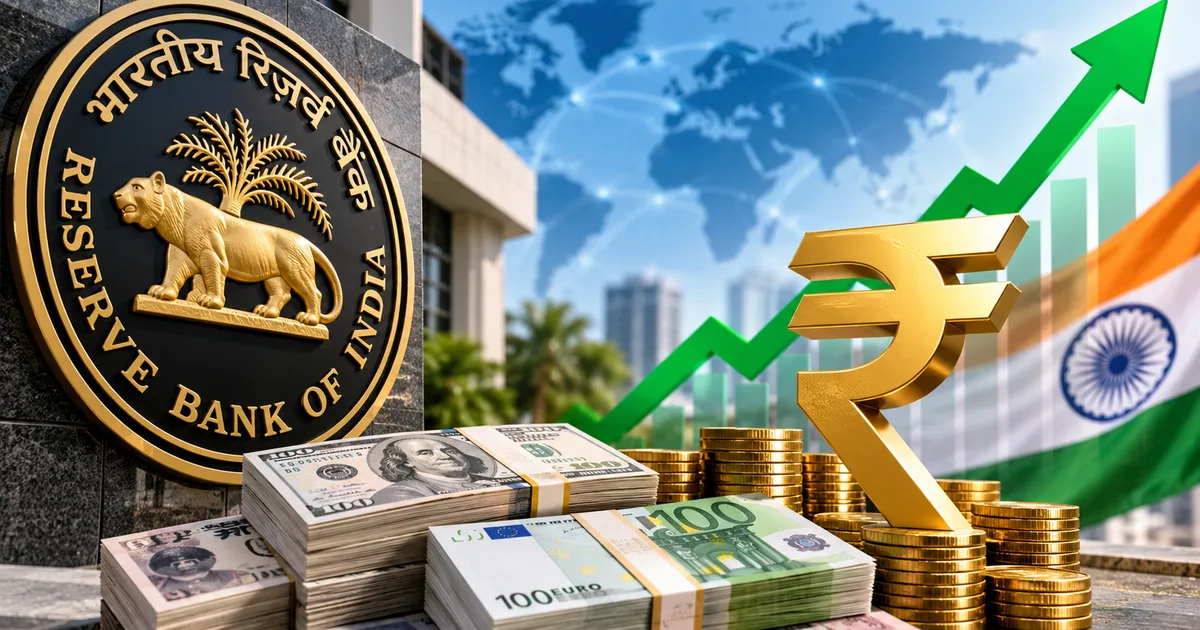
You might have noticed the news lately. The RBI India Forex Reserves Record High 2026 is making headlines everywhere across financial news channels and social media. India just added a massive $44.9 billion to its foreign exchange reserves in a single week ending September 4.
That brings our total war chest to $785.706 billion.
Honestly, numbers this big usually stop making sense to most of us. A billion here. A billion there. But if you convert that weekly jump to Indian rupees, it's around 3.7 lakh crore rupees just added to the national savings account in seven days. I was looking through the official RBI data release on Friday night, and even seasoned currency traders were surprised by the sheer scale of the jump. Nobody expected an increase this massive in such a short window.
This isn't a random economic statistic for bankers and Dalal Street brokers. It actually matters for your money. It affects the cost of the petrol you put in your scooter. It also impacts the exchange rate you get if you're sending money to a kid studying abroad in Canada or the US. So I want to break down exactly what's happening and why the Reserve Bank of India is hoarding dollars right now. I'll also explain what it means for everyday Indians.
Understanding foreign exchange reserves components
Think of foreign exchange reserves as the country's emergency fixed deposit.
When you buy a coffee in Mumbai, you pay in rupees. The coffee shop owner pays their staff in rupees. Everything domestic runs on our currency. But India doesn't produce everything it needs. We import roughly 80% of our crude oil to run our cars and factories. We also import cooking oil and advanced electronics from other nations (which makes sense, actually, given our consumption habits). The countries selling us this stuff don't want Indian rupees. They want globally accepted currencies. Mainly US dollars.
So, India needs a massive stockpile of dollars to make sure we can always pay our import bills. This covers us if a war breaks out or if global supply chains freeze up. The RBI manages this stockpile.
The reserve isn't exactly stacks of hundred-dollar bills sitting in a guarded vault in South Mumbai. It is broken down into four main buckets:
- Foreign Currency Assets (FCAs): The biggest chunk, sitting at $648.168 billion as of September 4. This includes US treasury bonds, euros, British pounds, and Japanese yen. When the euro or yen gets stronger against the dollar, the overall dollar value of our reserves goes up automatically.
- Gold reserves: Indians love gold, and so does the RBI. Our national gold reserves are currently valued at $113.816 billion. Funnily enough, the value of our gold actually dropped by about $2.5 billion that week, but the massive surge in foreign currency totally masked it.
- Special Drawing Rights (SDRs): These are special assets allocated by the IMF, currently sitting at $18.806 billion.
- IMF reserve position: The smallest bucket, which is about $4.916 billion held directly with the International Monetary Fund.
The main reasons for forex surge in 2026
So how did we jump by $45 billion in a week? This isn't random luck.
The total had actually been declining earlier this year. Remember the conflict in West Asia escalating a few months back? The rupee was taking a massive beating in the international markets. The RBI had to step into the market and heavily sell dollars to stop the rupee from crashing through the floor. They burned through billions to keep things stable.
"India's forex reserves jumped by a record $44.903 billion to a new lifetime high of $785.706 billion during the week ended September 4, 2026," the Reserve Bank of India (RBI) said.
But then they changed tactics. In June, the RBI announced some concessional forex swap initiatives.
Here's the deal. The RBI basically told banks, "Give us your US dollars today, and we'll give you Indian rupees. We promise to give you back your dollars later at a favorable exchange rate."
This was a smart move. It removed the exchange rate risk for banks and foreign investors. They didn't have to worry about the rupee dropping while their money was parked in India. The result was a massive flood of dollars into the country. I'm not sure exactly why it worked so quickly, but the data says this swap move alone has brought in more than $136 billion in new flows over the last few months.
And foreign investors are still pouring money into Indian stock markets and government bonds. The Indian economy is growing faster than most of the West. If you're a global fund manager looking for returns in a slowing world, you're looking very closely at India.
If you want to read more about how global financial shifts are affecting us, you should check our breakdown on the potential impact of the new BRICS payment system. It's a good related read if you want to understand the larger currency wars happening right now and how countries are trying to move away from the dollar.
India overtakes Russia in global rankings
The geopolitical angle here is pretty fascinating. With this new record high, India is officially the fourth-largest foreign exchange holder in the world. We just overtook Russia.
Let that sink in for a second. Back in 2014, our reserves were barely over $300 billion. We've more than doubled that in twelve years. That's a crazy amount of wealth accumulation for a developing nation.
We're now sitting behind only three countries. China is in the top spot with a massive $3.85 trillion. They're basically in a league of their own. Their pile is built on decades of manufacturing exports. Japan is second with $1.21 trillion. Switzerland is third with $1.09 trillion.
I find it wild that Switzerland holds over a trillion dollars in reserves. They have fewer people than Bangalore. But that's the nature of global banking and safe-haven currencies.
Having the fourth-largest reserve gives India serious diplomatic muscle. When our negotiators go into trade talks with the US or the European Union, they are taken much more seriously now. We aren't a country living paycheck to paycheck on the international stage anymore. We have a massive buffer.
How this impacts the Indian rupee and your wallet
You might be thinking, "Great, the RBI is rich. How does this help me pay my bills?"
It helps you directly by keeping the Indian rupee stable.
Currency markets are brutal. Trillions of dollars change hands every day. They are driven by complex algorithms and aggressive hedge funds. If traders think a currency is weak, they'll short it and drive the price down further. We saw this happen to the Sri Lankan rupee and the Pakistani rupee recently. The consequences were a complete mess. When a currency collapses, imported goods become instantly unaffordable. Ordinary people suffer the most.
The RBI is notoriously aggressive about defending the rupee. They don't want the currency to be wildly volatile. If the rupee starts falling too fast against the dollar, the RBI steps in. They dip into these massive reserves. They sell billions of dollars in the open market to buy up rupees. This creates artificial demand for the rupee and stops the fall dead in its tracks.
When you have nearly $800 billion in the bank, currency speculators know they can't pick a fight with the RBI and win. The RBI has too much firepower. They'll crush anyone betting against the rupee.
This stability is an absolute necessity for your daily life. A stable rupee means the cost of importing crude oil remains predictable. So the price of petrol and diesel at your local pump doesn't jump by ten rupees overnight. It means inflation stays under control. And that means the prices of vegetables and groceries stay manageable.
It gives confidence to foreign companies wanting to set up factories here. If an American tech giant wants to build a semiconductor plant in Gujarat, they want to know the local currency won't lose 20% of its value in a year.
I'd highly recommend checking out our Tech Explainers section. We have more deep dives into how these macro-level financial shifts affect everyday technology and consumer goods in India. We try to break down these complex topics regularly so you can stay informed.
What this means for your international travel
If you're planning a trip to Dubai or Europe anytime soon, this news is actually pretty relevant to you. When the RBI keeps the rupee stable, it means your travel budget doesn't suddenly blow up in your face.
Imagine you saved up three lakh rupees for a family vacation to Europe. If the RBI didn't have these reserves, the rupee could have crashed by 10% against the Euro right before you booked your tickets. Your trip just became 10% more expensive overnight. You'd be paying more for hotels and food.
Because the RBI has the firepower to keep the exchange rate steady, you can plan your expenses with much more certainty. The same goes for parents sending money to their kids studying in foreign universities. A stable exchange rate means you aren't forced to arrange for thousands of extra rupees just to cover the exact same tuition fee in dollars.
So yeah, while $785 billion sounds like an abstract government number, it acts like a massive shock absorber for the entire country. It keeps the ride smooth for all of us. Whether we're buying petrol or taking a flight abroad.
Are there downsides to hoarding so many dollars?
I get asked this sometimes. Is it bad to hold so much foreign money?
Some economists have argued in the past that developing nations can overdo it with reserves. The logic goes like this: The RBI takes these dollars and invests them in safe assets like US government bonds. These bonds pay very low interest, maybe 4% or 5% a year.
Meanwhile, India as a rapidly developing country needs massive infrastructure investment. We need better roads and more schools (annoying, I know, that we still lack basics). Some people say sitting on $785 billion in low-yielding foreign bonds is a waste of capital. We could theoretically use some of this money for domestic development to speed up our growth.
But the RBI is traditionally very conservative. And for good reason. They remember the 1991 balance of payments crisis vividly. Back then, India had barely enough foreign exchange to cover three weeks of imports. The country was on the brink of default. We literally had to pledge our national gold reserves. We loaded them onto planes and flew them to London to secure an emergency loan from the IMF.
Nobody at the RBI ever wants to relive 1991. They'd much rather accept slightly lower returns on the money. They want to sleep peacefully at night knowing the country is safe against external financial shocks.
And honestly, given the state of the world right now with wars in Europe and unpredictable trade tariffs, a conservative approach is probably the smart move. Better safe than sorry.
Looking ahead to the rest of 2026
The rest of the year is going to be incredibly interesting to watch. The US Federal Reserve is expected to start cutting interest rates soon. When US interest rates fall, global investors usually pull their money out of America. They send it to emerging markets like India looking for higher returns.
If that happens, we could see even more dollars flooding into the country. The RBI will likely keep buying these dollars. They will add to the reserves and hold the rupee back from getting too strong. A slightly weaker rupee is actually good for our massive IT sector and our exporters. Their services and goods become cheaper and more attractive for foreign buyers.
So, don't be surprised if we cross the $800 billion mark before the end of the year. The numbers here are a bit fuzzy, but it's entirely possible given the current trajectory.
If you found this breakdown useful and want to keep track of these trends, you can find similar articles in our Latest Tech News hub. We cover the intersection of finance and policy every week.
This record high is a massive vote of confidence in the Indian economy. Foreign money is betting heavily on India's growth story. For the average citizen, it means your money and your economy have a very solid foundation.