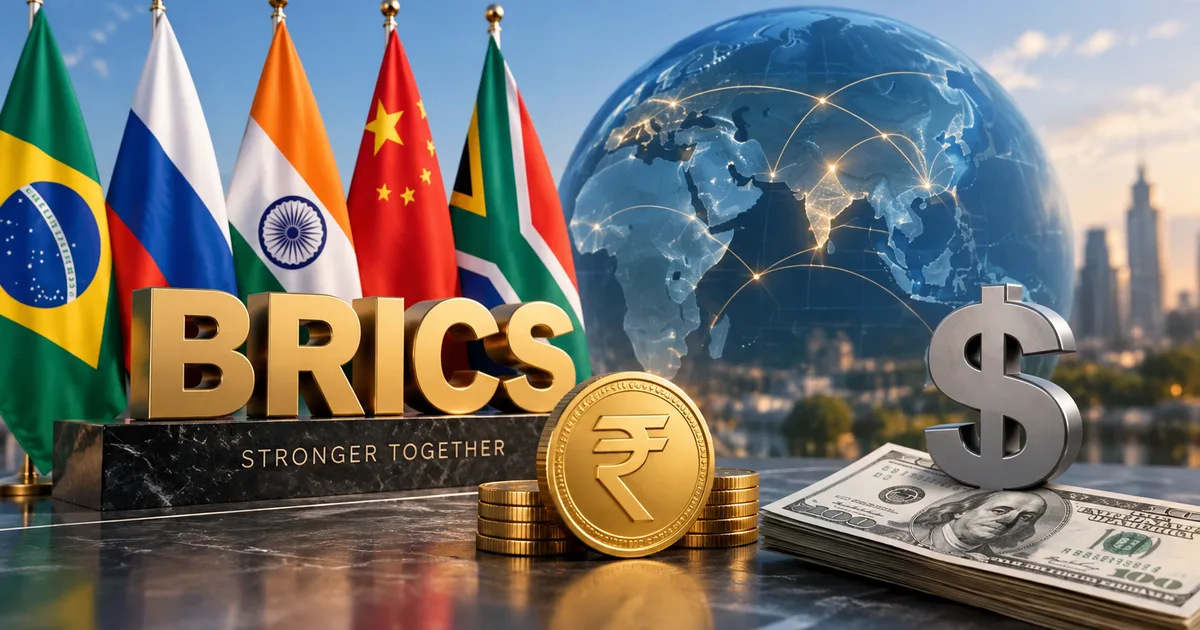
I saw the same WhatsApp forwards you did last week. The ones claiming the US dollar was going to crash by Friday because India and Russia were launching a new global currency. I even had relatives asking if they should sell their US stocks immediately. Thing is, international finance doesn't work like a Bollywood movie plot. The hype around the BRICS Currency Payment System 2026 reached fever pitch during the 18th BRICS Summit in New Delhi this September. But if you were expecting a dramatic overnight shift in how the world handles money, you might be slightly disappointed. Or relieved, depending on how many dollars you've saved up.
So what actually happened at Bharat Mandapam?
Basically, India officially said no to a single BRICS currency. We aren't getting a global equivalent of the Euro for the Global South. We're not going to be carrying around BRICS notes in our wallets. Instead, the focus is on the plumbing of international finance. Payment systems and trading in our own local money. It's a highly technical, boring-sounding shift. But it's actually incredibly important.
The difference between a currency and a payment system
This is where most of the confusion comes from. A currency is what you hold in your bank account. A payment system is the road that moves that money from your account to someone else's. Think about UPI. You don't hold "UPIs" in your wallet. You hold Indian Rupees. UPI is just the highway. It moves those Rupees to your local vegetable vendor in two seconds.
What BRICS nations are trying to build is a massive, cross-border highway. Not a new type of car. (I know, sounds complicated, but it's actually a very straightforward concept once you remove the banking jargon).
For years, the US dollar has been the most popular car and the owner of the only functional highway. That highway is called SWIFT. If a business in Mumbai wants to buy medical equipment from Brazil, they usually have to convert Indian Rupees into US Dollars. Then they send those dollars through an American correspondent bank using the SWIFT network. Finally, the Brazilian company converts those dollars into Reais.
Every step of that process costs money. And every single step gives the United States a huge amount of power over global trade. They can see the transactions and take a cut. If they really want to, they can block the transaction entirely.
The 2022 wake-up call for the Global South
You can't understand the BRICS 2026 summit without looking back at 2022. When the Ukraine conflict started, Western nations didn't just impose trade sanctions on Russia. They kicked Russian banks out of the SWIFT messaging system. They even froze hundreds of billions of dollars in Russian sovereign reserves.
That was a massive wake-up call for every developing nation on earth.
It showed governments across the Global South that holding US dollar reserves isn't a risk-free choice (which makes sense, actually). Dollars aren't just financial assets. They can instantly become political weapons. If you disagree with American foreign policy, your access to your own money could be cut off.
This political grievance is very real. But as we saw in New Delhi, the economic case for abandoning the dollar is much harder to execute. You can't just flip a switch and build a new global financial ecosystem.
Why India rejected the single currency idea
Honestly, a single BRICS currency was always a pipe dream. You just can't put the economies of China, India, Russia, Brazil, and South Africa under one monetary policy. We have completely different inflation rates and political systems. If India wants to lower interest rates to boost manufacturing, but Brazil needs to raise them to fight inflation, who wins in a shared currency system? Nobody.
Sudhakar Dalela, the Secretary of Economic Relations in the Ministry of External Affairs, made this completely clear right after the summit wrapped up.
"There is no proposal in the Brics for a Brics currency, as of now. We believe local currency settlement is a practical mechanism to reduce transaction cost in bilateral trade. This has been encouraged as complementary to global payment and settlement system, improving overall global trade across nations."
That's the official Indian stance. And it makes perfect sense. India doesn't want to tie the fate of the Rupee to the Chinese Yuan or the Russian Rouble. We have our own economic ambitions. Our actual goal here is making the Indian Rupee stronger and more globally accepted. We aren't trying to create a new synthetic currency from scratch.
How local currency settlements actually work
This is where things get interesting for the Indian economy. Instead of forcing a new currency on everyone, the BRICS Payment Task Force is working on cross-border interoperability. They want countries to trade in their own money.
Let's say India buys crude oil from Russia. Under the new proposed systems, Indian oil companies pay in Rupees. Russian suppliers receive Roubles. The financial institutions in the middle figure out the exchange rate and handle the settlement. They do all of this without ever touching a US Dollar.
This sounds simple on paper. It's incredibly difficult in reality.
You need deep, liquid financial markets to make this work. If Russia ends up with billions of Indian Rupees from selling us oil, they need something to buy with those Rupees. If they don't want to buy Indian goods or invest in Indian businesses, those Rupees just sit in a Russian bank account doing nothing. If you ask me, this trade imbalance is the biggest hurdle to dumping the dollar.
But India is pushing hard to solve these problems. We're upgrading our domestic systems to handle these complex international settlements. If you read our coverage on the Payment and Settlement Systems Act Amendment 2026: Impact on UPI and Indian Fintechs Explained, you can see how the Reserve Bank of India is quietly laying the legal and technical groundwork for a much bigger global role for Indian financial technology.
The US dollar is not going anywhere tomorrow
I need to be very clear about this. The dollar isn't collapsing. It isn't losing its status as the world's primary reserve currency this year, or next year.
There's a concept in economics called the Triffin dilemma. I won't bore you with a textbook definition. Basically, it means that for a currency to be used globally, the country printing it has to be willing to run massive trade deficits. They have to pump their money out into the world so other countries can actually use it for trade. The United States does this willingly. India doesn't want to do this. (Which, for the record, I think is actually a good thing for our long-term stability). China definitely doesn't want to do this either.
As a recent report from Frontline noted, you can't conflate a transaction currency with a reserve currency. Bilateral trade settled in national currencies reduces dollar exposure in specific transactions. It definitely offers some insulation from sanctions. But it doesn't magically create a self-sustaining international monetary system overnight.
A true reserve currency requires deep financial markets and a huge supply of safe assets that foreign governments trust enough to hold for decades. Right now, only US Treasury bonds fit that description for most of the world.
Plus, the politics are getting a bit messy. US President Donald Trump recently warned that countries trying to reduce reliance on the US dollar could face heavy punitive tariffs. He described the BRICS initiatives as a direct challenge to American dominance. That's a massive threat for export-heavy economies in the Global South. No one wants to risk their access to American consumers just to make a political point about currency.
Enter the central bank digital currencies
So if a single currency is out, and local currency trade has severe limitations, what's the actual solution? The answer seems to be digital money. Specifically, Central Bank Digital Currencies (CBDCs). In India, we call this the e-Rupee.
India pitched the integration of these digital currencies heavily at the 2026 summit. The idea is to connect the digital Rupee directly with Russia's digital Rouble and China's digital Yuan using shared protocols.
Look, blockchain and digital ledgers are very good at one specific thing. They move value securely without a middleman. If the central banks of BRICS nations can build a secure, interconnected digital network, they can bypass the traditional Western correspondent banking system entirely.
This is obviously bad news for traditional payment processors. We're already seeing the friction in the corporate world, which you can read about in our breakdown of the Visa layoffs 2026: Impact on Indian techies explained. Legacy financial institutions are nervous about a future where central banks talk directly to each other via software.
Of course, building a shared digital infrastructure brings up huge cybersecurity questions. When you connect national payment systems, the attack surface grows exponentially. We track these kinds of enterprise risks in our Latest Tech News section constantly. Just look at the recent TCS Security Alerts 2026: Impact on Indian IT Clients Explained to see how quickly network vulnerabilities can spiral out of control. I'm not sure exactly how they'll handle the protocols, but building a secure digital currency bridge between five massive countries is going to take thousands of engineers and intense security audits.
What this means for the everyday Indian
If you're a regular reader of our Tech Explainers, you're probably wondering how this affects your wallet right now. Today? Not much. Your salary still comes in Rupees. Your Netflix subscription still gets billed based on dollar conversions. But over the next five to ten years, the changes will be massive.
First, if you're a freelancer working with clients in other BRICS nations, expect transaction fees to plummet. In my experience, losing 3% to 5% of your income to currency conversion and SWIFT fees is just considered the cost of doing business. A direct digital corridor could drop that to mere pennies.
Second, this helps insulate the Indian economy from American inflation. When the US Federal Reserve raises interest rates, it usually causes chaos in emerging markets. Capital flees India and goes back to America. By settling more of our essential trade in local currencies, the RBI gains a bit more control over our own domestic inflation. That means more stable prices for things we import heavily, like crude oil.
Finally, it puts Indian technology on the map. We've already proven that our digital public infrastructure is world-class. Taking the concepts behind UPI and applying them to sovereign cross-border settlements is the logical next step for Indian tech.
The US dollar has enjoyed a comfortable monopoly for decades. That monopoly isn't ending tomorrow. But for the first time in modern history, countries like India are actually building a viable alternative route. It's a mess, honestly. It's going to take years to perfect.
And honestly, that's exactly how real financial reform happens. Not with a flashy new currency announcement. It happens through thousands of quiet, technical upgrades to the systems that run the world.