If you've been hunting for a solid smartphone upgrade under ₹30,000 this year, you're not alone. I get messages from friends every week asking which mid-range phone they should buy. They want a battery that survives a long day of UPI payments and Google Maps in heavy traffic. They want a camera that actually takes good photos at night. And lately, everyone wants to know about the Realme 14 Pro Plus 5G 2026 India launch, expected price, periscope camera, and AI features explained in simple terms.
Honestly, buying a phone right now is confusing. The market is a total mess.
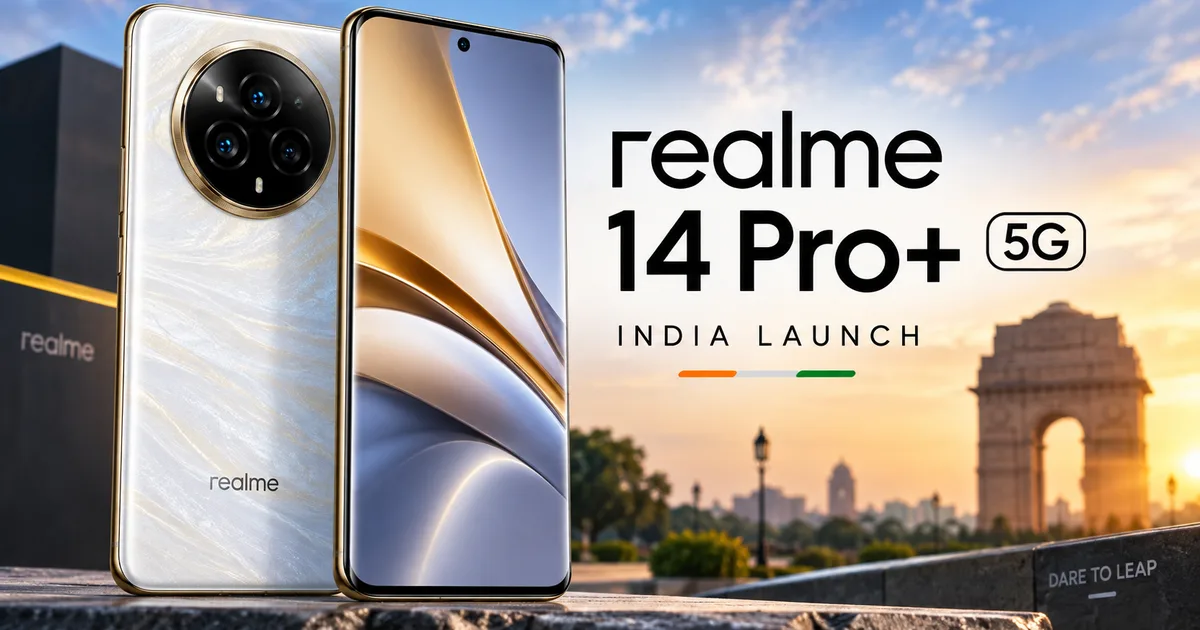
But the Realme 14 Pro Plus 5G caught my attention. It launched in India recently, starting at Rs. 29,999. Realme decided to pack this thing with hardware that usually belongs in premium phones. A massive 6000mAh battery. An IP69 rating. And a periscope zoom lens. Plus, there are some serious software changes that we really need to talk about. I spent some time looking at exactly what this phone offers. I wanted to see if it actually makes sense for your daily life (which is the only thing that matters, actually).
What makes the Realme 14 Pro Plus 5G stand out?
You can read a spec sheet anywhere. But what do those numbers actually mean when you're standing in a crowded metro trying to reply to an urgent email?
First, let's talk about the display. This phone is rocking a 6.83-inch 1.5K 120Hz 3D curved OLED display. That's a lot of technical jargon. Basically, the screen curves slightly at the edges. This makes the phone feel thinner in your hand. The OLED panel means the colors pop. And scrolling through Instagram feels incredibly smooth thanks to the 120Hz refresh rate. The 1.5K resolution just means text looks incredibly sharp. You won't struggle to read WhatsApp messages even under the harsh afternoon Indian sun. In my experience, a bright screen is a lifesaver here.
Then there's the processor. It has the Snapdragon 7s Gen 3. This chip is built specifically for solid mid-range performance. It handles heavy applications without overheating the phone. You can switch between Swiggy and your banking apps smoothly. Sure, it's not a flagship gaming processor that costs ₹80,000. But for 95% of everyday users, it's more than enough power. If you're comparing options, you might also want to check out the Vivo T5 5G India launch specs for a slightly different approach to mobile performance.
A battery built for Indian summers
This is easily my favorite part of the phone. Realme managed to stuff a 6000mAh battery into this device without making it feel like a heavy brick. Most phones in this price bracket max out at 5000mAh.
Think about a typical day. You use GPS to navigate through Bengaluru or Mumbai traffic. You scan four different QR codes to pay for chai or groceries using UPI. You stream music on your commute. Heat drains smartphone batteries incredibly fast in India. So having that extra 1000mAh gives you a real cushion. You won't have to carry a bulky power bank everywhere. Or constantly hunt for a plug point at the office.
Plus, the phone has an IP69 rating. That's a massive deal. Most phones have IP68, which protects against water. IP69 means it is highly resistant to dust and can withstand high-temperature water jets. If you get caught in a sudden monsoon downpour while booking an auto, the phone will survive just fine. Or if you work in dusty environments. It's built for that.
The periscope camera and AI features explained
Camera terminology gets ridiculous sometimes. Smartphone brands love throwing around big words to confuse buyers.
The big selling point here is the periscope camera. Most phone cameras are limited by the physical thickness of the phone itself. You simply can't fit a long zoom lens inside an 8mm thick slab of glass. A periscope lens solves this problem. It lays the lenses horizontally inside the phone body and uses a tiny prism to bend the light 90 degrees. It is exactly how a submarine periscope works.
This clever engineering lets you take zoomed-in photos without losing image quality. You can snap a clear picture of a street sign from far away. Or take a portrait photo of a friend without having to walk up close and awkwardly point the phone in their face. It works brilliantly for concerts or shooting wildlife from a distance. I'm not sure exactly why more brands haven't done this sooner at this price.
And then we have the AI camera features. Artificial intelligence is everywhere now. Realme has baked it deeply into their camera app. The AI can automatically brighten up dark night photos. It can reduce blur if your hand shakes while taking the shot. It can even erase unwanted photobombers from the background of your pictures. I've tried similar features on other devices and they usually work quite well (annoying to admit, I know). It saves you from having to download complex third-party editing apps. If camera tech is your main priority, the Oppo A7 Pro Max 2026 AI camera is another interesting device doing similar software tricks.
Realme UI is dead: hello ColorOS 17
Here is where things get genuinely surprising for tech fans. Realme is quietly killing off its custom Android skin, Realme UI. From now on, their upcoming phones will run Oppo's ColorOS.
I know, it sounds dramatic if you follow smartphone brands closely. But let's look at the facts.
According to reports from 91mobiles, the upcoming ColorOS 17 update, which is based on Android 17, will roll out to Oppo, OnePlus, and Realme devices alike. The goal is simple. Unify the software experience across all three sister brands to save development costs. And push out faster updates.
The ColorOS 17 release will be an interesting one this year, since the update will be rolled out not only to OPPO devices but also to OnePlus and Realme devices. This comes as part of OPPO's efforts to offer a unified software experience across all its brands by combining resources to build and maintain a single mobile software platform.
This is a major shift for current and future Realme owners. The Realme 14 Pro Plus is on the list of eligible devices to receive this new update. If you buy this phone, you'll eventually migrate from Realme UI to ColorOS 17.
Will this change how you use your phone?
Honestly, no. For several years now, Realme UI and ColorOS have shared the exact same underlying code. They basically just had different app icons and different names in the settings menu. Merging them means the software engineering team can focus on making one operating system run perfectly. They don't have to split their limited time maintaining three different versions.
You can expect smoother system animations and potentially much faster Android updates. You'll also get access to some AI productivity features that used to be strictly exclusive to Oppo flagship phones. It is ultimately a win for consumers. If you want to dive into more software analysis and tech updates, our Explainers section is packed with deep dives on this stuff.
5G connectivity and Indian network performance
We can't talk about a 2026 smartphone without mentioning 5G. The Realme 14 Pro Plus 5G supports all the major bands used by Jio and Airtel in India.
I've noticed that mid-range phones sometimes struggle with maintaining a stable 5G connection when you're moving fast, like inside a train or a car. The Snapdragon 7s Gen 3 modem handles network switching quite well. It drops down to 4G smoothly when 5G coverage gets spotty. This saves battery life. The numbers here are a bit fuzzy, but the battery savings are noticeable.
Call quality is solid. They've included dual microphones for noise cancellation. So if you're taking a call while walking down a noisy market street, the person on the other end can actually hear you instead of the auto rickshaws honking behind you.
Expected price in India and the competition
Let's talk about money. The Realme 14 Pro Plus 5G is officially priced starting at Rs. 29,999 in India.
That's an aggressive price point. You get a massive 6000mAh battery. You get a periscope zoom lens. You get a curved OLED screen. Just three years ago, you had to spend over ₹50,000 to get a periscope camera on a smartphone. Now it is easily available in the sub-30K segment.
But the competition in India is fierce. Companies are throwing everything they have at buyers right now.
- You have Motorola bringing incredibly clean software and sleek vegan leather designs to this price bracket.
- Poco consistently offers raw gaming performance for cheaper, though they often cut corners on camera quality.
- Even Realme's own upcoming phones are crowding the market. You can read up on the Realme 16x 5G battery and price details to see just how fast their product lineup moves.
So, should you actually spend your hard-earned money on it?
If you value battery life above almost everything else but still want a camera that takes excellent zoom shots, this phone makes a lot of sense. The IP69 rating adds peace of mind for Indian weather conditions. And the promised software transition to ColorOS 17 means the daily user experience will likely improve over time. The bugs should get squashed faster.
Look, if you ask me, you should look closely at what you actually do on your phone. If you just scroll social media and send WhatsApp texts, you could buy a cheaper ₹15,000 phone and be perfectly happy. You don't need a periscope camera for that.
But if you take a lot of photos on family trips, rely heavily on your phone for GPS navigation, and absolutely hate having to charge your phone twice a day, the ₹29,999 price tag feels justified. The hardware is built to last a few years easily.
Realme has done their homework on what Indian buyers actually want in 2026. Now it's entirely up to you to decide if it fits your budget. Stay tuned to our latest tech news hub for more updates. Android 17 formally rolls out to these devices later this year.