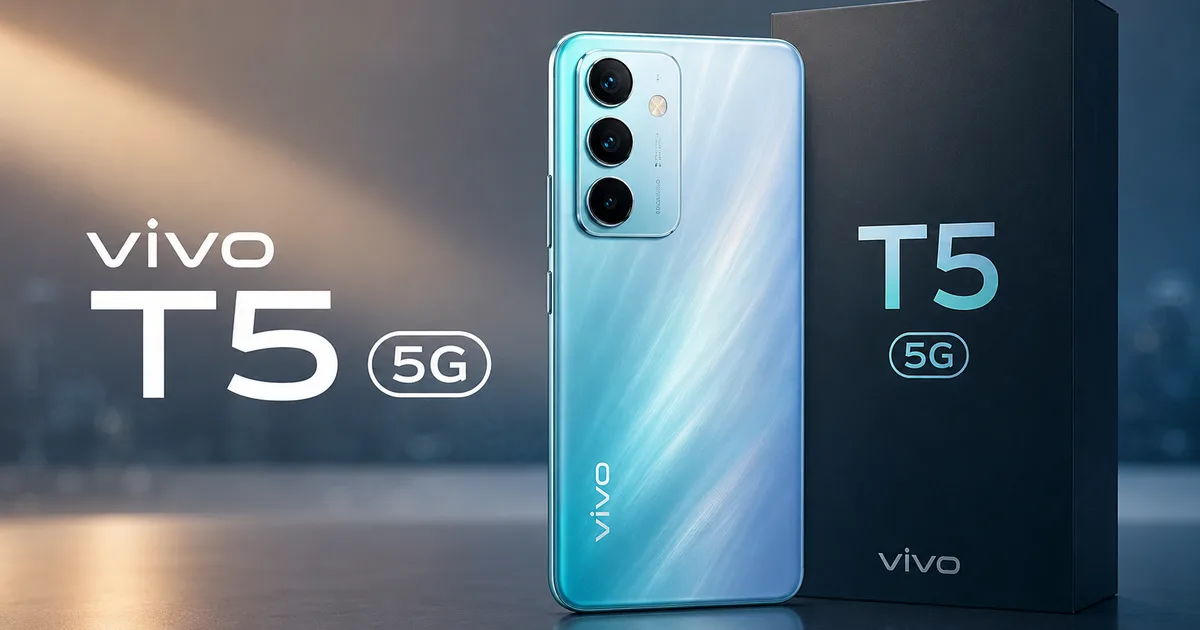
Look, the premium mid-range smartphone market in India is absolute chaos right now. Every month, we see a new phone drop that promises flagship features for half the price. But the upcoming Vivo T5 5G India Launch 2026: Expected Price, Specifications, and Features Explained is actually worth paying attention to. And honestly, it comes down to one massive number: 7,050.
That's the battery capacity in milliampere-hours. A 7,050mAh cell in a phone that's supposed to be under 8mm thick. Sounds impossible. But it's not, actually. Basically, battery tech hit a weird inflection point lately. And we're finally seeing the benefits filter down to regular consumer devices.
Vivo officially confirmed the T5 5G will hit Indian shelves on Wednesday, September 2, 2026, at exactly 12 PM. You'll find it on Flipkart and Vivo's own online store. I spent the morning digging through teasers and official specs from Vivo to figure out what this phone actually brings to the table. In my experience, leaked benchmark scores don't tell the whole story anyway.
The elephant in the room: That 7,050mAh battery
Let's address the battery first. That's the main reason anyone will buy this phone. Most phones today cap out at 5,000mAh. A few push to 5,500mAh or 6,000mAh, but they usually end up feeling like absolute bricks in your pocket.
Vivo managed to cram a 7,050mAh cell into a chassis that's only 7.9mm thick. For context, an iPhone 15 Pro is 8.25mm thick and has a battery less than half that size. How did they do it? Silicon-carbon anode batteries. This newer chemistry lets manufacturers pack way more density into the same physical space. If you want to dive deeper into how the smartphone landscape is changing, check out the Latest Tech News section.
So what does 7,050mAh actually mean for your daily usage? If you're a heavy user who spends hours on Instagram and plays BGMI on your commute, you'll likely get a full two days of use without hunting for a charger. Or maybe you just constantly use maps. For a casual user, you might be looking at three days. It genuinely changes how you interact with your device. You stop worrying about battery percentages before long trips (which makes sense, actually).
The trade-offs of a big battery
But there's always a catch. A bigger battery means more weight, regardless of how thin the phone is. Vivo hasn't officially listed the weight yet, but expect this thing to tip the scales past 200 grams easily. It'll feel substantial in the hand. Which, for the record, I think is actually a good thing. A little heft makes a phone feel premium.
Then there's charging speed. The official teasers don't give us the exact fast-charging wattage yet. Thing is, a battery this large takes a while to fill up. Even with an 80W or 100W charger in the box, getting from zero to 100% will probably take closer to an hour. That's a lot longer than the 30-minute top-ups we see on smaller 5,000mAh phones. We've seen similar trade-offs with the Realme 16x 5G, which also focused heavily on endurance.
And don't expect wireless charging. Brands simply don't put wireless charging coils on phones with batteries this large in this price segment. It creates way too much heat. Plus it adds thickness they're desperately trying to avoid.
Performance: What is the Dimensity 7500 Turbo?
The processor is the engine of your phone. Vivo went with the MediaTek Dimensity 7500 Turbo. If you aren't familiar with MediaTek's naming scheme, the 7000 series sits comfortably in the upper mid-range. It's designed to offer 80% of a flagship chip's performance at a much lower cost to the manufacturer.
Vivo claims this chipset hits an AnTuTu benchmark score of 1.2 million points. To put that in perspective, anything over a million on AnTuTu means you won't notice any lag in daily tasks. And it'll handle heavy gaming quite well. You can play Genshin Impact or Call of Duty Mobile on high settings. You won't see the phone stuttering or dropping frames aggressively.
There's also a strong push for on-device processing. The company claims the Dimensity 7500 Turbo can process 10 tokens per second on a 3-billion-parameter model locally. In plain English, the phone has an NPU capable of running basic tasks natively without sending your data to the cloud. You'll likely see this used for live translation or generating text summaries built into OriginOS 6.
Cooling is another factor. Sustained gaming generates a lot of heat. And pushing a 1.5K display at 144Hz while gaming taxes the GPU even more. Vivo typically includes vapour cooling chambers in their T-series devices, and I expect nothing less here. If they cut corners on cooling, that Dimensity chip will throttle hard after 20 minutes of gameplay.
Display and design: Curved vs flat
Displays are where premium mid-range phones usually shine. The Vivo T5 5G is throwing big numbers around. You're getting a 6.83-inch 1.5K 3D curved AMOLED panel.
Let's talk about the curve. I have a love-hate relationship with curved screens. They look incredible. Swiping from the edge of a curved display feels really smooth, and it makes the side bezels almost invisible. But they're a nightmare if you want to apply a tempered glass screen protector. And accidental palm touches can still be annoying depending on how well the software rejects them.
Smoothness and brightness
The screen hits a 144Hz refresh rate. Which is frankly overkill for 99% of people. Most flagship phones stick to 120Hz. The jump from 60Hz to 120Hz is massive and noticeable immediately. The jump from 120Hz to 144Hz? Only a hardcore gamer might spot the difference. Still, it means scrolling through menus will feel impossibly fluid.
Peak brightness is rated at 2,000 nits. That's entirely enough for the harsh Indian summer sun. You won't have to squint to read a WhatsApp message while standing outside in the afternoon. You won't struggle to scan a UPI QR code either. And speaking of UPI, the fingerprint scanner is under the display. Which is standard for AMOLED panels now.
As for the back panel, Vivo has what they call a "Skyline Design." There's a pill-shaped horizontal camera module with a circular ring light (they call it the Aura Light). It looks very familiar. In fact, if you put it next to the recently announced iQOO Z11, they look like identical twins. This isn't surprising since iQOO is a sub-brand of Vivo, and they often share chassis designs to keep manufacturing costs down. If you're comparing options in this segment, you might also want to look at our breakdown of the iQOO Z11 Lite 5G to see how the specs line up.
The phone comes in two colours: Royal Bronze and Silver Green.
Both look decent in the renders, avoiding the loud gradients we saw a few years ago. Vivo is clearly aiming for a more mature and understated look here.
The camera situation: What we don't know
Notice what Vivo isn't talking about much? The cameras. The teasers clearly show two camera lenses on the back. But the company has stayed completely quiet on the megapixel counts and sensor sizes.
Usually, when a brand focuses heavily on battery and display in their early marketing, the camera system is where they cut corners. I strongly suspect we'll get a decent 50MP primary sensor. Probably a midrange Sony or Samsung sensor. And a largely useless 8MP ultrawide or a 2MP macro lens. Don't buy this phone expecting it to beat a Pixel 8a or a Samsung S23 FE in a photography shootout. I'm not sure exactly why they're hiding the specs, but the numbers here are a bit fuzzy.
It'll likely take great photos in daylight and decent photos at night with the help of the Aura Light flash. But it won't be a dedicated camera beast. The front has a standard punch-hole cutout for selfies, which will probably house a 16MP or 32MP sensor. That sensor will probably be tailored heavily with Vivo's aggressive skin-smoothing algorithms.
Video recording will probably cap out at 4K 30fps for the main camera, and 1080p for the front and ultrawide. This is pretty standard for the mid-range segment. Though optical image stabilization on the main lens would be a huge plus if Vivo decides to include it.
OriginOS 6 and software experience
The phone ships with OriginOS 6 based on Android 16. If you haven't used a Vivo phone recently, their software has improved a lot. But it's still heavy. It's heavily customized and looks completely different from stock Android. You get a ton of customization options and floating windows.
The downside? Bloatware. Mid-range phones in India almost always come pre-installed with folders full of third-party apps like Snapchat and various random games (annoying, I know). You can usually uninstall most of them. But you shouldn't have to spend your first 15 minutes with a new phone cleaning up junk apps. And Vivo hasn't confirmed how many years of Android updates the T5 5G will get. At this price point, you should expect at least three years of major OS updates and four years of security patches. Anything less is unacceptable in 2026.
Pricing expectations in India
So, how much will this thing cost? Vivo set up a microsite on Flipkart that places the phone in the ₹34,999 to ₹49,999 price bracket.
Let's look at the current lineup. The base Vivo T5x starts around ₹25,000. The Vivo T5 Pro just received a price hike in India, jumping up to ₹41,999 for the 8GB RAM and 128GB storage model. Given those numbers, I expect the Vivo T5 5G to slide right into the ₹38,000 to ₹42,000 range for the base variant.
At ₹40,000, you have to ask yourself what you value most in a smartphone. If you want the absolute best camera, you should look elsewhere. If you want a clean software experience with zero bloatware, buy a Motorola or a Nothing phone. If you want to understand complex tech topics simply, browse our Tech Explainers.
But if you're constantly anxious about your phone dying before you get home from the office, the Vivo T5 5G seems built exactly for you. Or if you travel frequently on trains and need a device that can stream movies for 15 hours straight without complaining. The combination of a 7,050mAh battery in a thin design with a top-tier curved display is a rare mix. It's a highly specialized device for battery-anxious power users.
The official launch is on September 2. We'll have the confirmed Indian pricing and exact camera specs then. Until then, hold off on buying any phone in the 40K segment just in case this turns out to be exactly what you need.