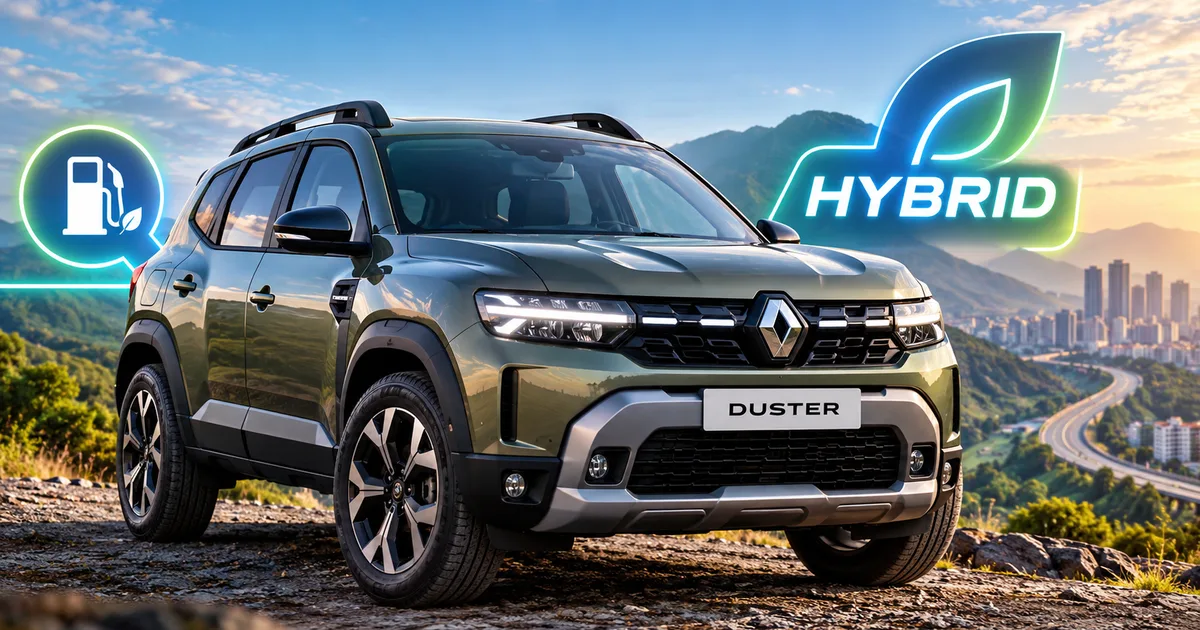
Picture this scenario. You're crawling past Bengaluru's Silk Board junction at 6:30 PM on a rainy Tuesday, watching the fuel needle on your petrol car dip while the air conditioner works overtime. Petrol costs Rs 103 a litre in Delhi and over Rs 105 in Mumbai. Running a family SUV in this kind of gridlock feels like burning cash. That daily pain is why the Renault Duster Hybrid 2026 India launch at a starting price of Rs 16.99 lakh matters so much to regular buyers.
I still remember driving the original Duster through rural Maharashtra back in 2014. Monsoon season. It took lunar-sized potholes without breaking a sweat. But when Renault dropped the diesel engine for BS6 emission rules, the car just vanished from Indian showrooms. Lots of fans were gutted. Now it's back. But this time around, Renault swapped that noisy diesel clatter for an electrified powertrain that delivers genuine 25-plus kmpl mileage in city traffic without needing a wall charger.
Sounds too good to be true? Let's look at the actual engineering.
Renault Duster hybrid price in India and variant breakdown
Renault set the introductory ex-showroom price for the Duster Strong Hybrid E-Tech 160 at Rs 16.99 lakh. It lands right against the hybrid variants of the Maruti Suzuki Grand Vitara and Toyota Urban Cruiser Hyryder. It also undercuts top-spec turbo-petrol versions of the Hyundai Creta and Kia Seltos. And if you ask me, it gives buyers cross-shopping premium sedans like the Skoda Slavia facelift a completely different kind of ride.
Here's the thing with on-road pricing: what you actually pay depends entirely on your state. Delhi gives hybrid buyers a break on registration, so you'll pay around Rs 19.3 lakh on road. Bengaluru and Mumbai are another story. Brutal road taxes push the total past Rs 20.6 lakh once you add insurance and dealer fees. The numbers here are a bit fuzzy, honestly, since state transport policies change without much warning. Uttar Pradesh previously waived registration taxes on strong hybrids, knocking almost Rs 1.5 lakh off the bill (which makes total sense, honestly).
How the Renault Duster E-Tech hybrid engine actually works
So what is a strong hybrid anyway? Think of it like home power. If you have rooftop solar panels hooked to an inverter battery, your fans run on stored juice whenever power demands stay low. The noisy diesel generator in the basement only kicks on when you turn on three air conditioners at once. That's how the Duster works on our roads.
Under the hood, you get a 1.6-litre four-cylinder petrol engine. Renault paired it with two electric motors and a 1.2 kWh lithium-ion battery pack. The larger electric motor drives the front wheels directly. The smaller motor works as a high-voltage starter generator to wake the engine and top up the battery on the go. Combined, the setup has E-Tech 160 horsepower. That's punchier than the Grand Vitara Hybrid and Hyryder Hybrid, which both make around 114 horsepower.
Thing is, Renault didn't use a normal gearbox. No clutch pedal. No rubbery CVT drone. Instead, Renault adapted a clutchless dog-ring transmission developed from their Formula 1 racing programme. It pairs four mechanical gear ratios for the petrol engine with two gear ratios for the electric motor. A clever control unit runs the show, switching between 15 driving modes without any hesitation.
Here's what happens during your daily commute:
- The car always starts rolling in pure electric drive, giving you smooth torque and silence as you pull out of your society gate.
- During low-speed city crawls under 40 km/h, the electric motor powers the wheels while the petrol engine rests or runs quietly as a generator.
- When you hit an open highway and need quick acceleration to pass a freight truck, both the petrol engine and electric motor fire together for maximum push.
- Whenever you take your foot off the accelerator or brake at a red light, the system converts motion back into electricity through regenerative braking.
Basically, you get the quiet zip of an electric car in bumper-to-bumper jams. No searching for charging plugs. In my experience, skipping the whole charging routine is what makes these cars so painless to own in India. If you want to dig into the mechanical side of things, our collection of automotive tech explainers covers how different hybrid platforms stack up against pure electric cars.
Renault has brought Formula 1 derived multi-mode engineering to Indian family buyers who want 25 kmpl efficiency without waiting at crowded public EV charging hubs.
Renault Duster hybrid mileage and real-world fuel economy
Renault claims an official ARAI fuel efficiency figure of up to 29 kmpl for the Duster E-Tech. That number looks fantastic on a dealership brochure. But laboratory rollers don't represent the chaotic reality of Indian city roads.
So what should you actually expect in daily life? Traffic is where this powertrain shines. Autocar India tested similar strong hybrids under Indian conditions, and the real-world numbers hold up quite well. Renault claims the Duster can run on battery power for up to 80 percent of your city commute time. In crawling peak-hour jams along Mumbai's Western Express Highway or Delhi's Ring Road, realistic fuel economy will likely hover between 21 and 24 kmpl with the climate control set to 23 degrees.
Highway cruising changes the math completely. Once you hit sustained speeds of 100 km/h on expressways, wind drag increases and the petrol engine stays engaged to hold that pace. On long road trips, your mileage will settle around 18 to 21 kmpl. But that's still far better than the 11 to 13 kmpl you get from conventional turbo-petrol SUVs with a full load.
Let's look at the actual monthly fuel math. Say you drive 1,200 km each month entirely in city traffic:
- A standard 1.5-litre turbo-petrol SUV averaging 10 kmpl burns 120 litres of petrol, costing roughly Rs 12,480 at Rs 104 per litre.
- The Duster Strong Hybrid averaging 22 kmpl consumes around 55 litres of petrol, totaling approximately Rs 5,720.
- You pocket a direct monthly saving of Rs 6,760.
- Across 60,000 km over five years, your total fuel savings easily cross Rs 4 lakh.
That Rs 4 lakh saving wipes out most of the price premium you pay upfront for the hybrid tech.
Design, ground clearance, and cabin features
Built on Renault's CMF-B platform, the 2026 Duster looks tough. You get squared-off wheel arches, Y-shaped LED lights, thick body cladding made from recycled plastics, and functional roof rails. Best of all, the SUV has 217 mm ground clearance. That extra height means you can clear waterlogged subways and those unmarked monster speed bumps that pop up overnight outside residential colonies without scraping the underbody.
Inside, the cabin feels durable rather than fragile. A 10.1-inch touchscreen sits angled toward the driver with wireless Apple CarPlay and Android Auto, paired with a 7-inch digital cluster. You also get an electronic parking brake with auto-hold and an Arkamys-tuned sound system. Wireless phone charging is on the list as well. Boot capacity is 472 litres. The 1.2 kWh battery sits right under the boot floor, so you don't lose luggage space when packing for an outstation road trip (a huge relief, honestly).
For safety, the Duster comes with six airbags, electronic stability control, hill-start assist, and a Level 2 ADAS suite. The sensor package handles adaptive cruise control along with autonomous emergency braking. If you want to see where Indian automotive engineering and electric architecture are heading next, check our report on the Tata Aeris concept and follow the latest car news for updates on upcoming launches.
Should you buy the new Duster hybrid or stick to petrol?
Look, buying a car in India is an emotional choice backed by practical math. If your daily office run involves crawling through 30 to 50 km of heavy traffic, buying the Duster Hybrid is an easy call. You get a quiet automatic transmission that won't strain your left knee in gridlock. There's plenty of instant electric torque to plug gaps in traffic. And your monthly fuel bills won't make you wince every time you pull up to the pump.
And the Duster still gives you that rugged suspension that handles broken Indian tarmac better than most delicate crossovers. Honestly, that plush ride comfort alone will win over buyers who drive beyond metro limits.
Who should skip it? If your annual driving is under 5,000 km, or if your usage is 90 percent high-speed expressway touring, you won't recover the hybrid price difference anytime soon. In that case, saving upfront cash with a standard turbo-petrol car makes much more sense. But for typical Indian families dealing with chaotic city traffic every single day, the new Duster Hybrid delivers where it counts.