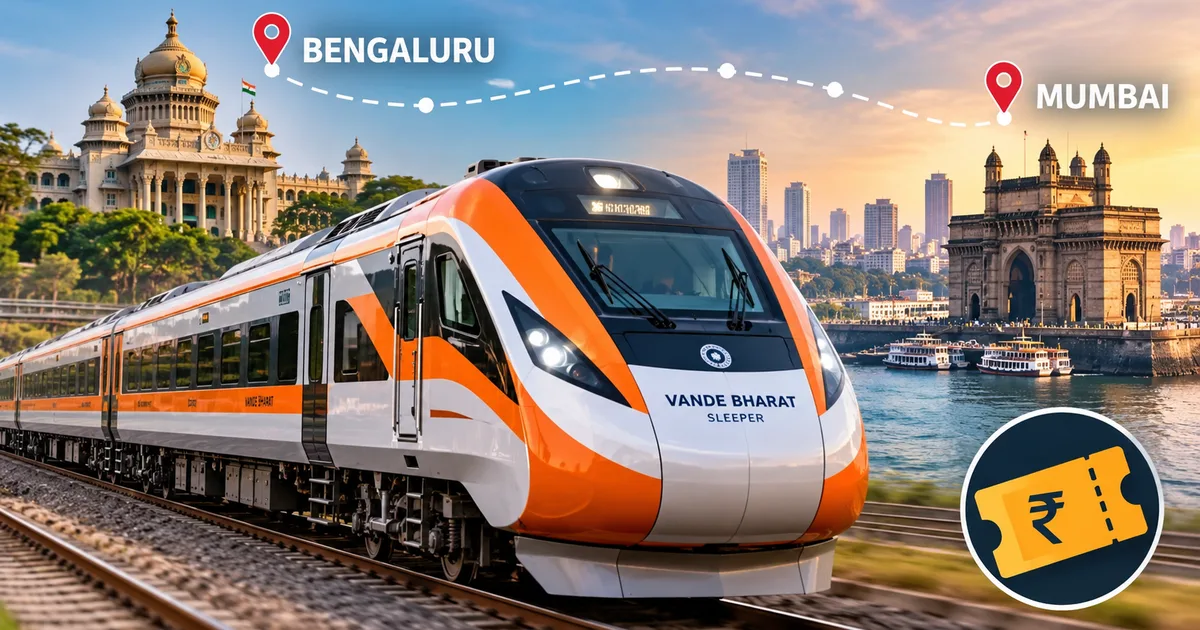
If you've ever tried booking a last-minute flight from Bengaluru to Mumbai on a Friday evening, you know the headache. You open your travel app and see one-way economy airfares touching ₹8,500. So you just close your phone in frustration. Your usual railway choice has been the Udyan Express, but spending 22 hours on the track eats up an entire working day. That's why the upcoming Bengaluru-Mumbai Vande Bharat Sleeper train has generated so much genuine interest across Karnataka and Maharashtra.
Six hours saved.
That's the real difference here. The new semi-high-speed service covers 1,118 km in about 16 hours, running overnight between Sir M Visvesvaraya Terminal in Bengaluru and Chhatrapati Shivaji Maharaj Terminus in Mumbai. You board after work and sleep through the dark Deccan plateau. Next morning, you wake up right before lunch in Mumbai. Honestly, in my experience, this is the exact middle ground regular travelers have wanted for years. It's faster than old express trains, without the frantic airport rush or ₹1,500 cab rides to Kempegowda International Airport (annoying, I know).
Bengaluru-Mumbai Vande Bharat Sleeper route and timings
Indian Railways has set the inauguration for November 1, 2026, right on Karnataka Rajyotsava, with commercial passenger bookings opening right after. And the timetable is tailored directly for working professionals and regional business owners who can't afford to waste daytime hours sitting in transit. If you ask me, the overnight timing is spot on.
Here's how railway officials describe the schedule:
- The train leaves SMVT Bengaluru at 7:50 PM and pulls into CSMT Mumbai at 11:55 AM the next morning, taking 16 hours and 5 minutes.
- The return service departs CSMT Mumbai at 8:10 PM and arrives at SMVT Bengaluru at 11:55 AM the following day, taking 15 hours and 45 minutes.
- The service runs six days a week, giving regular commuters a dependable overnight schedule.
Look at the terminal choice. The Bengaluru train departs from Sir M Visvesvaraya Terminal (SMVT) at Byappanahalli rather than Krantivira Sangolli Rayanna (KSR) Bengaluru City station. I'm not sure of the exact reasoning behind skipping KSR City station, but SMVT is built specifically for long-distance trains to ease congestion at Majestic. Still, you'll definitely want to factor in eastern Bengaluru traffic when heading out on a Friday evening. Traffic there can be a mess. At the Mumbai end, arriving at Chhatrapati Shivaji Maharaj Terminus (CSMT) puts you right in South Mumbai with direct suburban rail and taxi connections.
Seven stoppages along the 1,118 km track
Thing is, a semi-high-speed train can't stop at every small junction if it wants to keep a 16-hour schedule across 1,118 km. But it can't skip major commercial hubs either. So the Railway Ministry settled on seven commercial halts along the corridor. That feels like a sensible compromise.
The approved intermediate stoppages include:
- Anantapur and Guntakal in Andhra Pradesh, connecting the Rayalaseema belt and major railway interchange routes.
- Raichur and Kalaburagi in northeastern Karnataka, serving industrial cement hubs and the Kalyana-Karnataka district headquarters.
- Solapur in Maharashtra, providing access to the regional textile and trade hub.
- Pune Junction, which is a major boarding point for IT employees and students moving between Maharashtra and Karnataka.
- Kalyan Junction, serving the eastern Mumbai metropolitan region and Thane commuter belt.
Stops at Pune and Kalaburagi make total practical sense. Pune alone accounts for thousands of trips to Bengaluru every single week. From what I've seen, travelers constantly complain about private sleeper buses on NH 48. Those buses take anywhere from 14 to 18 hours, and they almost always get stuck near the Katraj tunnel or the Tumakuru toll plaza. It's exhausting.
Expected ticket fare for AC sleeper classes
Indian Railways hasn't released the final booking tariff on the IRCTC portal yet, so the numbers here are a bit fuzzy. Still, we can make a solid estimate based on per-kilometer rates for existing premium sleeper trains. The rake has 16 coaches. That comes to 823 sleeping berths divided across three travel classes.
Here's what passengers can expect when reservations open:
- AC 3 Tier (11 coaches): Estimated between ₹2,200 and ₹2,500 per passenger, which includes standard bedding and linen.
- AC 2 Tier (4 coaches): Estimated between ₹3,200 and ₹3,600, offering wider berths and individual reading lights.
- AC First Class (1 coach): Estimated between ₹4,500 and ₹5,200, featuring lockable coupe doors and hot-water shower cubicles.
Compare those numbers with airfare, and the train wins easily. A return flight booked a week ahead usually runs between ₹12,000 and ₹16,000 once you add checked luggage and booking fees. Then toss in the airport cabs. You're looking at ₹1,500 from Whitefield out to Devanahalli, plus another ₹1,000 from Mumbai airport down to Nariman Point. Suddenly your travel bill is touching ₹18,000. For a family of three, taking the Vande Bharat Sleeper in 2AC cuts that expense by more than half, and everyone gets to sleep peacefully through the night.
You can read more about how Indian Railways is rolling this out on other major routes in our guide to the Vande Bharat sleeper train network.
How distributed traction changes the overnight ride
A lot of folks assume this train is just a Rajdhani Express with fresh paint and automatic sliding doors. It isn't. The real difference is the rail engineering underneath, specifically how the train actually moves.
Traditional long-distance trains in India rely on one heavy locomotive at the front pulling 20 to 24 coaches. That setup has real limitations. Whenever the train slows down for a speed restriction or track curve, that single engine takes kilometers of full throttle to drag 1,200 tons back up to speed.
The Vande Bharat Sleeper operates on distributed traction.
Instead of one locomotive pulling the entire rake, traction motors are placed underneath alternate coaches across the train. Think of it like all-wheel drive on an electric car versus a small hatchback towing a heavy loaded trailer. You get quick acceleration and smooth braking. So when the train slows down near Solapur or tackles the winding ghat curves near Pune, it recovers cruise speed in minutes instead of lagging behind.
Honestly, that quick pickup is why the train cuts around six hours off the trip (which makes sense, actually) without needing brand-new bullet train tracks.
Couplers, noise insulation, and bio-vacuum toilets
If you've traveled in older ICF or LHB coaches, you know the sudden jerks that wake you up whenever the driver hits the brakes or restarts from a signal. It's annoying. Vande Bharat trainsets use semi-permanent tight-lock couplers that remove mechanical slack between coaches. The whole train moves as one solid unit. That means no sudden jolting while you're trying to sleep.
The passenger amenities inside have some thoughtful upgrades too:
- Sealed gangways between coaches minimize wind turbulence and reduce track roar down to a quiet hum.
- Bio-vacuum toilet systems function like aircraft lavatories, clearing waste instantly with minimal water and zero odor creeping into passenger berths.
- Berth cushions feature extra memory-foam layering and integrated USB charging ports placed right beside your pillow.
- First AC compartments even include integrated hot-water shower cubicles for passengers wanting to freshen up before arriving in Mumbai.
I think those bio-vacuum toilets alone are a massive improvement over traditional gravity-drop train toilets. Anyone who has walked through a train vestibule early in the morning knows exactly what I mean.
Safety systems and Kavach protection
Speed means nothing without safety, especially on crowded corridors like Bengaluru-Mumbai. This sleeper train comes factory-fitted with Kavach, India's own Automatic Train Protection (ATP) system developed alongside the Research Designs and Standards Organisation.
So how does Kavach actually protect passengers on this route?
Basically, RFID tags along the tracks talk directly to onboard computers inside the train cabins. If two trains ever enter the same track block due to human error, or if an engineer overshoots a red signal, Kavach takes control of the braking system automatically. It stops the train completely without needing driver intervention.
Rail technology upgrades only matter when they protect everyday travelers. Integrating automated braking and collision prevention directly into sleeper trainsets gives passengers complete peace of mind during overnight runs.
The train body itself uses crash-resistant austenitic stainless steel with deformation zones at both ends. In the rare event of an impact, the coaches are engineered not to climb over each other or crush passenger compartments.
If you want to understand how modern rail safety systems work across India, check out our collection of railway tech explainers.
Booking your berth on IRCTC and travel tips
Once Indian Railways opens the reservation window, booking will follow standard IRCTC procedures. You can book berths through the official IRCTC website or the Rail Connect mobile app. Since this is India's second commercial Vande Bharat Sleeper service, demand will be crazy during the inaugural weeks (believe me, tickets will vanish fast).
Here are a few practical booking tips:
- Make sure your IRCTC user profile is linked with your Aadhaar number to take advantage of higher monthly booking limits and faster checkout.
- Use UPI apps like PhonePe, Google Pay, or Paytm for ticket payments rather than net banking, as UPI gateways rarely suffer verification timeouts during high-traffic booking opening hours.
- Keep your DigiLocker app updated on your smartphone to carry official government identity proofs without needing physical cards.
- Review the new railway ticket reservation rules regarding advance booking windows and waitlist confirmation policies before planning your holiday trips.
- Stay tuned to our latest tech news updates for the exact date when ticket booking counters go live on IRCTC.
Look, no single train solves every transit bottleneck in India. But taking six hours off the journey between Bengaluru and Mumbai while giving passengers a clean bed and a quiet ride is a huge step in the right direction. It makes overnight rail travel practical again for busy folks who want to save time without burning money on airport cab lines.