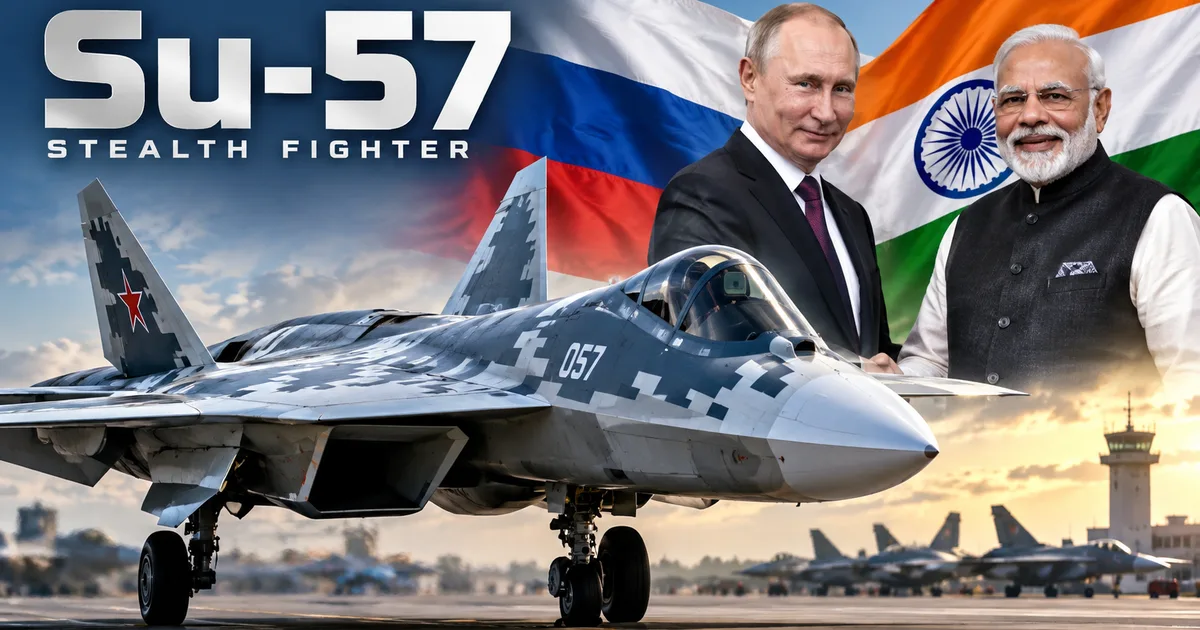
The Russia Su-57 Stealth Fighter Jet India Deal 2026 is dominating headlines right now, and for good reason. At Aero India 2025, on a warm February morning at Yelahanka Air Force Station near Bengaluru, a small boy tipped his head all the way back. Above him, a Russian Su-57 hauled itself into a vertical climb. It rolled over the top and fell back toward the crowd. For most people watching, it was just a loud, thrilling shape in the sky. But for the men in uniform standing beside them, it was a glimpse of the one major capability the Indian Air Force simply doesn't have.
We fly some fantastic fourth-generation fighters. The Su-30MKI is a heavy-hitting beast. And the Rafale is great. But we don't have a single stealth jet in our fleet. Not one.
Then Vladimir Putin stepped into that gap with an offer that's incredibly hard to refuse. Speaking at the St Petersburg International Economic Forum back in June 2026, the Russian president proposed building the Su-57 together right here in India. He promised full technology transfer and integration of Indian systems. "No limitations," he stated. Personally, I think it's a huge gamble.
Why is this happening now? Just look at the map. The pressure isn't coming from Moscow. Rather, it's pushing in from our borders. China is pumping out its J-20 stealth fighters at a terrifying pace. And there are strong reports that Pakistan is pushing to buy China's J-35 stealth jet. This raises a very real, very uncomfortable prospect. India could soon be the only major military power in the region without a fifth-generation stealth aircraft.
Let's break down what this jet actually is. Let's also look at why the IAF is in a tough spot and what this multi-billion dollar proposal means for us.
What exactly makes the Su-57 different?
If you spend any time reading Tech Explainers, you probably want to know what makes this plane worth billions of dollars. The Sukhoi Su-57 (which NATO calls the "Felon") is Russia's answer to the American F-22 Raptor and F-35 Lightning II. It is a fifth-generation multirole stealth fighter.
But what does "fifth-generation" actually mean? It is a specific combination of features that changes how air combat works.
First, you have low-observable design. Most people just call it stealth. The shape of the plane and the radar-absorbent materials on its skin make it very hard for enemy radar to spot it from a distance. It carries its missiles and bombs inside internal weapon bays. If you hang missiles under the wings like a normal fighter, they catch radar waves. They light up enemy screens like a Christmas tree. (Which is obviously bad).
Second, it has supercruise. This means the jet can fly faster than the speed of sound without using afterburners. Afterburners burn through fuel incredibly fast. They also create a massive heat signature that enemy infrared missiles can easily lock onto. Supercruise lets a jet dash into enemy territory fast and cool.
Third, supermaneuverability. Russian jets are famous for doing physics-defying flips and turns in the sky. The Su-57 has thrust-vectoring engines. Basically, the engine nozzles can tilt. This allows the plane to point its nose almost independently of the direction it's actually flying. If it gets into a close-range dogfight, it can out-turn almost anything. Honestly, it's pretty wild to watch.
Finally, there's the sensor fusion. Older jets had separate screens for radar and targeting pods. The pilot had to do the math in their head. The Su-57 uses artificial intelligence to combine all that data into one clean picture. It sees everything around it in a 360-degree bubble.
So, the specs look great on paper. But the stealth part is exactly where the arguments start.
The messy history of India and the FGFA program
If this proposal sounds familiar, that's because we've actually been here before. It's not a new romance.
Back in 2007, India and Russia launched a joint Fifth Generation Fighter Aircraft (FGFA) program. The idea was to take the early Su-57 design and build a customised twin-seat version specifically for India. We poured millions of dollars and a whole decade of negotiating into it.
Then in 2018, New Delhi completely walked away. The IAF was unhappy with a few things. The costs were spiralling out of control. And the Russians weren't sharing the core computer codes and technology we asked for. Most importantly, the IAF had real doubts about whether the plane was actually stealthy enough to survive against modern Western and Chinese radar.
Russia went ahead and finished the jet alone. Now the roles have quietly reversed. Russia is courting India again. And the sweetener they are offering is precisely the thing India walked away over last time. They are offering a massive share of the technology and a production line on Indian soil. In my experience, these turnarounds are rare.
Why the sudden urgency for the IAF?
We're running short on planes. The IAF is currently short of about 13 fighter squadrons. We need numbers. And we desperately need modern tech.
We're aggressively building our own Advanced Medium Combat Aircraft (AMCA). The AMCA is our indigenous stealth fighter dream being developed by HAL and ADA. But aerospace development is brutally slow (annoying, I know). Even the most optimistic estimates say the AMCA won't be ready for full operational deployment until the 2030s. You don't just throw together a stealth fighter overnight.
Meanwhile, our neighbours aren't waiting around for us to catch up.
China is actively expanding its fleet of J-20 stealth fighters. They're also advancing the J-35 program. This is a medium-weight stealth fighter designed for aircraft carriers and export. That leaves India staring down a massive fifth-generation capability gap on our northern borders. It's honestly a bit of a mess.
The western front isn't looking much better. Pakistan wants to strengthen its air power through China. They have confirmed an initial collaborative agreement to get the Chinese J-35 stealth fighter. If the PAF gets their hands on a squadron of J-35s before our AMCA is flying, we're going to be at a severe tactical disadvantage. Our non-stealth Su-30s and Rafales would have a very hard time dealing with a plane they can't even see on radar until it's too late. If you ask me, that's the real threat.
This is exactly why the Su-57 proposal is back on the table. As Kremlin spokesperson Dmitry Peskov stated clearly on September 8 just before the BRICS summit:
"Issues of selling Su-57 is on the agenda between India and Russia."
Russia wants us to commit to buying around 100 aircraft and manufacturing them here. But the IAF might only want a smaller batch of 36 to 54 jets just to plug the gap until the AMCA arrives. Negotiating that difference in numbers is going to be incredibly tough. I'm not sure exactly why they'd agree to a low number.
The $11 Billion "Super Sukhoi" connection
Thing is, Russia rarely pitches just one thing. Along with the Su-57, they are pushing a massive $11 billion upgrade for our existing fleet of around 260 Su-30MKI jets.
The numbers here are a bit fuzzy, but they want to turn our current frontline fighters into "Super Sukhois". They want new Active Electronically Scanned Array (AESA) radars and better electronic warfare suites. (Which we do need, actually). This is smart business from Moscow. In my experience, they always bundle the shiny new thing with something practical. They're bundling the shiny new stealth fighter with an upgrade we actually desperately need for the planes we already fly every day.
If you keep an eye on the Latest Tech News, you know these mega defence deals are never simple. It's about securing supply chains and locking in maintenance contracts for the next forty years. Oh, and integrating weapons like our indigenous BrahMos missiles.
It's similar to how global financial shifts impact us locally. Just like reading about the US Fed Rate Hike September 2026: Impact on India Explained helps you understand your home loan rates, understanding defence tech transfer helps you see where billions of tax rupees are going and how it affects our national security.
We've also seen how technology supply chains matter in consumer electronics. For instance, the delays we covered in the Leap India IPO 2026 Explained: GMP, Allotment & Supply Chain Impact show exactly what happens when parts stop moving across borders. India wants to avoid that in defence by demanding local production.
Should India actually take the deal?
So, does buying the Su-57 make sense for India in 2026? It's a heavily debated topic in defence circles. I think there are very strong arguments on both sides.
Let's look at the pros first:
- We get stealth fighters now, years before our own AMCA is ready to fly. Buying these jets completely shuts down the panic about Pakistan getting the J-35. This helps us regain the technological edge in the region.
- Putin has offered full tech transfer this time. If they actually hand over the source codes and manufacturing secrets, that knowledge could massively speed up our own AMCA program. We wouldn't have to reinvent the wheel.
- Building 100 stealth jets in India creates jobs and builds an aerospace ecosystem. It fits perfectly with the government's manufacturing push. And it heavily benefits local contractors.
But the cons are significant. And they're hard to ignore.
- Setting up a production line for fifth-generation fighters is astronomically expensive. Buying 100 of these jets will eat up the IAF's capital budget for years. That leaves far less money for drones and air defence systems. It also leaves less funding for the AMCA itself.
- The Su-57's stealth is sketchy compared to the American F-35 or even the Chinese J-20. The engines aren't fully concealed. And the radar cross-section is larger than its rivals. We have to ask if we're paying fifth-gen prices for a 4.5-gen plane.
- Buying billions of dollars of major Russian military hardware right now brings the very real threat of US sanctions under the CAATSA law. Washington usually gives New Delhi a waiver because they need us to counter China. But it's a massive diplomatic headache nobody wants right now.
The final verdict on the stealth fighter gap
Look, the Indian Air Force is in a tight spot. If Pakistan officially signs the cheque for those J-35s from China, the pressure on the Indian government to respond will be immense. You can't fight stealth jets with non-stealth jets and expect to win easily. The math just doesn't work in your favour.
Russia knows this. That's why they brought the offer back to the table sweeter than before. They timed it perfectly with the BRICS summit in New Delhi. But committing to the Su-57 is a 40-year marriage. It affects our budgets and our indigenous programs. It also affects our delicate relationship with the West.
We're going to have to wait and see what comes out of the closed-door meetings between PM Modi and President Putin. Whatever they decide, this is easily the most important defence technology choice India will make this decade. In my experience, these things take time. But the skies over South Asia are changing fast. We simply can't afford to be left behind.