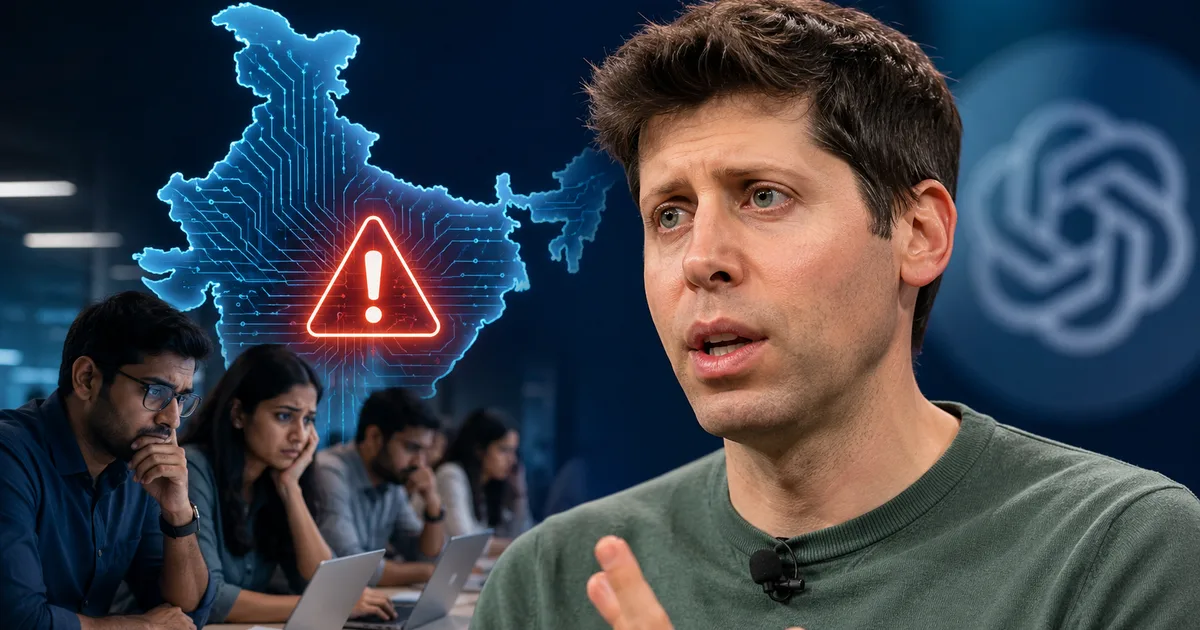
Imagine you're a software developer in Bangalore, two or three years into your career, writing decent Python and pulling in around ₹12 lakh a year. You've half-ignored the "AI is coming for your job" headlines for a while now. Then Sam Altman, the CEO of OpenAI, the company that makes ChatGPT, shows up at the India AI Summit in May 2026 and says, on camera, that AI job displacement is real, it's already happening, and there's more on the way. That gets your attention.
Altman's comments have been circulating on LinkedIn and every software engineer's WhatsApp group this week. So what did he actually say? And what does it mean if you're working in India right now?
What Altman actually said, and what he walked back
His exact words at the India AI Summit: "There is some real displacement of jobs by AI. I expect to see more of that over time. Of course, we will find new kinds of jobs."
Not exactly a five-alarm warning. But he also admitted something that got considerably less coverage. He was "roughly right" about how fast AI technology would improve, but "pretty wrong" about the social and economic consequences. The technology moved faster than expected. Jobs held up better than he feared. He told Business Today in May 2026 that AI will "not replace the human part of employment."
And separately, speaking to Fortune, he flagged something called "AI washing". Companies using AI as a convenient excuse to cut headcount when the real reason is something else entirely. He said some employers are doing this explicitly. So you've got the person who built the tools supposedly threatening your job, now saying the disruption is real but slower than feared, while also calling out companies that are cynically blaming AI for layoffs that were actually driven by margin pressure or bad hiring decisions from 2021-2022. It's a mixed message. But it's an honest one.
For the record, Altman also said "We always find new things to do, and I have no doubt" that this will continue. Whether that's optimism or deflection depends on your read of him. Probably both.
Why Indian tech workers need to take this seriously in 2026
India has somewhere between 5 and 5.5 million software professionals. The exact figures shift depending on which NASSCOM data you look at (the numbers here are a bit fuzzy depending on how you count contract workers). Honestly, a large chunk work in services: writing code, managing IT infrastructure, handling data, doing back-office work. These are exactly the categories where AI tools are getting genuinely capable.
Altman specifically called out coding. He told the Economic Times that coding alone won't guarantee a job. Sit with that for a moment. A lot of Indian engineering graduates, especially from tier-2 and tier-3 colleges, come out knowing how to write functional code but without the problem-solving depth or the business context that makes a developer genuinely hard to replace. Those graduates face the most direct exposure.
Thing is, much of India's IT export revenue is services work: writing code to specification and keeping large-scale systems running. These are exactly the functions where AI tools are making real inroads. And unlike manufacturing jobs that moved to machines over several decades, software automation can happen faster once the tools are good enough. The timeline is compressed.
At the same time, Altman said India leads global AI adoption and publicly backed the Tata-OpenAI partnership. So India is simultaneously a likely target of disruption and a potential major beneficiary, depending entirely on whether the workforce adapts.
The AI washing problem nobody's discussing enough
This is the part I think deserves more airtime than it's getting.
Altman explicitly warned that some companies are using AI as a cover story for firing people. "AI washing," in this context, is when a company frames workforce reductions as AI-driven efficiency when the real driver is over-hiring post-pandemic and squeezed margins. He flagged this to Fortune explicitly, which is an unusual thing for an AI company CEO to admit publicly.
This matters for Indian IT professionals because large service providers have workforces doing work AI can't fully replace yet. But "AI made us restructure" is a convenient narrative that sounds better than "we over-hired in 2022 and now margins are under pressure." If you get laid off and your employer says it's because of AI, ask specifically: what tool was deployed and what function did it replace? If they can't answer that clearly, the justification is a mess. Vague AI justifications for layoffs deserve scrutiny.
The latest AI industry news often conflates genuine AI-driven restructuring with ordinary business cost-cutting dressed up in tech language. They're very different situations, and knowing the difference matters for how you respond, whether that's negotiating severance or deciding whether to stay in the sector at all.
Which roles face real risk in India right now
Honestly, some jobs are more exposed than others. Based on what AI tools can actually do in mid-2026:
- Junior software developers doing routine code generation and boilerplate work
- Data entry and back-office processing roles in BPOs
- Basic content writing, especially templated or SEO-driven copy
- Entry-level customer service agents handling scripted, repetitive queries
- Some paralegal and document review work in legal services firms
Roles that are holding up considerably better:
- System architects and senior engineers making design and tradeoff decisions
- Product managers who understand both business problems and technology
- AI/ML engineers and data scientists (not a surprise, but worth stating)
- Professionals with deep domain expertise in healthcare and finance, where human judgment carries real liability
- Sales and relationship management roles where trust is the actual product being sold
The pattern is clear, if you ask me. Routine, well-defined tasks are replaceable. Work that requires judgment, context, relationships, and adaptability is not, at least not yet. This isn't new thinking. It's the same pattern automation has followed for decades. AI is just moving up the complexity ladder faster than earlier waves did. That speed difference is genuinely new and worth taking seriously.
What Indian professionals should actually do about this
Altman doesn't hand you a clean answer. And he shouldn't, because there isn't one. But his comments point somewhere useful.
He keeps emphasizing the "human part" of employment as what AI can't replace. Things like judgment, creativity, the ability to navigate ambiguous situations, ethical reasoning. These are hard to reduce to a prompt. They're also hard to learn in a six-week bootcamp (annoying, I know), which is why people who've actually worked in complex environments for several years have something that raw coding skills just don't give you.
India-specific AI platforms like Sarvam AI and Krutrim are building tools designed for Indian languages and workflows, which means professionals who work in Hindi, Tamil, Bengali, or any number of regional languages will have AI tools available to them. Ignoring these tools because "AI is for English speakers" is increasingly not a valid position.
For Indian professionals navigating this right now, a few things seem genuinely worth doing:
- Actually use AI tools in your daily work, not just know they exist. If you're in finance, use AI for analysis. If you're in law, use it for research. If you're in software, work seriously with tools like GitHub Copilot and understand what they do and don't do well.
- Build the contextual knowledge that lets you catch AI errors. Knowing when the model is wrong is a real skill, and it pays well.
- If you're in a pure coding execution role, start moving toward architecture or technical leadership. Not because coding is dead, but because execution-level coding is where the pressure is most acute right now.
- For students: pick up AI literacy as a secondary skill alongside your core discipline. You don't need to become an ML engineer. You need to understand enough to use these tools effectively in whatever field you're entering.
The AI explainers on this site cover many of these tools in practical detail if you're not sure where to start. The harder problem isn't finding learning material. It's knowing which skills are actually worth the time investment.
The honest picture for 2026 and beyond
Altman's revised view, that there won't be a "jobs apocalypse," is probably correct in the short run. Deploying AI into real organizations is slow, honestly much slower than the headlines make it sound. Companies need months or years to restructure workflows, retrain staff, manage compliance, and deal with the fact that AI tools still make enough mistakes that humans need to stay in the loop.
India's particular position is genuinely interesting. There's a young workforce that's comfortable with digital tools. There's government investment going into AI infrastructure through the IndiaAI Mission. And there's a local AI ecosystem that's actually building tools for Indian languages and contexts. Those are real advantages. The risk isn't sudden mass unemployment. The risk is a slower erosion of entry-level roles over five to ten years, combined with a skills mismatch between what universities are producing and what the market actually needs. That's a structural problem that individual career choices can't fully solve. It requires changes in how engineers are trained, and that takes time.
"It really, in both positive and negative ways, updated me to thinking that the jobs picture is likely to be very different than we thought." — Sam Altman, May 2026
"Very different than we thought" is doing a lot of work in that sentence. It's not reassuring. It just means the honest answer is that nobody really knows what the jobs picture looks like in five years, and I'm not sure even Altman does. Uncomfortable, but at least accurate.
The practical takeaway: the skills that got you hired in 2022 aren't guaranteed to keep you employed in 2030. That's been true for every generation that lived through a major technology shift. The career upskilling guides here can point you toward specific resources depending on your field. The tools to adapt are genuinely accessible, many free, most in English and increasingly in Hindi and other Indian languages.
Waiting for the apocalypse that never arrives, then concluding everything is fine, is the actual risk to watch out for. The disruption is real. It's just slower and more uneven than the headlines suggest.