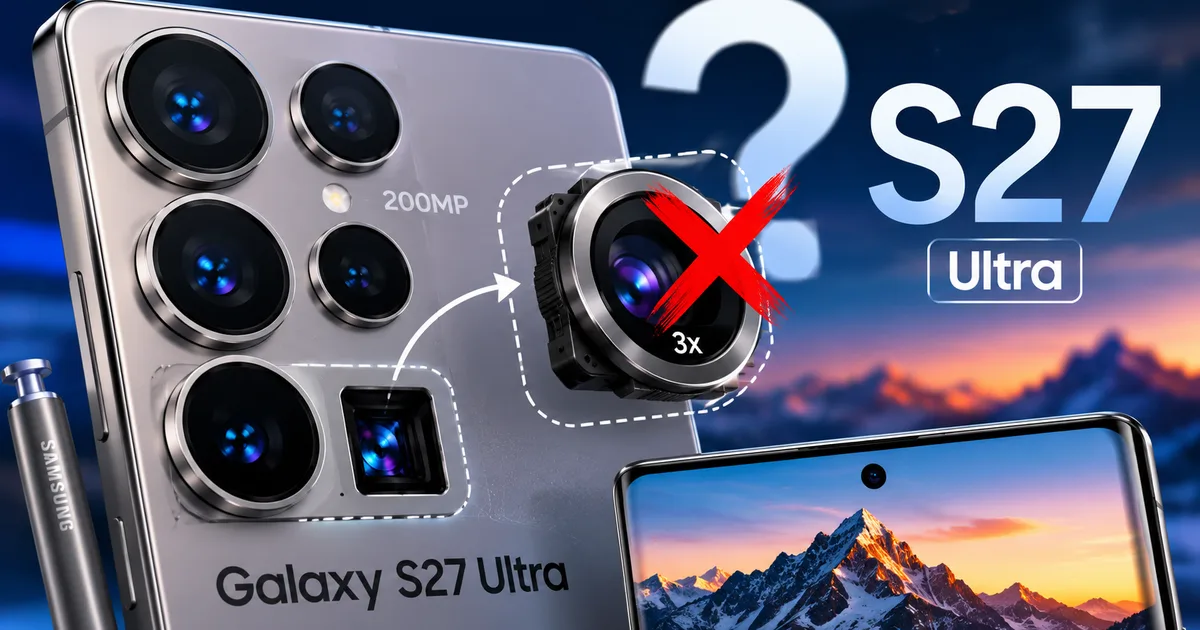
The Samsung Galaxy S27 Ultra camera has become one of the more hotly debated leaks of 2026. A wave of credible-looking tips from GSMArena, Notebookcheck, some hardware tipsters, and online forums point to a big camera redesign, one that could mean the end of the 3x telephoto lens that's been part of Samsung's Ultra lineup for years. And honestly? The reaction from tech fans has been complicated.
So what's actually being reported, and what's Samsung trying to do? Should you be worried or excited? Let's break it down.
What the leaks actually say
Multiple sources, including GSMArena and Notebookcheck, have reported that the Galaxy S27 Ultra is moving to a horizontal camera layout at the back. Also, the phone's reportedly dropping one of its two telephoto lenses. The S26 Ultra had both a 3x and a 5x periscope telephoto. But the S27 Ultra, if you ask me, may ditch the 3x entirely because Samsung wants a different setup.
A separate leak flagged by GSMArena mentioned a 200MP main sensor with variable aperture (which makes sense, actually). That's a big hardware bump if it's true. But losing the 3x zoom to get it? That's where people get nervous.
There's also talk, which Gadgets 360 covered, that the S27 might "miss out on major display and camera upgrades." But that framing conflicts a bit with the 200MP sensor story. The truth's probably somewhere in the middle, with some upgrades and some features traded away.
Why Samsung might be dropping the 3x telephoto
Honestly, this part actually makes sense when you think about it.
The S26 Ultra had a 3x optical zoom and a 5x periscope. The gap between those two is real. But with computational photography improving fast, especially with Samsung's AI-upscaling through Galaxy AI (which works surprisingly well, by the way), a 3x optical shot's easy to approximate by cropping from a 200MP main sensor. In my experience, that's not ideal, and optical's always better, but the gap's getting smaller.
Meanwhile, adding a variable aperture to the main 200MP camera is really useful in a way that a third telephoto isn't. Variable aperture affects your low-light shots, depth of field, video, and overall sharpness. It shows up in everyday photography far more than the rare occasion where you need exactly 3x zoom rather than 2x or 5x.
So the trade's simple: lose the 3x telephoto, and gain a 200MP variable aperture main sensor that performs way better in real-world conditions. That's a sensible engineering choice, even if it looks bad on a spec sheet.
The new triple-camera design and what Notebookcheck found
Notebookcheck ran a piece specifically titled "Four advantages over the Galaxy S26 Ultra thanks to the new triple-camera design," and it's worth taking that framing seriously. Their analysis shows the new layout has these benefits:
- Better low-light performance from the higher-resolution main sensor
- Improved video thanks to variable aperture
- More consistent image quality across zoom levels due to the camera arrangement
- A horizontal layout that may improve thermal management (less heat clustering in the camera module)
That last point's underrated. Heat throttling's been a quiet pain point on Ultra devices during long 4K video recording sessions, and I think spreading the camera hardware horizontally could really help.
Battery and magnetic charging: the other trade-off
Tom's Guide reported something interesting: the S27 Ultra might get a bigger battery and maybe magnetic charging support, "but it may come at the expense of the cameras." That tracks with everything else. Samsung seems to be making space inside the body for battery capacity and a magnetic coil, which, in my experience, is a huge upgrade. Honestly, I'm not sure exactly why they can't fit both, but the 3x telephoto is one of the things they're trading to make room.
A larger battery in a flagship Android phone is welcome news for Indian users. The S26 Ultra's 5,000mAh cell was fine. But power users, especially anyone running Samsung DeX, shooting 8K video, using the S Pen heavily, or gaming on 5G, burned through it faster than they liked. If the S27 Ultra bumps that capacity, it's going to change the daily experience more than a 3x telephoto would.
What about the Galaxy S27 Pro?
Here's something the S27 Ultra coverage tends to bury. Samsung's reportedly adding a fourth model to the S27 lineup. The Galaxy S27 Pro, which sits between the Plus and Ultra, may have a strong camera setup. I think it might even get camera features that were previously Ultra-exclusive.
If you're buying for camera versatility, the S27 Pro might be the smarter choice. It doesn't have the S Pen, which is fine for most of us. And if it has optics close to the Ultra at a lower price, the value math gets interesting fast. (India pricing isn't confirmed, but if the Pro lands anywhere near ₹85,000-90,000 compared to an Ultra at ₹1,30,000+, that's a real conversation to have.)
Should Indian buyers care about this right now?
Honestly, it's sort of like that (which isn't ideal, honestly), but with caveats.
The S27 Ultra isn't expected until early 2027. Samsung's Unpacked event usually lands in January or February, so Indian stores won't get it until February or March. That's at least eight months away. Lots can change before then.
What's worth tracking is whether India gets the Exynos or Snapdragon version. For the S26 series, India received the Snapdragon 8 Elite variant, which was the better chip. If Samsung repeats that for the S27, that's great. If not, and this comes up with every generation, it'll matter more than the telephoto question.
The second thing to watch is India pricing. The latest news on Samsung's India strategy suggests the company's navigating price sensitivity carefully. S26 Ultra launched at around ₹1,29,999 here. Since the dollar-rupee rate's volatile and component costs are shifting, the S27 Ultra's price could go up. That changes whether the camera trade-offs feel okay.
And third, you've got Samsung Care+ and after-sales service. Camera systems this complex, especially those variable aperture mechanisms, have more moving parts that can fail. In my experience, that's worth factoring in.
The broader pattern Samsung is setting
This goes beyond just one phone. What Samsung's doing with the S27 series is rethinking what "Ultra" means. For the last few generations, Ultra has basically meant "everything, stacked": the biggest sensor, most telephoto choices, biggest battery, and maximum RAM. The S26 Ultra fits that idea completely.
But stacking everything creates a mess of problems. The phone's heavier. Also, heat management gets harder as charging physics hit limits. And the small gains from adding another telephoto get smaller every year while the cost in space, weight, production budget, and power stays high.
Moving to a 200MP variable aperture main sensor with a cleaner two-telephoto layout, or just one periscope, feels like a more mature design choice. It's less about spec sheets and more about real-world performance. Honestly, I'm not 100% sure Samsung's making the right calls here, but the direction makes sense.
Compare this to Apple's approach with the iPhone 16 Pro. They didn't go for the maximum camera count. Instead, they made deliberate choices about which cameras to put in and why. Samsung's likely learning from that.
How to follow this if you're planning an upgrade
If you're on an S24 Ultra or older, and you're thinking about waiting for the S27 Ultra, here's my honest advice: wait. Don't wait for the S27 Ultra specifically. The S26 Ultra's price's going to drop when the S27 launches. You'll likely end up with the phone that has all the telephoto lenses you want, at 30-40% off.
If you're on an S26 Ultra already, the S27 Ultra's going to need something massive to justify upgrading. Based on what's leaked so far, it doesn't. In my experience, it's just a different set of trade-offs, not a clear step up.
For people looking at this as a fresh purchase, check out our buying guides for flagship smartphones in India and our explainers on camera specs. That's because what a spec sheet says about megapixels and how a phone actually takes photos are two completely different things.
The S27 Ultra camera story's going to keep evolving. More leaks'll surface, and some'll contradict others. Samsung won't confirm anything until a few weeks before launch anyway. That's the game. But the current leaks suggest a phone that's making deliberate trade-offs rather than just upgrading everything. Depending on what trade-offs matter to you, that could be the right phone or the wrong one.
Samsung's reported move from a dual-telephoto setup to a 200MP variable aperture main sensor reflects a broader shift in flagship camera philosophy: optimizing for real-world performance rather than maximizing the spec list.