Honestly, when the rumors first started circulating about a "Watch Ultra" from Samsung, I was a bit skeptical. Another expensive piece of wrist tech? But the Samsung Galaxy Watch Ultra India launch has actually caught my attention for a few solid reasons. The company isn't simply releasing a reskinned older model with a bigger battery here. This is Samsung finally taking the premium rugged smartwatch market seriously. They are clearly trying to beat the competition at their own game.
Here's the deal. Apple has dominated this high-end space with their Ultra line for a couple of years now, and Samsung needed a solid answer. So from what I'm seeing with the Galaxy Watch Ultra 2 (launched alongside the Watch 9), they might just have a genuinely strong contender on their hands. Let's break down exactly what you're getting for your money. We'll look at the specs that actually matter in day-to-day use, and see whether those much-hyped AI fitness features are actually worth the premium price tag.
Samsung Galaxy Watch Ultra 2 price in India and availability
Let's talk about the elephant in the room right away. The price. Premium tech in India is never cheap, and the Watch Ultra 2 is absolutely no exception here.
The Samsung Galaxy Watch Ultra 2 is priced at ₹69,999 in India. That is a hefty price tag. You're basically paying the price of a decent premium mid-range smartphone just for a smartwatch. But you have to compare it to its main rival, the Apple Watch Ultra 2, which sits at around ₹89,900 in the Indian market. In that context, Samsung is undercutting Apple significantly while offering very similar rugged capabilities and battery life (which is pretty wild if you ask me).
If you're thinking about buying it, pre-orders are already open across major platforms like Amazon or Flipkart, plus Samsung's official website. And there are some solid discounts if you look closely. The numbers here are a bit fuzzy, but you can apparently get discounts up to ₹9,500 if you bundle offers and use specific bank credit cards like HDFC or ICICI. So you could potentially grab it for closer to ₹60,000. It's still expensive. But it's definitely a bit more palatable.
For those looking at the regular series, the Galaxy Watch 9 starts at a much more reasonable ₹38,999. If you are someone who regularly checks our news section, you'll know that pre-ordering Samsung gear usually comes with some nice freebies. Keep an eye out for those bundle deals.
Design and build: built like an absolute tank
Look, I've broken my fair share of smartwatch screens bumping into doorways or desk edges. It happens more often than I'd like to admit. The Watch Ultra 2 is designed specifically so you don't have to constantly worry about babying your wrist.
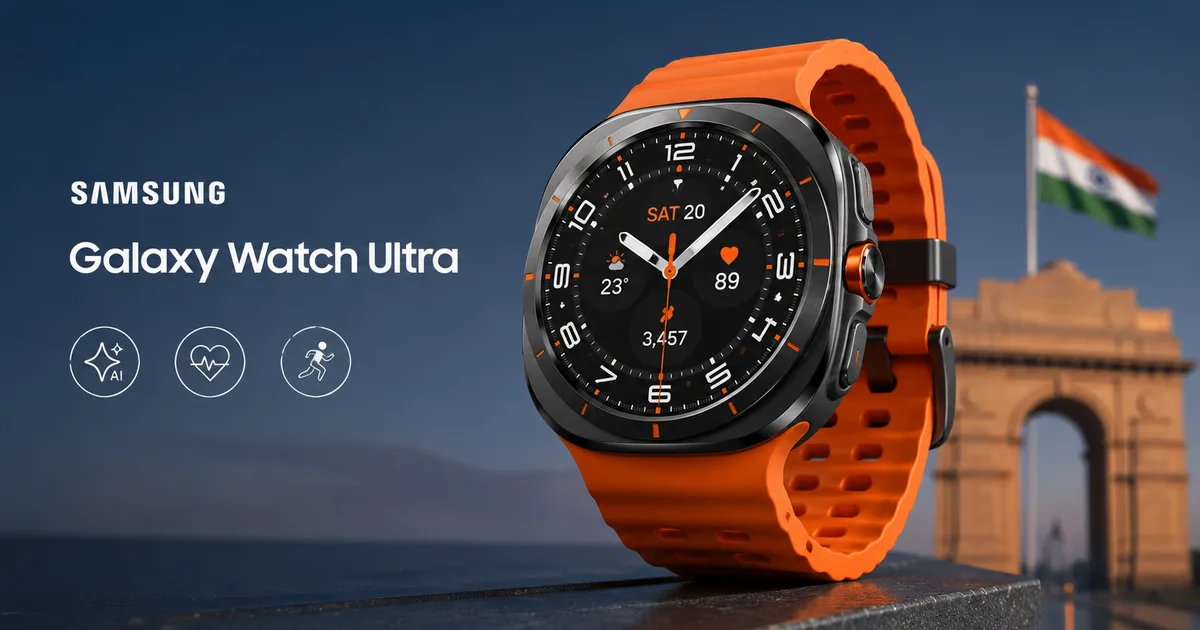
It has a massive 47mm dial. If you have thin wrists, this thing is going to look gigantic on you. There's simply no getting around it. But that massive size accommodates a significantly brighter display and a much larger battery. The case is made of Titanium Grade 4. This gives it a premium feel without making it feel like you have a brick tied to your arm. And yes, it looks very rugged. It has an almost industrial aesthetic that screams durability.
It's water-resistant up to 10ATM and carries an IP68 rating along with MIL-STD-810H military certification. That means you can swim with it and generally treat it terribly without breaking it. For the adventurous folks out there trekking in the Himalayas or just dealing with the waterlogged streets during Mumbai monsoons, this durability actually matters in the real world.
The display: brighter is always better
One of the biggest functional upgrades is the display brightness. When you're outdoors in the harsh Indian summer sun, reading a smartwatch screen is a mess. You end up cupping your hand over the watch just to see the time. But the Watch Ultra 2 pushes peak brightness up to 3000 nits. This makes it easily readable even at noon in Delhi. It's a small quality-of-life improvement that you'll notice every single day.
Under the hood: specs that actually matter
Smartwatches often suffer from micro-lags. You tap an app, wait a second, and then it opens. It's frustrating when you just want to quickly log a workout or check a message. Samsung is aggressively trying to fix this.
Both the Watch Ultra 2 and the Watch 9 are powered by a new 3nm processor based on the Snapdragon Wear Elite platform. This is a very big deal. Moving to a 3nm process means faster app launches and significantly better battery efficiency. It's exactly the engine this watch needed.
- Processor: 3nm chipset for faster performance and lower power draw.
- Storage: 32GB internal storage, which is plenty for offline Spotify playlists or podcasts.
- Connectivity: LTE comes standard on the Ultra model.
I've always found LTE on a watch to be a bit of a battery drain. But it's incredibly useful. Being able to leave your phone at home during a morning run and still get UPI payment notifications or emergency calls is freeing. You can easily link your eSIM via Jio or Airtel directly from the Galaxy Wearable app.
Software and Indian ecosystem integration
Hardware is only half the story. The Watch Ultra 2 runs on WearOS 5 with Samsung's One UI 6 Watch layered on top. It's smooth and highly customizable.
But what really matters for us is how it integrates with the Indian digital ecosystem. Samsung Pay (now Samsung Wallet) works flawlessly for tap-to-pay using NFC at local merchants. You can load your credit cards and pay without pulling out your phone. And getting OTPs for quick transactions directly on your wrist saves a lot of time.
If you're ever worried about digital fraud while using these features, check out our scams section to understand how to keep your connected devices secure.
AI fitness features: gimmick or game changer?
Everyone is slapping "AI" onto their products right now. It is easily the most overused tech buzzword of the year. So I was naturally skeptical about Samsung's "AI-powered health tracking" at first. But digging into it, there's some actual substance here. It isn't just marketing fluff.
The new BioActive sensor on the Watch Ultra 2 is significantly more precise. It passively tracks your heart rate and interprets the data using machine learning models. This gives you a more holistic view of your health.
The new energy score
This is probably the feature you'll use the most on a daily basis. It analyzes your sleep patterns and resting heart rate to give you a daily "Energy Score." Think of it as a readiness metric. If you slept poorly and had a heavy workout yesterday, your score is going to be low. It's basically the watch telling you to take it easy today and prioritize recovery. In my experience, it's surprisingly accurate and actually helpful for avoiding burnout.
Personalized workout routines and dual-frequency GPS
Instead of just tracking your run, the AI tries to understand your fitness level. If you always run a 5K at a specific pace, the watch will start suggesting personalized intervals to help you improve your stamina. It's like having a basic digital coach on your wrist. Is it going to replace a real personal trainer? No. But for the average person trying to get fit, it's a massive step up from basic distance tracking.
Then there is the dual-frequency GPS (L1+L5). This is a feature serious runners demand. In dense urban environments like Bangalore or Gurgaon with tall buildings, standard GPS often loses signal or draws a sketchy zigzag line. Dual-frequency GPS keeps your tracking perfectly accurate even in concrete jungles.
If you're serious about setting up your fitness tech properly, you might want to check our guides section on how to calibrate your health profiles. Bad data in means bad data out.
Sleep tracking enhancements and FDA authorizations
Samsung is usually pretty decent at sleep tracking. But the new AI algorithms supposedly detect signs of moderate to severe sleep apnea more accurately. The watch tracks your blood oxygen levels and skin temperature consistently overnight. It looks for drop-offs that indicate breathing interruptions.
"The integration of AI into wearables isn't about adding completely new, confusing features; it's about making the massive amount of data we already collect actually understandable and actionable for the average user."
Battery life: the real test
Here's my biggest gripe with most smartwatches. Charging them every single day is a massive pain. You forget once, and you have a dead piece of metal on your wrist. But the Watch Ultra 2 finally addresses this.
Samsung claims the Galaxy Watch Ultra 2 can last up to 100 hours in power-saving mode. That's over four days. Now realistically, with the always-on display and tracking a 45-minute workout every day, you're probably looking at around 48 to 60 hours. That is still a very solid two days of heavy use. You can go away for a weekend trip to Lonavala or Nandi Hills and not even pack the proprietary charger (which is a huge relief, honestly). That alone might be worth the upgrade for some people.
The regular Watch 9 also gets a battery bump thanks to the new chip. But it won't touch the endurance of the Ultra model.
Who should actually buy this?
Let's be totally real here. Not everyone needs a ₹70,000 smartwatch. If you just want to see your WhatsApp notifications or track your daily steps, get a cheap ₹3000 fitness band. We review plenty of those budget options in our explainers section.
So who is the Watch Ultra 2 actually for?
- Android users who want the "Ultra" experience. If you're deep in the Samsung ecosystem and have been secretly jealous of your iPhone friends with their chunky, indestructible Apple Watches, this is the exact device you've been waiting for.
- Serious outdoor enthusiasts. The multi-band GPS is incredibly accurate, which matters if you're hiking trails where cell service is non-existent. The battery life ensures it won't die halfway up the mountain.
- People who absolutely hate charging their watch daily. The two-to-three day battery life under normal use is a massive selling point.
If you fit into one of those categories, the Galaxy Watch Ultra 2 is easily the best premium smartwatch you can buy for an Android phone right now. It's expensive, yes. But for once it actually feels like you're getting a premium piece of hardware that matches the heavy price tag. The AI features are a nice bonus. They make the data easier to read. But the real star here is the exceptional battery life and the rugged, go-anywhere build quality. Just make sure you have the wrist size to pull it off before you drop 70 grand.