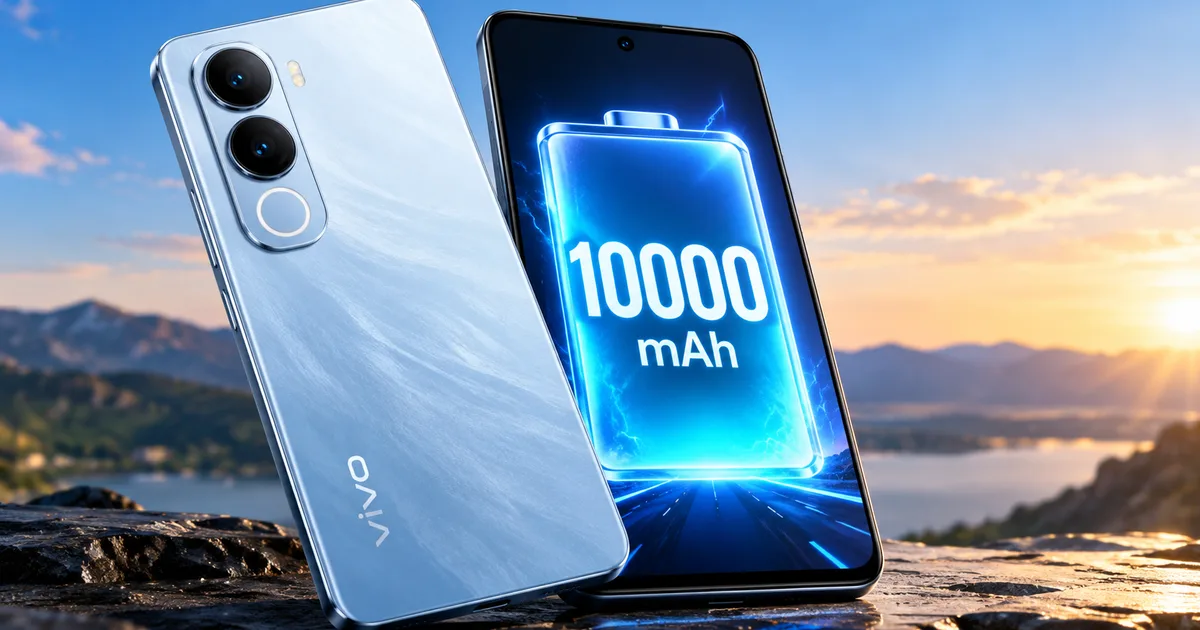
If you've ever had your phone die in the middle of scanning a QR code at a tea stall, you know the panic. It's awful. The rumored Vivo Y600 10000mAh battery phone is Vivo's direct answer to that daily Indian headache. Leaked regulatory certifications from China's 3C database and early supply chain filings suggest this budget powerhouse will land in India soon, and it has the largest battery ever seen on a mainstream slim smartphone.
Honestly, the smartphone battery race took a strange detour over the last five years. Brands kept chasing razor-thin designs while buyers bought bulky power banks and strapped them to their handsets with rubber bands. It was a mess. But things are shifting fast now. If you ask me, Vivo is ready to push battery life past the two-day mark without turning the phone into a heavy brick.
We've seen early whispers in Vivo V80 Lite battery rumors earlier this season. But the Y-series has always been the real sales driver across Indian retail shops from Jaipur to Vijayawada. And if these leaked specs hold true, the Y600 is going to raise the bar for sub-₹20,000 phones completely.
How silicon-carbon tech fits 10000mAh into your pocket
Whenever someone hears 'ten thousand milliampere-hours,' they picture those chunky rugged phones that look like army walkie-talkies. Those weighed 350 grams and ripped your trouser pockets. Crazy heavy. But the Y600 doesn't follow that old playbook at all.
Instead, leaks indicate Vivo has a silicon-carbon battery inside.
Thing is, standard lithium-ion cells rely on graphite anodes that hit a strict physical wall on energy density years ago. Silicon-carbon changes the game. It packs around triple the lithium ions into the exact same physical space. So phone makers can grow battery capacity by 40% to 50% without ballooning phone thickness or weight. Supply chain insiders say the Y600 is around 9.1mm thick and weighs roughly 220 grams (which is only slightly heavier than an iPhone Pro Max, but has double the battery capacity).
In my experience, 6000mAh just isn't enough anymore for long trips. I tested an older 6000mAh phone on a 24-hour train ride from Delhi to Patna last year, and with patchy cell towers draining power nonstop, it barely survived without a recharge. A 10000mAh tank changes the math completely. You can leave your charger at home for a weekend wedding trip and never worry about your screen brightness.
Fast charging speeds and managing Indian summer heat
Big batteries bring one obvious dread: charging time. Nobody wants to leave their phone plugged in for four hours while waiting to step out. It's painful.
Leaks confirm Vivo has paired this cell with 80W flash charging. On paper, that setup pushes the battery from flat to 50% in roughly 28 minutes, and it gets to a full 100% recharge in about 65 minutes. That's fast enough to plug in while you get ready in the morning, and you have enough juice for two solid working days.
Here's where Indian weather creates real headaches. Fast charging generates heat, and temperatures in cities like Nagpur or Ahmedabad routinely cross 42°C in peak summer (and that heat is no joke in May). Vivo has handled this with a dual-cell split architecture, alongside graphite cooling layers that spread thermal buildup across the rear panel. The numbers here are a bit fuzzy on real-world throttling under direct sun, but I think the physical cooling setup is capable enough.
The phone also has 10W reverse wired charging support. It's basically a pocket power bank. If your wireless earbuds run dry or your friend's iPhone runs out of juice during an evening out, an ordinary USB-C to USB-C cable turns the Y600 into an emergency battery pack.
Display, chipset, and everyday performance specs
To hit a competitive price point, Vivo had to make calculated hardware trade-offs. Naturally. You can't get a flagship processor alongside a massive battery at this price tier.
The leaked spec sheet outlines a sensible, balanced package:
- 6.78-inch Full HD+ AMOLED display with a 120Hz refresh rate and 1800 nits peak outdoor brightness
- MediaTek Dimensity 7300 octa-core processor built on a power-efficient 4nm process
- 8GB of LPDDR4X RAM with up to 256GB of internal storage
- Dual rear camera setup featuring a 50MP main sensor and a 2MP depth camera
- 16MP front selfie camera housed inside a centered punch-hole cutout
- IP64 dust and splash resistance rating for protection against sudden monsoon showers
- Funtouch OS 15 based on Android 15 out of the box
If you ask me, choosing the MediaTek Dimensity 7300 chip is a smart move. It isn't an extreme gaming engine for competitive esports titles. But it sips power gently during everyday tasks like WhatsApp video calls and quick UPI transactions. I'm not sure exactly why phone makers still skimp on dual speakers at this price, but the power efficiency here is undeniable. If you want to compare how other budget brands are handling battery optimization this year, check out our report on Moto G Max battery features.
Who this battery monster is actually built for
Look, tech enthusiasts often complain that budget phones don't have telephoto lenses or glass backs. But regular buyers have much simpler priorities. They just want their phone to last.
In my experience, delivery partners face the hardest battery grind in India, pulling twelve-hour shifts on Swiggy and Zomato, or grocery runs on Blinkit. Their phones run GPS navigation continuously and display customer orders under harsh afternoon sunlight. Most drivers carry two power banks strapped together with tape on their bike handlebars (annoying, I know). It's a genuine work tool, not a luxury.
The same logic applies to college students sharing hostel rooms with limited plug points, and travelers on state transport buses where seat sockets are sketchy or completely dead. Our team tracks these hardware shifts closely across latest tech news updates, and the trend is clear. Indian buyers are prioritizing raw utility over gimmicks.
For shoppers in the sub-₹15,000 segment, domestic contenders like the Mivi One 5G phone have also started offering bigger cells. That shows phone makers finally understand that battery anxiety is real.
Battery size without thermal efficiency is a hazard in tropical climates. The inclusion of silicon-carbon chemistry and bypass charging ensures the phone draws power directly from the wall during navigation, which protects the cell from premature degradation.
That bypass charging feature in the callout above deserves real attention. When you mount the phone on a motorcycle or car dashboard for GPS navigation, the device draws electricity straight from the charger to power the screen and processor. It bypasses the battery entirely. That stops the battery from heating up while discharging and charging at the same time.
Expected India price and official launch timeline
So what'll this cost in India? Retail leaks from domestic distribution channels suggest Vivo wants to dominate the offline market with this model.
The baseline 8GB RAM and 128GB storage configuration is tipped to arrive at a ₹15,999 starting price. A higher 256GB storage tier will likely sit around ₹17,999. And with standard bank discounts from SBI and HDFC, or cards from ICICI, launch day buyers could see the effective price drop right to ₹14,499.
As for timing, regulatory filings usually take six to eight weeks to clear local testing labs (which makes sense, actually). That's normal. Bureau of Indian Standards certification records typically surface just before festive or early-year launch windows. Distributors in Delhi point toward an official Indian unveiling in the first quarter of 2026. If you want to understand how battery certifications and local testing standards work, explore our detailed tech explainers for background.
Will the phone feel a bit chunky compared to slim fashion devices? Yes, inevitably. But for millions of Indians tired of scrambling for a charger before the workday ends, I think that's a trade-off worth making every single day.