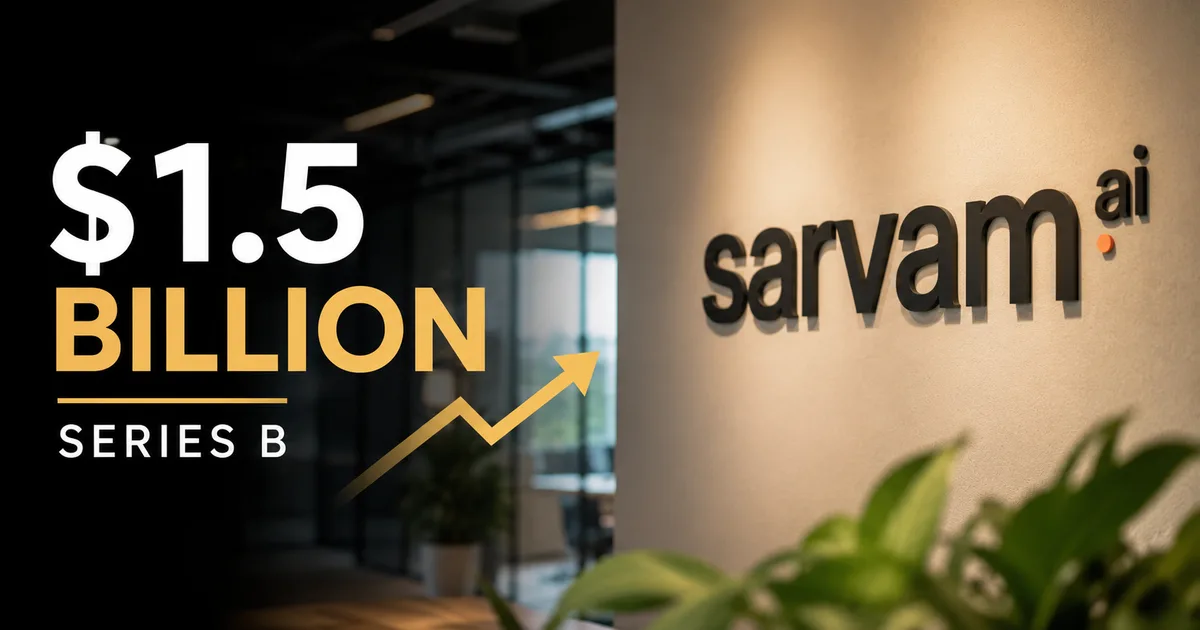
You've probably heard tech folks drone on about Silicon Valley AI models. But Bengaluru just saw something massive. Our very own Sarvam AI has officially joined the unicorn club. They just raised a cool $234 million in a Series B round led by IT giant HCLTech. This massive cash injection pushes the Sarvam AI valuation to $1.5 billion. It's a huge deal. Why? Because we're talking about building AI that actually speaks our languages, works on our budget, fits our needs, and runs on our terms. Honestly, I've been watching this space for a while, and I think this is the first time an Indian AI play has the actual financial muscle to back up its ambition.
Let's look at the numbers because they're wild.
Look, HCLTech didn't just throw spare change at this. They put down ₹1,427 crore for a 10.46% stake in the company. That's a serious bet. The funding round is the first close of a larger $300 million target, and Bessemer Venture Partners is also on board. Existing backers like Khosla Ventures and Peak XV Partners kept their skin in the game too. This isn't about vanity metrics, if you ask me. Sure, hitting unicorn status in three years is impressive, but they need the cash to pay for the massive computing power that trains these AI models. Without that capital, Indian startups can't compete with OpenAI or Google.
And the founders, Vivek Raghavan and Pratyush Kumar, aren't newcomers. You probably remember Raghavan from Aadhaar. He helped build our national identity program. These guys know how to build technology that actually works at a massive scale. So they started Sarvam AI in 2023 with a clear goal: build AI for India.
Why the massive HCLTech investment in Sarvam AI matters
If you've tried using ChatGPT or Claude in Hindi or Tamil, you know they're often terrible. They translate literally and feel stiff. That's because they're trained mostly on English text from the Western web. Sarvam AI is taking a different route. In my experience, they've already developed homegrown AI models trained in 22 Indian languages. These models don't just read and write; they work via voice commands. That's a game-changer. Think about a small shop owner in Bihar who doesn't write English but can talk to a phone in Bhojpuri to check GST filings. Or think of a student in rural Karnataka who learns coding through spoken Kannada. That's the real potential here.
But training these models is expensive. It costs millions of dollars just to rent GPUs to crunch data. That's why this partnership is so strategic. HCLTech has deep connections with global enterprise clients. They have the infrastructure too. By teaming up, I think Sarvam AI gets a lot more than just a bank transfer. They get a direct pipeline to companies that want to adopt AI. It's a smart path to commercial survival.
Building foundation models for the Indian market
Most Indian AI startups just build wrappers around OpenAI's API. That's a mess. They're basically selling someone else's tech with a different interface, and if OpenAI changes pricing or shuts down, these startups die. Sarvam AI is building foundation models from scratch. This means they own the underlying technology. In my experience, training models on Indian datasets helps the AI understand local contexts, languages, dialects, and cultural differences. It's much harder to do, but it's the only way to build long-term value.
And they're focusing heavily on voice.
The voice-first approach for everyday users
Why voice? Because writing on a small screen isn't natural for millions of Indians. A voice-first interface removes the literacy barrier. In a country where thousands of dialects exist, a tool that can understand spoken language and respond in the same tongue is incredibly powerful. I'm not sure exactly why other startups haven't copied this, but the government's Bhashini project shows how translation tech bridges gaps. Sarvam AI wants to take this further. They're creating models that can reason and complete tasks based on spoken instructions. Imagine paying your electricity bill or checking crop prices simply by talking to an AI assistant. This is what they're actively building today.
How the sovereign AI stack impacts Indian businesses
Let's talk about sovereignty. It's a word politicians love, but it has real business implications. Right now, almost all Indian AI data is processed on servers in North America or Europe. That's sketchy. If geopolitical tensions rise, or if foreign governments pass strict export controls on AI, Indian businesses could be left stranded. Building a sovereign AI stack means keeping our data and technology within our borders. It fits the government's DPDP Act.
Honestly, I think this is where the real value lies.
Reducing reliance on foreign cloud servers
When you use a foreign cloud provider, you're paying in US dollars. Money flows out of India with every single query. Rupee fluctuations mean these costs spike. By building a local AI stack, Sarvam AI helps Indian enterprises run workloads locally. It keeps money in the country and keeps costs predictable. Plus, it complies with local regulations that require sensitive financial and healthcare data to stay right here in India. The RBI is super strict about data localization, so this setup fits perfectly.
Cost benefits for small and medium enterprises
Small business owners in India don't have the budget for expensive SaaS subscriptions. If an AI tool costs $20 a month, that's roughly ₹1,700. That's a lot for a local shopkeeper. So Sarvam AI aims to offer voice-based AI services at a fraction of that cost. By optimizing their models to run on cheaper hardware, they're making tech accessible to businesses that were previously priced out. This helps local enterprises automate customer support and handle billing without larger staff costs.
What a $1.5 billion Sarvam AI unicorn means for the ecosystem
This funding round is a massive win for Sarvam AI. Beyond that, it sends a clear signal to the global tech community. Critics always claimed we only do call centers. But a $1.5 billion valuation for an AI startup that's barely three years old changes that story completely. It proves that Indian founders can raise serious capital for long-term research instead of just building another quick-delivery app or fintech clone.
Attracting global venture capital to Indian startups
Global investors are looking for the next big AI hub outside the US and China. India is the obvious candidate. We have a massive developer base and a huge digital audience. When Bessemer Venture Partners and Khosla Ventures invest hundreds of millions here, other funds pay attention. You'll likely see a wave of funding flow into other Indian AI startups that build specialized tools for healthcare and education. It's a cycle that could fund the next generation of Indian tech.
The path forward for Indian tech policy
But it's not all smooth sailing. The government is still figuring out how to regulate AI. We've seen draft guidelines from the Ministry of Electronics and Information Technology (MeitY) that suggest strict oversight on AI models before they launch. Protecting users from deepfakes is necessary, but regulations shouldn't choke startup innovation. Policymakers need to work closely with companies like Sarvam AI to create rules that protect citizens and support local startups.
What do you think about this?
Technology shouldn't just be imported; it must be built to solve local challenges.
The infrastructure challenge for Indian AI
Building AI requires both code and heavy hardware. But our startups face a massive lack of local data centers with high-end GPUs. Right now, you're renting power from US-based providers. This adds latency and increases costs. The government announced an IndiaAI Mission with a budget of ₹10,372 crore to set up local computing capacity, but these projects take time. Meanwhile, startups like Sarvam AI must navigate high rental costs. It's a bottleneck that could slow us down if we don't address it quickly.
We'll see how this plays out in the coming years.
How everyday users can prepare for AI tools
You don't need to be a developer to benefit from this shift. Tasks get simpler as voice-first AI tools become common. For instance, you can use these tools to translate legal documents and write business emails in multiple languages. If you run a small business, it's time to start exploring how basic AI assistants can handle repetitive queries. You don't want to get left behind when competitors start using them to speed up work. I think the main thing is to start experimenting early.
Three ways sovereign AI changes the game for India
This shift impacts several parts of our digital life:
- It makes digital services accessible to people who can't read or write English, thanks to voice interfaces in local dialects.
- It keeps sensitive financial and personal data safe within the country, complying with local regulations.
- It lowers the cost of tech tools for small businesses, helping them compete with larger corporations.
Building a $1.5 billion AI startup is a major milestone, but the hard work starts now. Sarvam AI has the funding and the partnerships, but they still have to deliver on their promise of voice-first, multilingual AI that actually works in real-world Indian conditions. We'll be watching how they deploy this capital. In the meantime, you can check out our AI guides and tech policy updates to stay ahead of these changes. If you want to know how local tech is built, read our sovereign technology guide.