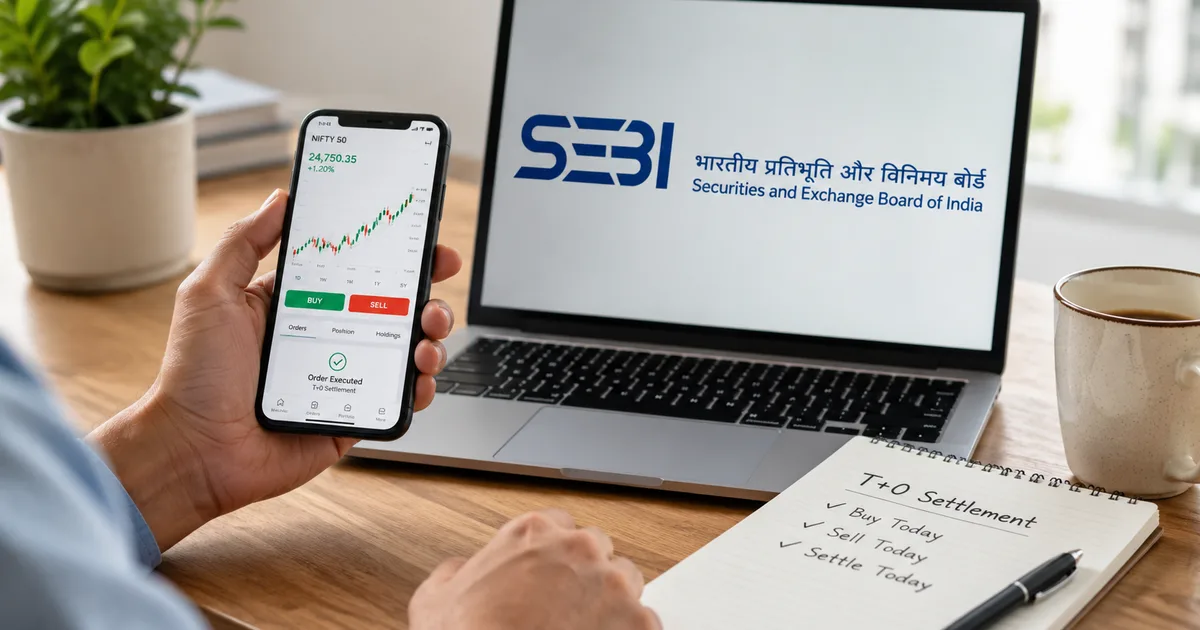
Imagine you sell your Infosys shares on a Tuesday morning. By Tuesday evening, the money is already back in your bank account. No waiting until Wednesday, no overnight anxiety about what might happen before the funds actually land. That's the promise behind T+0 settlement, and SEBI has been pushing toward it, though the road has been considerably bumpier than the regulator probably expected.
What settlement actually means in stock trading
When you buy or sell a stock on NSE or BSE, two things happen at different speeds. The trade itself (your order matching with someone else's) happens in milliseconds. But the actual transfer of money and shares? That's settlement. And it takes time.
Think of it like agreeing to buy a second-hand phone from someone on OLX. You shake hands on a price in two minutes. But the actual exchange of cash and phone happens the next day when you both meet. Stock settlement works the same way, except it runs through clearing corporations, depositories like CDSL and NSDL, and quite a bit of financial plumbing you never see (and honestly don't need to).
The "T+" notation just refers to the trade date. T+2 means settlement two business days after the trade. T+1 means the next day. T+0 means today, same day.
India's settlement journey: from T+3 to T+1
India once ran on T+3. You'd wait three business days for your proceeds after selling. SEBI pushed it to T+2 back in 2003, and that held for nearly two decades. Then came the shift to T+1 settlement, phased in and completed in January 2023.
That was genuinely significant. India became one of the very few major markets in the world on T+1 at the time, ahead of the US, which only completed its own T+1 transition in May 2024. European markets are still largely on T+2. So when people say Indian markets are technologically backward, they're not looking at settlement infrastructure. If you ask me, that point doesn't get made enough.
Naturally, the next question was: why stop at T+1?
SEBI's T+0 pilot — what it was and how it started
SEBI launched an optional T+0 settlement pilot in March 2024, starting with 25 stocks. The list included names like Reliance Industries, TCS, Infosys, HDFC Bank, Wipro, and a handful of other large-caps. The idea was to keep T+0 as an opt-in choice, so investors and brokers could pick between T+1 (the standard) and T+0 for eligible stocks.
Under the pilot, if you sold before a cutoff time (initially around 1:30 PM), you'd get your funds the same day. Buyers would get shares credited to their demat account the same day too. Both legs, money and shares, would settle before markets closed.
How the mechanics work
For T+0 to function, several things need to happen in compressed timeframes:
- You place a sell order before the cutoff time with a T+0-enabled broker
- The trade gets matched on the exchange in the T+0 segment
- The clearing corporation processes it intraday rather than batching it overnight
- Your broker's system confirms funds and pushes them to your bank account same day
- Shares are credited to the buyer's demat account — CDSL or NSDL — before end of day
None of this is trivial. Brokers need real-time margin systems and instant fund verification, plus the backend infrastructure to run two parallel settlement tracks at the same time. That's a significant technology ask. That's exactly why SEBI gave extended timelines to Qualified Stock Brokers (QSBs), the large brokers handling most of India's retail volumes. Moneycontrol and Business Standard both reported that SEBI extended these deadlines multiple times.
Why SEBI paused the broader T+0 rollout
Here's the honest part: T+0 hasn't taken off the way SEBI hoped.
BusinessLine reported that SEBI hit pause on the T+0 plan, citing muted demand and liquidity fears. And both those concerns are legitimate.
Liquidity was thin in the T+0 segment from the start. Because participation was optional and limited to select stocks, there weren't enough buyers and sellers choosing T+0 at the same time. When trading volume splits across two settlement windows (T+0 and T+1) for the same stock on the same day, price discovery gets distorted. You could see slightly different prices in T+0 trades versus T+1 trades for Reliance at 11 AM, which creates arbitrage noise and confuses retail investors.
Broker readiness was another issue. Even the larger ones kept asking for more time. Smaller brokers weren't remotely ready. And frankly, most retail investors (the crores of users on Zerodha, Groww, Angel One, Upstox) weren't demanding same-day settlement with any urgency. For someone doing a monthly SIP or holding stocks for years, whether money arrives Tuesday evening or Wednesday morning is irrelevant.
SEBI paused the wider T+0 rollout citing low uptake and operational readiness concerns at brokerages, even as India's T+1 system remains one of the fastest settlement cycles among major stock markets globally.
SEBI hasn't abandoned T+0 entirely. It's more a "when the ecosystem is ready" pause than a cancellation. But the timeline has stretched significantly from initial expectations.
Who actually benefits from T+0?
Honestly, it depends on what kind of market participant you are.
If you're a long-term equity investor doing SIPs into index funds or holding bluechips for years, T+0 does almost nothing for you. T+1 is already fast enough. The money arrives next morning and you're not in a hurry anyway.
If you're an active trader holding positions for days or trading frequently, faster settlement genuinely helps. You don't need to keep as large a cash buffer in your trading account. Sell in the morning, redeploy the funds the same afternoon. In theory, your capital efficiency improves.
For small investors managing tight liquidity (someone with ₹30,000 or ₹50,000 in their trading account), T+0 could make a real difference in how many opportunities they can act on. Right now, if you sell on Monday, your funds are available Tuesday. Miss a Tuesday opportunity? That's a T+1 limitation T+0 would fix.
The risks that come with faster settlement
Speed has a cost. Under T+0, you need funds or shares available before placing a trade, not just promised. Brokers can't extend the same kind of credit in a same-day settlement world. If your bank transfer hasn't cleared by the time you want to buy, your trade simply won't process in the T+0 window.
There's also a broader market risk: faster settlement can amplify volatility in stressed conditions. If large participants need to arrange funds within hours rather than overnight, it could force more selling during sharp market declines. I'm not sure exactly why more markets haven't engaged with this concern publicly, but it's part of why even the US, which just completed T+1, isn't rushing toward T+0. Check our explainers on how stock market infrastructure works if you want more background on how settlement affects day-to-day trading.
Where things stand in 2026
T+0 remains optional, limited in scope, and not something you'll encounter unless you specifically seek it out through a broker that supports it. Your regular trades on any major broker continue on T+1. Mutual fund investments, SIPs, all of that? Completely unaffected.
SEBI has a crowded regulatory agenda right now. The latest SEBI moves include reforms to IPO pricing and the ongoing F&O crackdown that hit exchange revenues hard in H1 FY2026, with re-listed stock pricing changes added on top of that. T+0 is one item among many, and not the most urgent one by any measure.
SEBI has also floated the idea of "instant settlement", sometimes called T+0 Phase 2, where trades settle within minutes rather than by end of day. That's even more ambitious. Almost certainly years away from becoming reality at scale.
The more practically useful thing for Indian investors right now is understanding how to manage your trading account and margins under T+1 and how SEBI's ASBA-UPI mandate for secondary market trading affects your funds. What settlement holidays mean for your available balance matters too. That's where the day-to-day impact actually is.
T+0 will arrive eventually. When it does become mainstream, your broker will walk you through it. For now, India's T+1 system is one of the most modern in the world, and that's genuinely worth acknowledging.