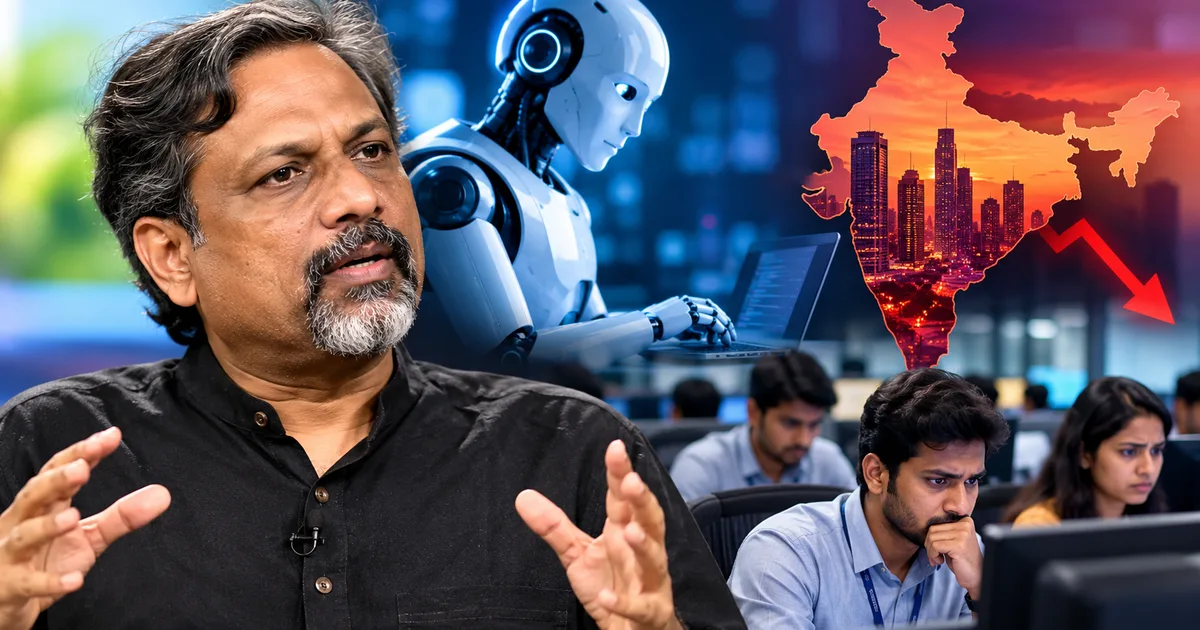
Picture a campus placement hall in Coimbatore or Pune this morning. A few years ago, recruiters from big outsourcing companies arrived in busloads, handing out ₹4 LPA offer letters to almost anyone who could write basic code. Today, those halls feel noticeably quieter. If you work at a software desk or have a child finishing an engineering degree, you've probably heard about the recent Sridhar Vembu AI warning. The Zoho founder stated plainly that one smart person using modern AI tools can now do the work of ten people. It sounds harsh, but coming from an entrepreneur who built a global software business out of rural Tamil Nadu without outside venture capital, people stopped to listen.
When someone running a company with tens of thousands of employees says that desktop jobs face massive upheaval, it hits differently than a marketing pitch from Silicon Valley. If you ask me, that's why everyone paid attention (and frankly, they should).
What Sridhar Vembu actually said about tech layoffs and AI
Most viral summaries missed the point. Sridhar Vembu didn't say that 90% of computer workers will permanently lose their livelihoods tomorrow. He didn't. What he pointed out is a sharp jump in individual output. When an engineer or copywriter uses generative tools effectively, their daily throughput multiplies. Fast. Tasks that once required an entire squad of junior associates now get finished before lunch by a single capable professional.
Thing is, this sudden productivity spike creates what Vembu calls a painful economic rebalancing. If one worker handles the load of ten, companies stop hiring at the same pace. We're already seeing this unfold across major IT hubs like Bengaluru and Hyderabad. The massive bench system, where thousands of freshers collected salaries while waiting for client projects, has quietly withered away (which makes sense, actually, given the overhead). Zoho itself took the unusual step of halting annual appraisal salary hikes in 2026 to avoid mass job cuts. Vembu even publicly apologised for the freeze. High compute costs for running proprietary models forced the firm to protect existing jobs rather than inflate operating expenses.
"Any job performed on the computer has this risk now: one smart person using AI can perform the work of 10 people."
If you ask me, that's an honest assessment of current corporate math. When cloud expenses rise and clients demand lower billing rates, something has to give. Zoho chose a temporary salary freeze to keep everyone employed, while several multinational firms took the axe directly to payroll.
The math behind the 1-to-10 productivity jump
How does one person replace ten? I tested this myself on a small automation pipeline that pulls invoice data into an accounting ledger. In 2021, building that required three people: a backend developer for API connections and a frontend programmer for the interface, plus a quality tester to find edge cases (and believe me, it was tedious back then). Last week, I wrote the entire specification into an AI code assistant. I had a functioning prototype in four hours flat. It wasn't flawless, but fixing the edge cases took another two hours. A project that once consumed 120 combined engineering hours wrapped up in an afternoon.
Here's what changes when software generation gets that fast:
- Writing routine boilerplate code stops being a marketable skill because code assistants produce it in seconds.
- Basic unit testing and bug fixing happen during prompt iteration rather than requiring dedicated manual testing teams.
- Drafting routine business emails, support replies, and client status reports requires minimal human review.
- Database query optimisation and script migration finish in minutes instead of several developer sprints.
When you look at those workflow steps together, the arithmetic becomes obvious. Companies don't need five freshers converting Jira tickets into basic Java classes anymore. They just don't. They need one experienced lead who understands the business problem and verifies what the machine produces. In my experience, that's the whole reality behind the AI productivity multiplier that Vembu highlighted.
Why the Indian IT sector feels the pinch first
India built its software dominance on labor arbitrage. Global banks and retail chains outsourced millions of maintenance tasks to Indian IT firms because doing the work in Chennai or Gurugram was cheaper than hiring in London or New York. The business model depended directly on headcount. If an IT vendor billed an American client $25 an hour for a junior developer and paid that developer ₹30,000 a month, the firm pocketed healthy margins. More billable heads meant higher quarterly revenues.
Generative AI breaks that revenue engine directly. When an enterprise client uses an AI platform to automate legacy code migration, they no longer sign contracts for a 50-person maintenance team. They ask for three senior architects instead. You can read our detailed breakdown of tech layoffs driven by AI to see how this shift started shaking vendor contracts earlier this year. The pressure on margins is intense.
And freshers are catching the brunt of it. Engineering colleges in Tamil Nadu and Karnataka, along with Maharashtra, produce over 1.5 million graduates each year. Historically, the top four IT service providers absorbed between 150,000 and 250,000 fresh graduates annually. In 2026, those numbers dropped by more than half (the campus hiring numbers here are a bit fuzzy, but the drop is unmistakable). Campus placement officers who once coordinated day-one mass recruitments now struggle to fill small interview slots.
Look, software demand didn't vanish. Rather, the whole process of assembling software changed from top to bottom.
Is the GenAI bubble masking a deeper economic reality?
Vembu also pointed out another uncomfortable truth: we're living through a massive technology expenditure bubble. Global tech giants spend billions of dollars building server farms packed with power-hungry chips. Those infrastructure investments must generate real cash returns eventually. Yet many businesses paying for these premium AI subscriptions struggle to see direct profits on their balance sheets, and a lot of the vendor promises sound sketchy when you dig into them.
So what happens when the financial hype cools down? Vembu argues that the price of software will collapse. When software becomes dirt cheap to build, an entirely new layer of the economy can suddenly afford digital services. Think about your local kirana distributor in Madurai, or a modest clinic in Patna. Or take a regional transport operator in Nashik. Today, they don't hire software developers because paying ₹6 LPA to ₹10 LPA for custom inventory tools makes zero financial sense. They stick to paper notebooks or simple WhatsApp messages.
If building custom software costs ₹10,000 instead of ₹5,00,00, those millions of small businesses become active technology buyers. That's the rebalancing Vembu expects. In my view, technology jobs will leave the traditional software export enclaves and spread into domestic Indian commerce. It won't happen overnight (annoying, I know). And the bridge between here and there will feel very bumpy.
We explore these systemic changes regularly in our in-depth tech explainers, where we track how local enterprises adapt as digital costs drop.
How Indian engineers and freshers should navigate this shift
Panicking helps nobody. Blaming college placement cells or cursing the technology won't change the trajectory either. I think the practical step is adjusting how you build your daily value.
If you're a student or a working professional worried about the future, here are realistic ways to position yourself today:
- Stop treating syntax memorisation as a superpower, because language models know every programming syntax better than any human.
- Learn system architecture, data flow design, and security protocols so you can evaluate whether AI-generated code is safe and scalable.
- Master domain knowledge in specific fields like Indian banking compliance, GST workflows, or logistics tracking where machines lack context.
- Get comfortable with modern AI tools and platforms to speed up your own work rather than competing against them.
- Build real working projects that solve local problems instead of cloning popular apps from tutorial videos.
Move from writing basic syntax to building complete systems
Back in 2018, you could secure a comfortable entry-level job simply by demonstrating that you could reverse a linked list or write clean SQL queries. That was enough. Today, an AI tool writes those in three seconds. Recruiters want engineers who understand how components interact under heavy user traffic. Can your application handle thousands of simultaneous UPI webhooks without dropping transactions? Can it store customer records safely according to national data guidelines using DigiLocker integrations? That kind of end-to-end system design is where human judgment is still necessary.
Honestly, the engineers who thrive right now aren't the ones fighting automation. They're the ones who act as project directors, orchestrating AI tools to deliver complete software solutions in days rather than months.
Look at Indian businesses beyond the traditional IT corridors
For twenty years, the standard career dream was landing a job in an air-conditioned glass tower in Whitefield or HITEC City. That path is shrinking, but domestic demand across tier-2 and tier-3 India is picking up steam. Small manufacturing units, state cooperatives, rural hospitals, and regional retail chains need digital systems tailored to their operational needs. You can learn more about this in our analysis of the Indian tech job market.
Working for a local manufacturing firm in Coimbatore to digitise their supply chain might not sound as glamorous as working for an overseas bank. But the business problems are real. The job stability is often higher, too, because your work directly shapes the physical economy around you (which is plenty satisfying in its own right). As Vembu demonstrated with Zoho's rural offices in Tenkasi, building world-class technology doesn't require sitting in expensive metropolitan hubs.
Basically, the adjustment will take time. There will be tough quarters ahead for IT services, and fresher hiring will remain subdued while the industry recalibrates. But learning to direct AI rather than doing repetitive manual coding is the clearest route forward for every Indian developer.