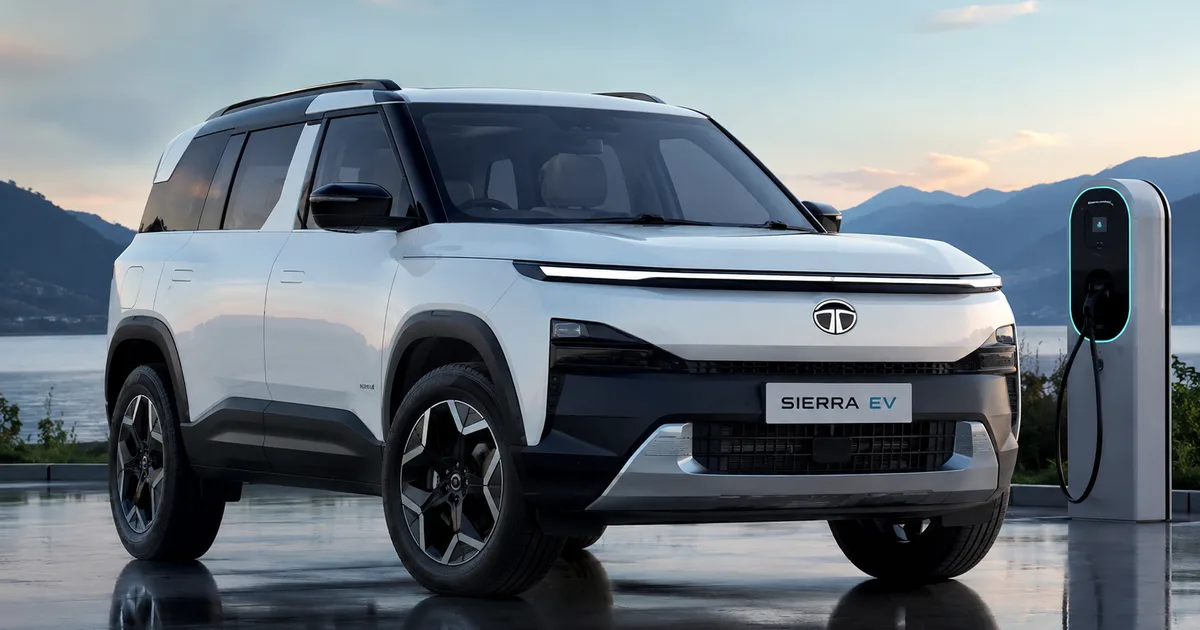
If you want a nostalgia trip with a modern electric twist, you're probably waiting for the Tata Sierra EV. I remember the original Tata Sierra from the 90s. It was a bold, three-door beast with massive alpine glass windows at the back. It was way ahead of its time, and honestly, most Indians weren't ready for it. Now, Tata Motors is bringing it back as a premium electric SUV, and they just dropped a teaser confirming a dual-motor all-wheel-drive system.
I think the timing is pretty interesting. Today is June 28, 2026, and Tata Motors is scheduled to debut this vehicle in just two days on June 30. We've pieced together all the official teasers, transport department filings, leaks, and media reports to give you a clear picture of what's coming. Want to know how other new electric models are doing? Check out our section on latest EV news.
Tata Sierra EV launch date and what to expect on June 30
So, when can you actually buy one? CarWale reports that Tata Motors plans a commercial release in the first quarter of the 2027 fiscal year. If you're not used to corporate speak, that basically means the car goes on sale between April and June of 2026. This timeline makes perfect sense with the June 30, 2026 debut.
Here's how Tata Motors usually handles these things. First, they show the near-production version. Then they take media reviews and open bookings a few weeks before the actual price announcement. In my experience, this rollout can feel pretty slow. If you want to stay updated on other upcoming electric vehicle releases, check out our EV buying guides.
But this isn't a concept car anymore. This is the real deal. The model debuting this week is the exact same one you'll see driving on Indian roads, which means we aren't looking at some futuristic fantasy vehicle that will never see the light of day. It's a big step for Tata. So why is there a gap between the June debut and delivery? Honestly, Tata Motors needs time to ramp up production at their Sanand plant, and they also have to clear their backlog of Nexon EV and Punch EV orders before they can even think about shipping the Sierra. If you book early, you might get your keys by Diwali 2026. Normal buyers will wait until early 2027. It's frustrating (annoying, I know), but that's just how Indian car launches work.
Expected Tata Sierra EV price in India
Buying an electric car in India is still a big financial decision. Let's talk money. We expect the starting price for the base variant to be around Rs. 20 lakh, but if you want the top-tier trims with dual motors, you'll probably have to shell out up to Rs. 25 lakh. In my experience, that sits right above the Nexon EV and below the upcoming Harrier EV.
Let's look at the numbers. At Rs. 20 lakh, it sits in a sweet spot. It's more expensive than a top-end Creta, but the low running costs are the main draw here. If you drive 50 kilometers daily, you'll save around Rs. 8,000 every month on fuel. Over five years, that's Rs. 4.8 lakh back in your pocket. Honestly, that's a real saving that makes the upfront cost way easier to swallow.
This pricing makes sense. Look, Tata Motors wants to go head-to-head with mid-size electric SUVs. The Mahindra BE 6 is a key rival, and it's expected to target a similar price bracket. If you want to understand how electric car financing works in India, check our EV buying guides for a full breakdown.
Honestly, Rs. 25 lakh is a lot of money for a Tata car. But the Sierra is a premium product. It's aimed way higher than your usual budget commuter. If they want people to spend that much, the build quality has to be top-notch.
AWD range: dual motors and distance
Let's look at the powertrain. The big news from the latest teaser is that they're including an all-wheel-drive system. I've seen some online discussions referring to this as the QWD range, which is just a common typo for AWD or quad-wheel drive, but what Tata Motors actually confirmed is a dual-motor setup. This AWD range is what everyone is talking about.
What does this mean for your daily drive?
- Better traction on wet roads during the monsoon.
- Quicker acceleration from a standstill.
- Stable handling around sharp corners.
- Mild off-road capability for weekend trips.
Think of it like having two people pulling a cart instead of one. It's smoother and more stable. But there's a catch. Dual motors consume more battery power. CarLelo reports that the single-motor variants should deliver a range of around 550 kilometers on a single charge. The dual-motor AWD variant will likely see that number drop closer to 500 kilometers.
These numbers are based on the modified Indian driving cycle. But in the real world, expect around 400 to 420 kilometers. Honestly, that's still enough to drive from Mumbai to Pune and back (a classic road trip route, actually) without stopping to charge. And that's the real test for any Indian EV. Can it handle the highway? With a real-world range of 400 kilometers, the answer is yes. You can comfortably plan weekend trips without worrying about running out of juice.
How AWD works in an EV: a simple analogy
If you've ever ridden a bicycle, you know that only the rear wheel drives you forward. Hit a patch of loose sand, and the rear wheel spins, making you lose control. That's how standard front-wheel-drive or rear-wheel-drive cars work. But in an electric vehicle with AWD, you get two separate motors. One handles the front, the other the back. They aren't connected by any heavy steel shaft. A computer monitors all four wheels in real-time. If it senses one wheel slipping on a wet road, it instantly routes power to the other wheels. It's like having two runners carrying you instead of one. If one trips, the other keeps you moving.
Under the hood: battery and platform
The vehicle uses the Acti.ev platform. It's the same setup that underpins the Punch EV, just scaled up for a larger car. I think building an EV on a dedicated platform makes a massive difference, unlike older electric cars that were just converted petrol models. The battery pack is flat and sits right under the floor. This lowers the center of gravity to help the car handle better around corners, and it frees up a ton of cabin space.
We expect Tata Motors to offer two battery sizes:
- A 50 kWh pack for the entry-level variants.
- A 60 kWh pack for the long-range and AWD variants.
You'll get DC fast charging support up to 80 kW. Plug it into a public fast charger and you'll go from 10% to 80% in about 45 minutes. For home charging, a 7.2 kW AC wall box charger takes around eight to nine hours for a full charge. Want to learn more about how EV charging works at home? Read our tech explainers.
Battery cooling and the Indian summer
One big concern for Indian EV buyers is how the battery handles our extreme heat because high temperatures can degrade lithium-ion batteries pretty quickly. To prevent this, the Acti.ev platform uses liquid cooling. Instead of just blowing air over the cells, a cooling liquid circulates through channels in the battery pack. This liquid absorbs heat and keeps the battery at its optimal temperature, even when it's 45 degrees Celsius outside in Delhi (which is basically every summer afternoon).
This system is important because fast charging also generates a lot of heat. Without proper cooling, charging speeds will crash to protect the battery. So, this liquid cooling system makes sure your fast charging times stay consistent all year.
Finding a charger on Indian highways
Having a 500-kilometer range is great, but you'll eventually need to charge. The good news? India's highway charging network is expanding fast. Tata Power, BPCL, Jio-bp, and other firms are installing fast chargers along major national highways. You can find them using apps like Tata EV Charge or PlugShare. Many chargers sit right next to highway dhabas and food plazas. By the time you finish your lunch and have a cup of tea, your Sierra EV will be charged and ready to go. The car also has vehicle-to-load technology. This means you can use the car battery to power external appliances, like a laptop or a camping light, directly from the charging port.
Inside the cabin: alpine windows and lounge seating
The design is where the nostalgia comes in. Tata Motors has kept the signature alpine glass roof from the original 90s model. The rear seats are designed like a lounge, with a curved bench that lets passengers turn slightly toward each other. It's more like a living room than a car backseat. Personally, I love this setup. You also get a 12.3-inch touchscreen system, a fully digital instrument cluster, wireless charging, and level two advanced driver assistance systems.
According to Autocar India, the Sierra EV is expected to share battery and motor specifications with the upcoming Harrier EV, making production more cost-effective for Tata Motors.
Part sharing is how Tata Motors keeps prices low. You get the premium feel of a larger car at a lower price point. But honestly, Tata needs to step up their quality control game. We've seen plenty of early Nexon EV owners taking to social media to complain about software glitches and other gremlins. With the Sierra EV moving into the Rs. 25 lakh bracket, buyers will expect a fuss-free experience. If you've been scammed by fake online booking portals, check our scam alerts.
Comparing the Sierra EV with the Mahindra BE 6
The Mahindra BE 6 is the closest competitor. Both cars are aiming for the exact same buyers. Mahindra is building its electric cars on the INGLO platform, which uses components from Volkswagen. They're going all-in on a futuristic design. The Sierra EV, on the other hand, is playing the nostalgia card while offering plenty of practical space.
Here is how they compare based on current data:
- Tata Sierra EV has a boxy design with a focus on cabin space and rear-seat comfort.
- Mahindra BE 6 is a coupe-style SUV with a sloping roofline and a driver-focused cabin.
- Both offer battery options around 60 kWh and real-world ranges of about 400 kilometers.
Ultimately, the choice comes down to what kind of design you prefer. If you like the classic, blocky SUV look, the Sierra is the obvious choice. But if you want something modern and sporty, the Mahindra BE 6 will probably appeal more. For a broader look at electric car platforms, check out our tech explainers.
Final thoughts on what we know
We'll get all the official specs on June 30, 2026. For now, the Sierra EV looks like a solid entry in the Indian market. It brings back a classic nameplate without relying solely on nostalgia. And including AWD shows that Tata Motors is ready to offer premium features to fight Mahindra.
Honestly, the car's success is going to depend on how Tata handles the software and fit-and-finish. Buyers spending Rs. 20-25 lakh won't tolerate stupid little issues. We'll know a lot more once we see the car in person on June 30.