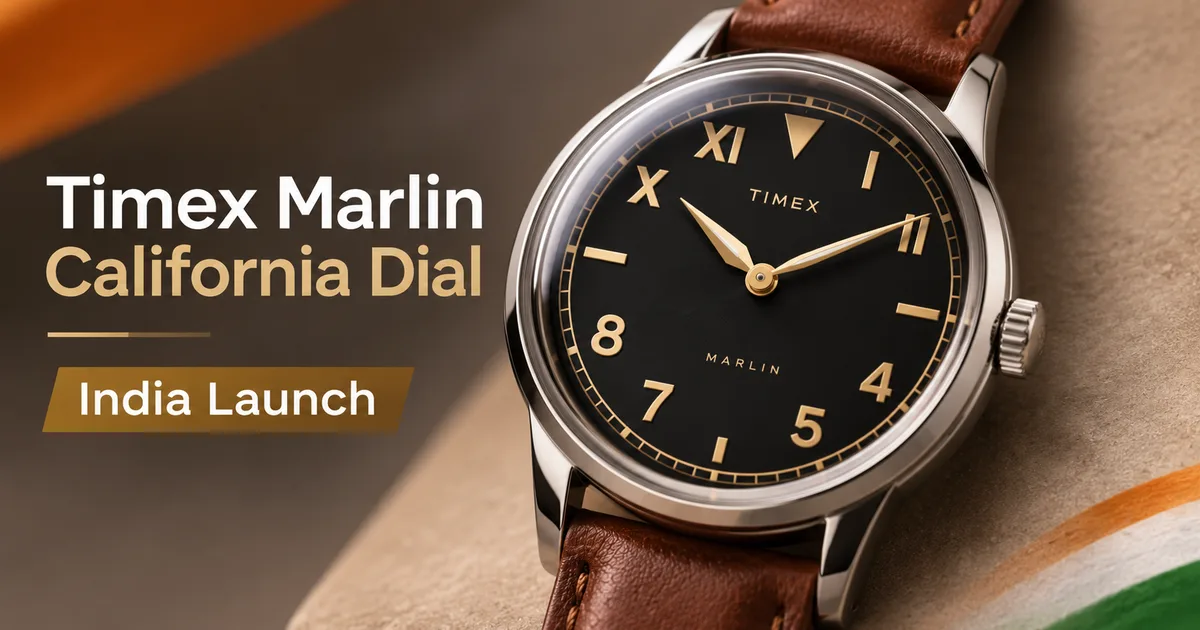
If you've been keeping an eye on vintage horology, the official Timex Marlin California dial watch India launch has finally arrived with an estimated retail price of roughly ₹28,000. It's a quirky watch. But whether it deserves a chunk of your monthly salary is another story entirely.
Timex turned heads back in 2017 when they brought back the Marlin as a 34mm hand-wound dress watch straight out of the 1960s. Watch lovers went wild for it. Affordable mechanical watches had practically vanished from Indian store shelves, so it filled a real void. Then Timex decided to expand the catalog with modern automatics and this odd split-numeral dial. Now that Livemint reports Indian availability at roughly ₹28,000, collectors are arguing over whether Timex priced it too high or built a stellar conversation starter.
I spent the past week looking closely at the hardware and the local Indian pricing context to figure out what you're actually getting. If you ask me, there's plenty to like here if you're bored of blank smart screens and want a machine ticking on your arm. Still, you've got to weigh a couple of compromises before tapping in your UPI PIN at checkout.
What is a California dial and why does it look split?
The first time you look at a California dial, your brain hesitates for a second. It looks mismatched. The top half uses Roman numerals from 10 to 2, while the bottom half uses regular Arabic numbers from 4 to 8. Horizontal dash markers sit at 3 and 9, a matching bar anchors 6, and an inverted triangle sits at 12 o'clock.
Why put two completely different numbering systems on one watch? Look, it wasn't a fashion statement.
Back in the 1930s and 1940s, combat divers needed to check their wrists in murky water or pitch darkness and immediately know which way was up. Getting orientation wrong during a night operation could get someone killed. So Rolex patented this high-contrast dial layout to eliminate confusion. They called it the "error-proof" dial.
"Initially created and patented by Rolex, this type of dial was designed for easy readability by having the upper half of the dial marked with Roman numerals, and the lower half in Arabic numerals," explains Matthew Catellier, founder of WatchReviewBlog.
So how did California get into the name? During the vintage watch boom of the 1970s and 1980s, a dial restoration business based in Los Angeles started repainting old dials with this split configuration. Italian dealers fell hard for the look. I'm not sure why they focused on the state instead of the city, but they began asking for California dials on every order. The nickname stuck across the collector world. Today, brands from Panerai to Nomos produce their own interpretations.
Timex took that historic aesthetic and brought it down to a price bracket where regular working people can buy one. Honestly, seeing a heritage layout like this in an accessible watch is refreshing. Most watches sitting under glass counters in Indian malls are cookie-cutter minimalist clones anyway.
Timex Marlin California dial specs and build quality
The build quality follows the classic Marlin blueprint, though the proportions are sized for daily wear instead of a display case. The stainless steel case has a clean mirror finish, paired with an exhibition caseback that shows off the rotor inside.
Case profile and wrist comfort
On paper, the case measures 40mm across with a 48mm lug-to-lug span. In my experience, that's right in the sweet spot for average Indian wrists, which typically sit between 6.5 and 7.25 inches. It slips under a buttoned office cuff without snagging. It stays planted.
Total thickness is around 13mm. Now, that sounds chunky for a dress piece, but most of that height comes from the tall bubble crystal rather than the steel case itself. The case sides are fairly slim, so it wears much thinner than the spec sheet indicates.
Crystal, dial finishing, and strap details
Timex made a deliberate retro choice that will divide buyers: the front has a domed acrylic crystal instead of modern scratch-resistant sapphire glass. Acrylic gives you that unmistakable warm optical distortion when you tilt your arm. The hour markers curve softly around the edges. It looks fantastic under warm room lamps.
Thing is, acrylic scratches easily. Brush against an aluminum office door handle or bump a metal metro railing during your morning commute, and you'll leave a mark (annoying, I know). Luckily, fixing it is simple: a ₹400 tube of Polywatch paste and a microfiber cloth will buff out light scuffs in three minutes.
The core specifications break down like this:
- Case diameter measures 40mm with a polished stainless steel finish
- Domed acrylic crystal provides vintage edge distortion
- Lug width sits at 20mm with quick-release spring bars
- Water resistance rating is 30 meters or 3 ATM
- Exhibition caseback displays the mechanical rotor and balance spring
- Dial features alternating Roman and Arabic indices with luminous hands
- Strap is genuine leather with crocodile pattern embossing and steel pin buckle
The dial finish itself is crisp. The printed numerals have sharp borders, while the leaf hands carry just enough lume to give you basic visibility after stepping inside from the afternoon sun. The leather strap has crocodile pattern embossing. It feels stiff on day one, but a week of daily sweat and body heat softens it up nicely.
Movement performance and everyday mechanical accuracy
Under that retro face sits an automatic mechanical movement with self-winding and hand-winding support. Timex doesn't publish the exact caliber name on the box, but teardowns show these Marlins run on proven movements based on Miyota or Sea-gull designs. That balance wheel ticks at 21,600 vibrations per hour. You get a gentle six-beat sweep of the seconds hand rather than the sudden jump of quartz.
If you've only worn quartz watches or smart bands, hearing an escapement tick is hypnotic. Hold the case against your ear in a quiet bedroom and you'll hear the tiny heartbeat right away. There's no battery inside. None.
Winding feel and power reserve
The power reserve runs around 40 hours on a full wind. Practically speaking, if you wear the watch through your Friday workday and take it off at 7 PM, it'll keep running until Sunday noon. Leave it sitting on your desk all weekend and it'll stop dead. Come Monday morning, you'll need to reset the hands and give the crown twenty turns (which, if you ask me, is part of the fun of owning mechanical gear).
How accurate is it? You can expect it to run within roughly -20 to +40 seconds a day out of the box. That's completely normal for an entry-level mechanical caliber. It won't match the pinpoint accuracy of your phone clock or a cheap Casio. You buy a mechanical watch for the physical gearing on your wrist, not to time satellite launches.
Timex Marlin price in India and market competition
At roughly ₹28,000, Timex is stepping right into India's most contested enthusiast bracket. In Western markets, this model sells for around $250. The exact import breakdown is a bit fuzzy, but once you factor in basic customs duty and our 18% GST slab, that ₹28,000 retail price makes practical sense. You can find it on Timex India's official web store and through horology retailers like Ethos.
Most Indian e-commerce platforms offer standard financing like no-cost credit card EMIs and instant UPI checkout. But before you pull the trigger, take a look at what else that ₹28,000 budget can get you in India.
The competition is brutal.
- The Seiko 5 Sports series retails between ₹22,000 and ₹27,000, offering 100 meters of water resistance, a robust in-house 4R36 movement, Hardlex crystal, and a day-date complication.
- The Citizen Tsuyosa sells for around ₹28,000 to ₹31,000, packing a scratch-proof sapphire crystal, an integrated solid-link steel bracelet, and an automatic Miyota caliber with a clean date magnifier.
- Homegrown Titan offers several automatic dress models in their Maritime and Edge collections between ₹14,000 and ₹22,000, backed by a service center in almost every tier-two Indian city.
- Meanwhile, buyers chasing pure digital utility often gravitate toward wearable tech like the Samsung Galaxy Watch Ultra specs to track workouts, monitor sleep, and handle incoming calls on the go.
And that's the real dilemma. If you judge this watch purely on objective specs per rupee, the Citizen Tsuyosa wins on crystal durability, while Seiko takes the lead on water resistance. But neither of those Japanese giants has a California dial. That split dial gives the Timex an eccentric personality those mainstream choices just can't match.
Just like audio enthusiasts who seek out specialized wired gear such as the Sony IER-M500 in-ear monitors instead of common wireless earbuds, mechanical watch buyers choose timepieces based on tactile enjoyment rather than raw benchmark numbers. You can keep up with the latest Indian tech news and browse our practical gadget buying guides to see how analog gear continues to hold its ground against glowing screens.
Should you spend ₹28,000 on this watch?
Honestly, the Timex Marlin California dial watch isn't for everyone. If you need a single watch to survive wet monsoon motorcycle commutes or sweaty gym sessions, don't buy this. The 30-meter water resistance rating means it can't handle a swim. That acrylic dome picks up scuffs fast if you're careless with it.
Buy it if you appreciate vintage character and want something genuinely unusual on your arm. It looks great with formal office shirts. People notice it. You get genuine mechanical charm without spending six-figure Swiss money. In my book, that's enough to earn a spot in your weekly rotation.