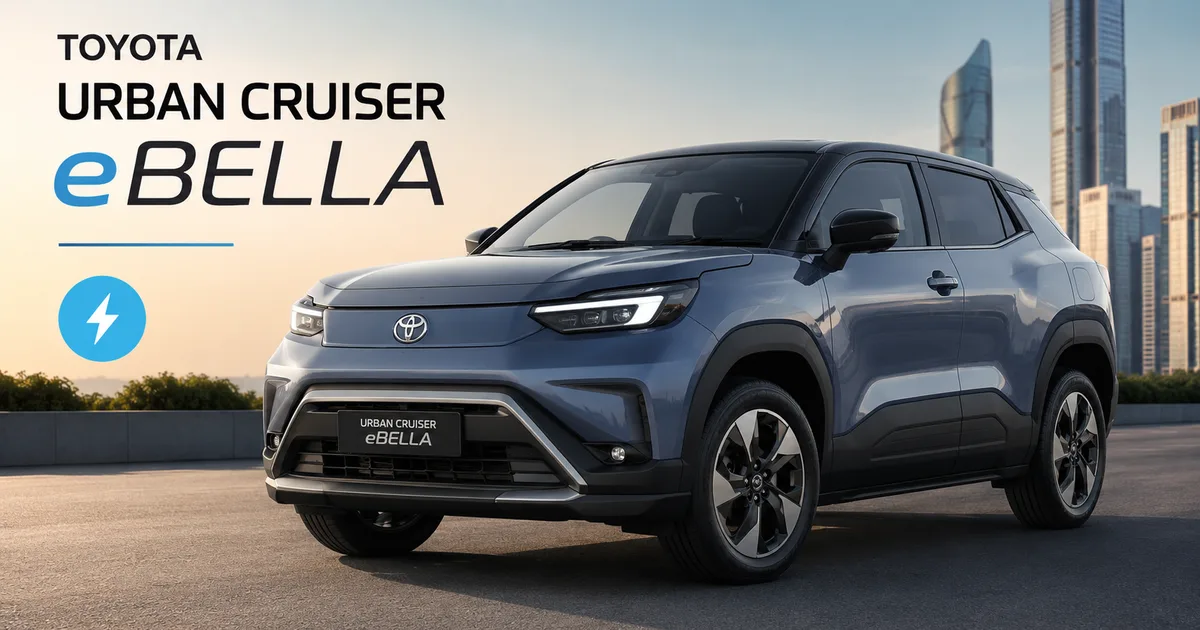
India's electric SUV market just got a serious new contender. Toyota Kirloskar Motor officially launched the Urban Cruiser eBella in India with the top-spec E3 variant priced at Rs 23.60 lakh (ex-showroom). Bookings have been open since January 20, 2026, the same day Toyota unveiled it at a Mumbai event. Dealer stock arrivals are now expected from mid-June 2026. So if you've been watching this one quietly for months, the waiting is almost done.
The eBella had a strange trajectory, honestly. Toyota opened bookings in January 2026, but the formal pricing took another four months to arrive. That gap was genuinely frustrating for early bookers who had committed money without knowing what the lower variants would cost. Things are clearer now. This is Toyota's first real mass-market electric SUV for India, aimed directly at the Hyundai Creta Electric, Tata Curvv.ev, and Maruti Suzuki e Vitara.
Variants and pricing: what's confirmed
At launch, Toyota confirmed the price for one variant only: the E3 at Rs 23.60 lakh ex-showroom. That's the top-spec trim with a 61kWh battery pack. Prices for the E1 and E2 weren't announced at the same time (annoying, I know), so expect those to follow shortly. Based on where competitors sit, the lower trims will likely land somewhere in the Rs 18-22 lakh range. That's my speculation, not confirmed pricing, so don't make the E1 vs E3 call until the full lineup numbers are out.
There's also a BaaS option worth knowing about. BaaS is Battery as a Service. You buy the car without the battery pack in the upfront price, then pay a monthly lease fee for the battery. Toyota has revealed its BaaS pricing structure separately, though monthly rates weren't widely confirmed in launch-day coverage. The idea is to cut the sticker shock upfront, shifting some cost to a recurring payment. MG has offered something similar in India with the ZS EV. Whether this makes financial sense depends entirely on how long you plan to own the car. Ask your dealer to walk you through the numbers.
For context, here's where the competition currently sits on pricing:
- Hyundai Creta Electric: Rs 17.99 lakh to Rs 23.50 lakh
- Tata Curvv.ev: Rs 17.49 lakh to Rs 21.99 lakh
- MG ZS EV: Rs 18.98 lakh upwards (approx)
- Mahindra BE 6: Rs 18.90 lakh onwards
- Maruti Suzuki e Vitara: pricing announced separately, expected lower than eBella
At Rs 23.60 lakh for the E3, Toyota is asking a small premium over most rivals' top trims. That premium is basically for the Toyota badge and what comes with it. More on that below.
The 543 km range claim: impressive on paper, real in practice
Toyota is claiming 543 km of range from the 61kWh battery pack. That's one of the highest claimed figures in the mid-size electric SUV segment right now. The Creta Electric's long-range variant claims 473 km. The Curvv.ev long-range claims 502 km. So on paper the eBella is ahead.
But treat these as ceiling numbers, not real-world ones. In Indian conditions, AC running hard through a 42-degree Delhi summer, traffic crawling on Hosur Road or the Pune-Mumbai expressway during peak hours, the practical range is going to be lower. Most Indian EV owners report getting 70-80% of claimed range in daily mixed driving. That puts the eBella's real-world range at around 380-430 km, which is genuinely solid. You're not going to run out of charge on your daily commute. Even a Mumbai to Pune trip starts becoming feasible without a mandatory charging stop.
Full charging specs weren't confirmed in detail at launch, but DC fast charging support is expected given the platform. For home charging, a 7.2kW AC wallbox (budget around Rs 15,000-25,000 for supply and installation) will get you a full charge overnight. If you live in an apartment, start the society approval conversation now. It takes longer than you'd expect.
Features: what the E3 actually includes
Level-2 ADAS is the headline feature and, if you ask me, one of the more useful things Toyota has packed in at this price. Level-2 means the car can help with steering, acceleration, and braking at the same time within defined conditions. You get adaptive cruise control, automatic emergency braking, lane-keep assist, and blind-spot monitoring as a package. Some rivals offer parts of this now, but a full Level-2 suite under Rs 25 lakh is still notable.
Beyond ADAS, the E3 comes with:
- Panoramic sunroof
- 360-degree surround-view camera
- Ventilated front seats
- Wireless Android Auto and Apple CarPlay
- Wireless phone charging pad
- Connected car tech with over-the-air software updates
- Multiple driving modes including Eco, Normal, and Sport
Early feedback on the interior design has been generally positive. Toyota has kept the cabin clean and modern without making it feel cold. That said, I'd strongly recommend a physical walkaround at a showroom before committing. Press photos are always flattering and cabin feel is personal. The Creta Electric is still the benchmark for interior finish quality at this price in India, and seeing how the eBella stacks up in person actually matters.
The Toyota-Suzuki platform: what it means for you
The eBella is built on the same platform as the Maruti Suzuki e Vitara. Toyota and Suzuki have a technology-sharing tie-up in India that has already produced badge-twin pairs like the Urban Cruiser petrol and Vitara Brezza, and the Glanza and Baleno. The eBella and e Vitara are the EV version of that same arrangement. Same basic architecture, same battery, different design, different badge, different dealership network.
In practice, this is good news for long-term ownership. Parts availability and service familiarity should improve over time as both networks learn the platform. But Toyota will price the eBella above the e Vitara for equivalent configurations, and Toyota's service pricing is typically higher than Maruti's. If you're choosing between the two and brand loyalty isn't a factor, the e Vitara will likely offer better value per rupee. The eBella wins on Toyota's service reputation and, arguably, resale value.
How to book right now: a step-by-step guide
Bookings opened on January 20, 2026, and are still open. Here's how to proceed:
- Visit toyotabharat.com or walk into your nearest Toyota dealership
- Confirm the booking amount (typically Rs 25,000 for Toyota models, but verify with your dealer)
- Decide upfront whether you want standard ownership or the BaaS battery lease model
- Ask your dealer about the waiting period for your preferred variant. E3 bookings from January will have a queue ahead of yours
- Check your state's EV subsidy before signing anything
- Arrange your home charging setup in parallel so you're ready when the car arrives
On subsidies: states like Delhi, Maharashtra, Tamil Nadu, and Gujarat have active EV purchase incentives that can cut effective cost by Rs 10,000 to Rs 1.5 lakh depending on the state and vehicle category. The central FAME scheme status also affects pricing. Your dealer should tell you exactly what's applicable, but come prepared with questions. Our state-wise EV incentive guide has current figures if you want to check before visiting.
One thing first-time EV buyers often miss: the home charger timeline. Contact a certified EV charger installer before you take delivery, get a quote, and if you're in an apartment, start the housing society approval process immediately. Some societies take weeks. Some take longer. You don't want to take delivery of your new electric SUV and then wait another month to charge it properly at home.
Who should actually buy the eBella
Honest take: the eBella at Rs 23.60 lakh for the E3 is a credible offering in a crowded segment. The range claim is one of the best available. Level-2 ADAS at this price is good value. And the Toyota after-sales network is one of the better ones in the country, which matters if you're buying an EV for the first time and worry about what happens when something goes wrong.
It's less compelling if you're purely chasing value. The Creta Electric and Curvv.ev both have larger real-world ownership communities, more charging infrastructure partnerships (especially Tata's fast-charger network), and more ownership reviews to draw on. The eBella is new. Teething issues are possible with any fresh model launch, and the numbers here are a bit fuzzy until real-world reports start coming in.
Wait for the E1 and E2 pricing before deciding if you don't need the full top-trim package. A base variant in the Rs 18-19 lakh range would change the calculus significantly and make the eBella competitive across multiple buyer profiles, not just for the top-spec buyer.
For a broader look at what to consider when buying your first electric SUV in India, including total cost of ownership, charging costs versus petrol, and what real depreciation looks like, read our EV buyer's guide for Indian first-timers. For ongoing eBella coverage as real-world range reports, ownership reviews, and the full variant pricing come through, our automotive news section will have updates as they land.
Toyota Kirloskar Motor first unveiled the Urban Cruiser eBella in Mumbai on January 20, 2026, opening bookings the same day. The formal launch and pricing came approximately four months later, with dealer deliveries expected from mid-June 2026. Source: The Hindu Business Line.