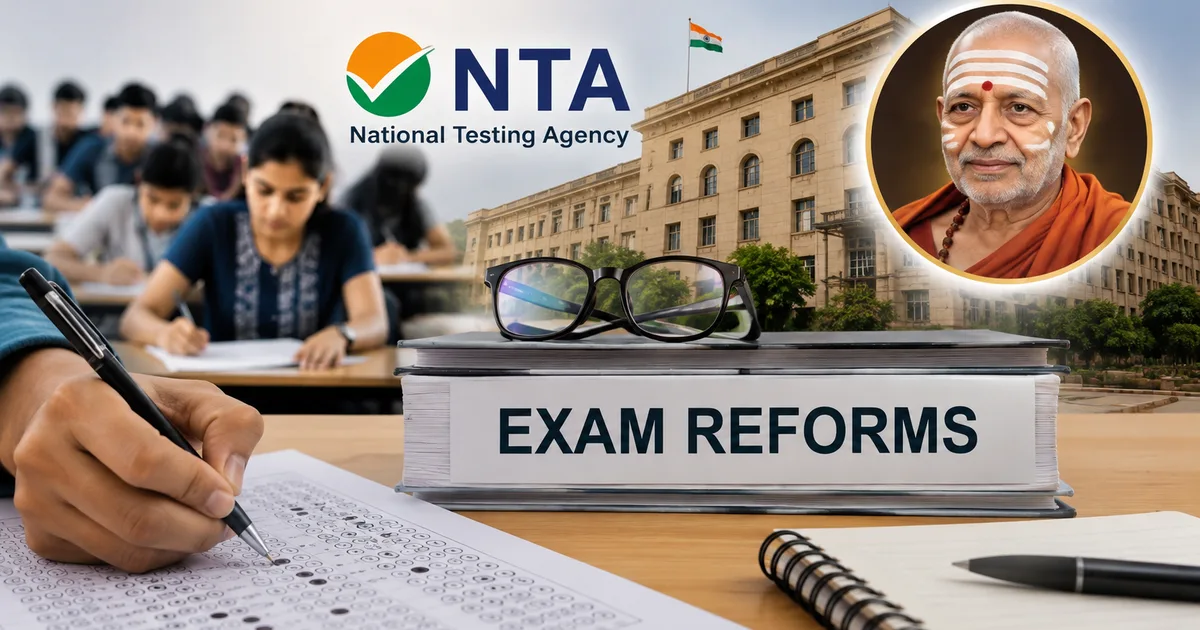
Imagine studying for fourteen hours a day for two years, only to find out your exam paper was sold on WhatsApp the night before. This is the nightmare millions of Indian students lived through recently, forcing the government to intervene drastically. The result is the V Kamakoti NTA Task Force 2026. This high-powered committee has an impossible job. They've got to completely overhaul the National Testing Agency, stop the paper leak mafia, and rebuild trust in a broken system before the next exam cycle begins.
I think I've been following this closely because the way we run exams in India is a complete mess right now. We have some of the best tech talent anywhere. It makes no sense. But our biggest tests get hijacked by basic paper leaks. Let me break down exactly who is on this task force, why their plan might actually work, and what students need to get ready for.
The people trying to fix the NTA
So the government didn't just stick a few random bureaucrats in a room this time. They brought in the heavy hitters. Nandan Nilekani is leading the six-member task force. He built Aadhaar and completely changed how digital identity works in India. If you use UPI today, you already know the massive scale he can handle.
But Professor V Kamakoti is the guy catching everyone's attention. He runs IIT Madras. And he is the one making all the headlines lately. The rest of the committee has ISRO Chairman S Somnath, former intelligence chief Tapan Deka, former education secretary Anita Karwal, and bureaucrat Amrit Lal Meena.
It's definitely an interesting mix. You have a space scientist and a spy master working alongside an IIT director and a digital infrastructure expert. They are treating this as a massive security and logistics problem. Honestly, the education part feels secondary to the immediate threat of compromised systems. If you check out our explainers on digital infrastructure, you'll spot a clear pattern here. The government treats exam security just like national security now. Putting the former Director of the Intelligence Bureau on an exam committee tells you everything you need to know. The paper leak mafia is a massive threat.
Who is V Kamakoti and why is he controversial?
This is where things get really messy. Priyanka Gandhi went after Kamakoti during a recent political rally. She didn't hold back. She called him a "gaumutra" (cow urine) expert. The Congress party raised loud objections about him joining the NEET reforms committee. They questioned his scientific temper because of some old comments and his perceived politics. It turned into a huge talking point across news channels and social media (which is pretty wild, honestly).
Look, if you check his actual resume, the picture is completely different. Kamakoti isn't your standard academic. Fun fact: he actually failed the Joint Entrance Examination (JEE) back in the day. He doesn't even have a passport because he thinks everything he needs to do is right here in India. The guy won a Padma Shri for his work in computer architecture and national security. He also designed Shakti, which is India's first indigenous microprocessor.
In my experience, it's pretty fascinating that a guy who couldn't clear the JEE is now the Director of the top-ranked IIT in the country. He brings a unique perspective to the committee. He understands the crazy pressure students face. He knows the system from the outside and the inside. The political noise is definitely loud. But his technical credentials in cybersecurity are exactly what the NTA needs right now.
The root cause of paper leaks in India
So how does this task force actually plan to stop the leaks? Kamakoti was very direct in a recent interview. He said tech intervention is super important for running these exams. But he also pointed out the actual weak link in the whole chain.
"Integrity of question paper setter biggest challenge for paper leaks."
Think about it for a second. We spend crores on secure printing presses in secret locations. We use GPS-tracked trucks to move the papers around. We install CCTV cameras at thousands of exam centres across the whole country. But before the paper even goes to print, a human being has to sit down and type out the questions. If that person snaps a photo on their phone or saves a copy on a pen drive, the entire secure system falls apart.
We have a massive underground industry built around this in India. Scammers go after printing press workers, transport drivers, security guards, and the bank managers who store papers in lockers. Sometimes they even approach the professors themselves. If you've read our scams section, you know how advanced these operations really are. They run just like corporate syndicates. They use Telegram groups and encrypted messaging to send out papers minutes before the exam starts. Sometimes they charge parents twenty lakh rupees for a guaranteed medical seat.
The roadmap to a secure exam system
Kamakoti laid out a phased roadmap to make NTA exams secure and leak-proof. This isn't going to happen overnight. You can't just flip a switch and suddenly secure exams for 24 lakh NEET aspirants. It needs a complete overhaul of the standard operating procedures.
Here is what the task force is looking at rolling out in the coming months:
- Moving away from physical papers: IITs have managed to keep the JEE Advanced relatively secure for years. They moved from pen-paper tests to computer-based testing. When the test is entirely online, there's no physical paper to intercept on a highway in Bihar or Gujarat. The encryption key to unlock the paper is only sent minutes before the start time.
- Dynamic question generation: Instead of having one set of 100 questions for the whole country, they want to use technology to generate unique, balanced question papers from a massive encrypted database. This happens dynamically. Even if someone hacks a terminal, they only get one student's paper.
- Advanced optical sensors: For exams that still require physical OMR sheets, they're looking at advanced sensors and tracking mechanisms to monitor every single sheet. They want to track the sheet from the moment it's printed to the moment it's scanned into the system. Any tampering will be flagged immediately.
- Biometric authentication at scale: We already use Aadhaar for many things. Expect much stricter biometric checks at exam centres to stop impersonators. The infamous Munnabhais who write exams for others using fake admit cards will find it nearly impossible to beat live fingerprint and iris scans connected to the central database.
The infrastructure challenge in rural India
That all sounds great in a PowerPoint presentation. But pulling this off in India is incredibly hard. It is a logistical nightmare. Running a computer-based test for two lakh students in big cities like Bengaluru or Delhi is one thing. Doing it for 24 lakh students in remote towns across UP, Rajasthan, and Jharkhand is a completely different beast.
Basically, we just don't have the infrastructure right now. There are not enough secure computer labs out in rural areas. Power cuts happen all the time. Internet connections drop without warning. If a server crashes in a small town exam centre during the NEET, it will cause mass panic and huge protests. I've seen firsthand how sketchy government portals get during high-traffic events. You can check out our guides on navigating government websites during tax season if you want an idea of the crazy server loads.
This is exactly why putting Nilekani and Kamakoti on the same team makes a lot of sense. Nilekani knows how to build digital systems that handle a billion people without completely crashing. His work on Aadhaar and UPI proves that India can build massive tech. And Kamakoti knows the hardware, the servers, the encryption, and the cybersecurity architecture needed to stop the hackers.
Integration with DigiLocker and state systems
Another big change we can expect is deeper integration with our current digital public infrastructure. The task force is looking at ways to link exam registrations directly with DigiLocker. This means your academic records, your identity proof, your caste certificates, and your income details are all pulled straight from government databases. No more uploading scanned PDFs that people can easily forge.
This cuts down the heavy administrative load on the NTA. It also wipes out a massive chunk of fraud right at the application stage. If a student claims a specific quota, the system checks it instantly against state databases. This simple step makes the whole process way smoother for honest students. And it makes life miserable for scammers. If you follow government updates, you will notice they are pushing DigiLocker integration across all departments now. Education is just the next big target.
What this means for students and parents in 2026
So if you are a student preparing for exams in 2026 or 2027, or a parent paying heavy coaching fees, you need to get ready for some massive changes. The days of simply filling bubbles on an OMR sheet in a local school classroom might be ending very soon.
Think about the brutal financial toll a paper leak takes on a middle-class family. Parents take out huge loans to pay for coaching classes in Kota. These easily cost upwards of three lakh rupees a year. They pay for hostels and expensive study materials. When an exam gets cancelled because a leaked paper hit Telegram, the student loses an entire year. And the parents lose a massive amount of money. The mental health impact is honestly even worse. Students burn out completely. They lose faith in meritocracy. They start thinking the system is just rigged for the rich who can afford to buy the paper. (I'm not sure exactly why it took this long to fix, to be honest). This task force is basically trying to save the whole concept of a fair chance in India.
You will probably face a much stricter registration process from now on. Your Aadhaar will be linked and verified multiple times. You might even have to go through live facial recognition before stepping into the exam hall. The exam formats might shift heavily towards computer-based testing, so you need to get comfortable reading questions on a screen and managing your time digitally. If you only practice on paper mock tests, you will be at a big disadvantage.
The types of questions might also change over time. Kamakoti hinted that exams need to test real understanding instead of just rote memorisation. If a machine generates the paper dynamically, you can't rely on past year question banks nearly as much. You have to actually know the concepts inside out.
The final verdict on the reform process
The government is absolutely desperate to win back the trust of the youth right now. The recent protests show that students are furious. They are completely tired of a broken system. The task force genuinely has the hardest job in the entire country today. They literally have to rebuild an airplane while it is flying in mid-air. Millions of careers depend on them getting this exactly right.
I spoke to a few students recently who are studying for the next NEET. They are super skeptical. They hear about panels and committees all the time, and then nothing ever changes. The real challenge for Somnath, Nilekani, Deka, and Kamakoti isn't just designing a secure system. It is convincing a very cynical generation of Indian youth that the new system is actually fair. They need transparency just as much as they need strong encryption.
And let's be real for a second. A lot of people are watching Kamakoti specifically because of all the political noise around him. He has to prove that his technical expertise is what really matters, not the crazy labels politicians throw at him. The roadmap he presented is definitely solid. The tech exists and we have the minds to build it. But the actual execution on the ground is going to be the real test.