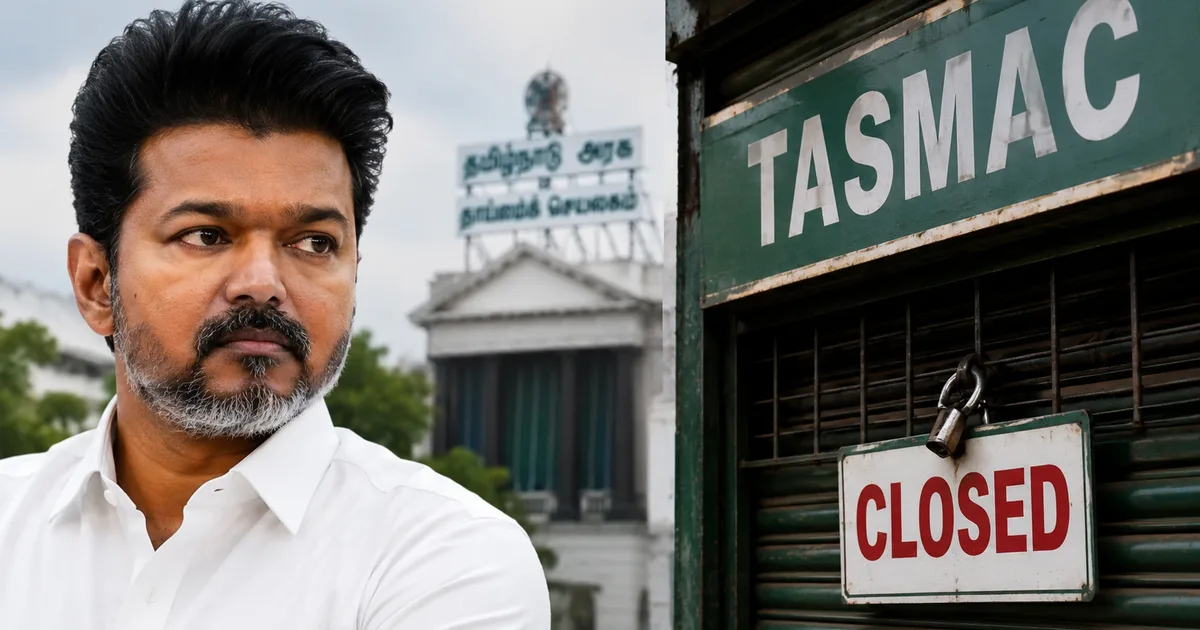
Picture this. You're walking down a street in Chennai, heading to a local tea shop for a quick cutting chai. Right next to a neighborhood temple or just across from a school, there's a long, chaotic queue spilling onto the road. That's a typical TASMAC outlet. But things are changing fast in 2026. The new state government led by Chief Minister C. Joseph Vijay has started a massive sweep. If you've been following the news, you've probably heard about **Vijay's TASMAC crackdown**, which is currently reshaping how alcohol is sold and regulated across the state.
Liquor sales in Tamil Nadu have been a hot topic for decades now. It's a messy mix of massive state revenue, local politics, election promises, and social issues. Every election, parties promise to shut down shops. Some promise full prohibition. But they stay open. If you ask me, they only stay open because the state budget depends on them. This time, the new government is taking a different approach. They're focusing on rules that already exist but were ignored for years. If you want to understand how these local policies affect everyday life, check out our section on digital and social explainers.
Honestly, the government didn't announce a complete ban on alcohol. They're just enforcing zoning laws and age limits to clean up the retail network.
What is the TASMAC system?
This crackdown targets the state monopoly. Unlike other states where private stores sell liquor, Tamil Nadu has a total state monopoly. Basically, a government body called **TASMAC**, which is the Tamil Nadu State Marketing Corporation, runs the show. It handles wholesale distribution. It also runs the retail sale of every alcoholic drink in the state. They started back in 1983. By 2003, under the AIADMK government, they took over every retail outlet (which was a huge change). So now, if you want beer or rum, you've got to buy it from a government shop.
This system makes a crazy amount of money. I think we're talking about over 45,000 crore rupees every single year. It's one of the biggest revenue sources for the state government. That money funds welfare schemes and infrastructure projects. But the system has also caused a massive public nuisance. Many shops are right next to schools and temples. People drinking in the open nearby became a daily headache for residents, especially women and children.
Why are 717 liquor shops closed in Tamil Nadu?
Shortly after he took office in 2026, Chief Minister C. Joseph Vijay signed an order to shut down 717 shops across the state. The reason was simple. These specific outlets violated zoning rules. In my experience, under Tamil Nadu regulations, liquor shops can't operate near sensitive spots.
The 500-metre proximity rule
Specifically, the law says shops can't operate within 500 metres of schools or places of worship. These include:
- Schools and colleges
- Temples and churches
- Major bus stands
The government moved fast. According to a report by The Hindu, the state Prohibition Minister confirmed that 436 out of the 717 targeted outlets were closed by May 23, 2026. Officials are shutting down the rest systematically as local administrations clear legal and logistics issues. Naturally, the opposition keeps a close watch. PMK leader Anbumani Ramadoss publicly questioned the government. If you ask me, he's just keeping them on their toes. He demanded a clear status report on whether all 717 shops were closed once the two-week deadline ended.
A few shop owners and landlords tried to fight back. They even filed petitions in court to stop the closures. But the Madras High Court stepped in. Actually, the Madurai bench of the Madras High Court dismissed two separate pleas that challenged the government's closure order. The court made it clear that the state has full authority to regulate or shut down liquor outlets for public welfare. Both the court and government sources are clear on this:
Every rupee of liquor revenue must reach the state treasury, and public welfare cannot be traded for retail profits near schools and temples.
This judicial backing means the government has a free hand. They can finish the closures now. For citizens, it means fewer crowded corners near temples and school gates (which is a welcome relief, honestly, for local neighborhoods).
Enforcing the 21-year legal drinking age in Tamil Nadu
Closing these physical stores is only one part of the plan. They're also tightening rules on who can buy alcohol. The official **legal drinking age** in Tamil Nadu is 21 years. But honestly, if you've ever stood near an outlet, you know ID checks just didn't happen. Schoolkids in uniform could buy beer. No questions asked.
That's changing fast. A report by Hindustan Times notes that the state government strictly enforces this age limit. Shop staff now face penalties if they sell alcohol to anyone under 21. Customers who look young must show proof of age, like an Aadhaar card or a driver's license. To keep up with these rules, you can read our tech guides on how to keep your digital documents handy.
Along with age limits, TASMAC is also looking at changing the operating hours. Right now, shops open at noon and close at 10 PM. A new proposal suggests they should close earlier, maybe by 8 PM or 9 PM. The idea is to prevent late-night brawls and drunk driving. While this proposal isn't finalized, I think it shows the government wants to reduce the availability of alcohol in residential areas.
Stopping the 102 crore rupee party fund leakage
Besides social goals, this crackdown has a big financial side. It's really about tackling corruption inside the state monopoly. Senior government sources told MSN that Chief Minister Vijay received detailed reports about massive leakages. Every month, around Rs 102 crore was allegedly diverted through unofficial collections (which people call the **party fund** system).
How the diversion system worked
At many outlets, salespeople charge customers ten to twenty rupees extra per bottle above the Maximum Retail Price (MRP). This extra cash doesn't go to the government. Instead, local syndicates collect it and pass it to political workers and officials. The government also found leakages in bar licensing. Unofficial bars operated next to retail shops and didn't pay proper fees. Chief Minister Vijay told his cabinet that every single rupee must reach the treasury (which is pretty bold, if you ask me). This led to surprise audits and police checks at outlets. To see how these policy changes compare with other states, you can check our latest news updates.
What does this mean for the state budget?
Can Tamil Nadu afford to close these shops? It's a tough balance. The state has a high debt burden. Plus, TASMAC revenues keep many welfare programs running. Shutting down 717 shops will lead to a drop in sales. But the government believes that anti-corruption measures and strict MRP enforcement will make up for the loss. If salespeople stop taking extra money and unofficial bars shut down, the official revenue might actually remain stable.
Also, the public response has been pretty positive. Political leaders like MMK MLA MH Jawahirullah welcomed the closure of these shops. He said that it's a good first step, though he hopes the government eventually moves toward complete **prohibition**. For now, the government doesn't plan a total ban. Complete prohibition often leads to bootlegging and fake liquor tragedies. The current policy is a middle ground. It keeps the revenue flowing but removes shops from sensitive locations and enforces strict retail discipline.
Look, the success of this plan depends on execution. If local police and TASMAC officials go back to their old ways in a few months, the shops will quietly reopen or start violating rules again. But for now, the new government has made its stance clear. Honestly, enforcing existing laws is a good way to start.