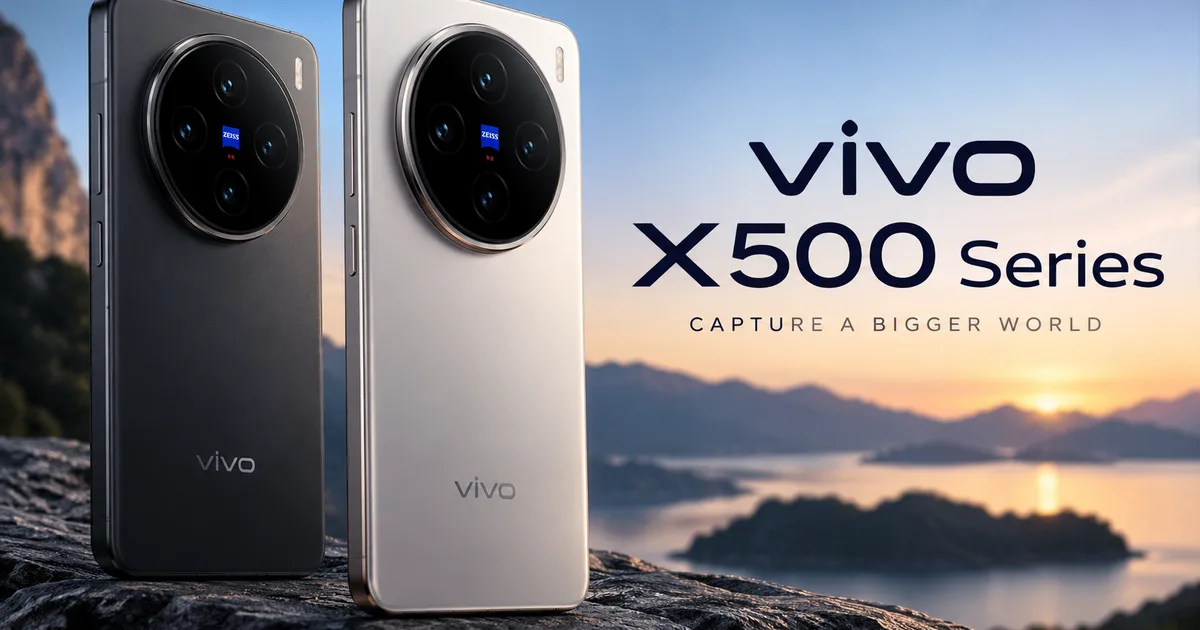
So you're looking at buying a premium phone this year, and you're wondering if you should wait for the Vivo X500 series 2026 India launch. I get it. The X series is the default recommendation for anyone who cares more about taking actual good photos than showing off an Apple logo at the local coffee shop.
And now the wait is almost over. Vivo just confirmed the X500 series is launching in China on September 21, 2026. The India release date won't be far behind (which makes sense, actually). We usually see these phones land in the Indian market around four to eight weeks after the China debut. So you should probably start saving up for a late October or November release here. That timing puts it right in the middle of the post-Diwali tech hangover. But honestly, it might be the only phone worth buying this winter.
Look, I've seen the leaks and the official Weibo posts. This isn't just an iterative update where they changed the processor and called it a day. Vivo is putting completely wild hardware in these phones. We are talking about three distinct models here. There's the base X500, the X500 Pro, and the massive X500 Pro Max. The spec sheet is insane.
But specs on a page don't mean much until you break down what they do for you in real life. Let me walk you through what we know about the expected price and the camera specs. And more importantly, I'll tell you if you should care about spending your hard-earned rupees on this when last year's models are getting cheaper.
The base Vivo X500 gets a massive upgrade
Usually, smartphone brands treat the base model like an afterthought. They strip out the good stuff. Why? So you have to buy the Pro version. Vivo isn't doing that here.
The standard X500 is inheriting the primary camera from the current X300 Pro. Yes, the phone that costs way more right now. It has a 50-megapixel 1/1.28-inch Sony LYT-828 sensor. Here's the kicker. They are keeping the Zeiss gimbal-level stabilization, which is absolutely wild for a base model. And it has a CIPA 5.5 rating.
If you shoot videos while walking or take photos in poorly lit restaurants, that stabilization stops your photos from looking like a blurry mess. Indian streets are chaotic. Having gimbal-level stabilization means your footage of a moving auto or a crowded market won't make people seasick. In my experience, this is a huge deal for night photography.
The telephoto lens on the base model is surprisingly capable too. It has a 64-megapixel Sony LYT-610 sensor. That's the exact same hardware going into the new X500 Pro. You get support for a 200mm teleconverter and 4K 120fps slow-motion video recording. Honestly, for most people, this camera setup is already overkill.
Add in a 6.37-inch OLED display and a 3nm MediaTek Dimensity 9-series processor. Now the base model is a serious problem for Samsung and Apple's non-Pro phones. The design is changing too. The base model is moving its circular camera bump to the top-left corner. This simple shift gives it a more traditional look compared to its bigger brothers.
The Pro and Pro Max are basically cinema cameras
This is where things get genuinely wild. If you regularly read our latest tech news, you know mobile photography is hitting a ceiling. But Vivo decided to break through that ceiling.
Vivo product manager Han Boxiao jumped on Weibo recently to confirm some details. The Pro models will have what Vivo calls a "ZEISS Ultra Dynamic Main Camera." I know, it sounds like pure marketing nonsense. But the hardware behind it is a custom Phantom 900 sensor. Sony and Vivo's Blueprint imaging team developed it together.
They claim this sensor has a 17EV dynamic range. For context, most flagship phones right now max out around 13 or 14EV. I'm not sure exactly why the jump is so massive this year, but it is. If that 17EV number is real, the X500 Pro can capture detail in blindingly bright Indian summer skies and pitch-black shadows at the exact same time. It pushes the phone closer to a dedicated cinema camera.
And then there's the video capability.
- 4K video at 240fps slow motion. That is literally four times the frame rate of most competitors' best slow-motion modes.
- 4K 120fps HDR video recording. You get super smooth, high-dynamic-range footage.
- A massive 200-megapixel triple camera array on the premium models.
If you want to read more about other upcoming tech in India, you can check out the Vivo T5e 5G India launch details we covered recently. But honestly, the X500 Pro Max is on another planet completely.
The Pro Max specifically has 3-degree optical image stabilization on its main camera. They gave it a CIPA 7.0 professional grade stabilization rating. You could probably shoot a movie from a moving train and the footage would look perfectly smooth. It's ridiculous.
The Jay Chou leak and design choices
You know a phone is close to launching when a celebrity accidentally gets photographed holding it. Taiwanese pop star Jay Chou was spotted on set filming a commercial with what looks exactly like the X500 Pro.
He was previously the face of the X300 Ultra, so this makes total sense. The photos show that the Pro models are keeping that massive, centered circular camera island. It looks like a real camera lens strapped to the back of a phone. Some people hate it. I actually love it. It makes a statement. It tells everyone around you that you care about photography.
Under the hood, these Pro models have MediaTek's new 2nm Dimensity 9600 Pro chips. This is a big deal for battery life and heat management. Heating is always the biggest issue when shooting 4K video in Indian summers. If you have ever tried to record a 10-minute 4K video in Delhi during May, you know your phone turns into a toaster. Then it shuts down the camera app. A 2nm chip should theoretically run much cooler than last year's models. This solves one of the biggest complaints mobile videographers have.
Expected India price and launch date
So, how much will this cost you? We don't have official Indian pricing yet. But we can make some highly educated guesses based on the current market and import duties.
The X-series is never cheap. Vivo isn't a budget brand anymore. I expect the base Vivo X500 to start somewhere around Rs 65,000 to Rs 70,000.
The X500 Pro will likely cross the Rs 90,000 mark. And the X500 Pro Max? Prepare yourself. That phone is competing directly with the iPhone 16 Pro Max and Galaxy S26 Ultra. I'd be shocked if it launches for anything less than Rs 1,15,000 in India.
As for the release date, September 21 is the China launch. Vivo usually takes a month or two to localize the software and sort out Indian manufacturing. November 2026 feels like a very safe bet for the India launch. If you need something cheaper to tide you over, you might want to look at our tech explainers covering mid-range options, or check out the expected Poco M8x 5G pricing.
Battery, charging, and the competition
You can have the best cameras in the world. But they are useless if your phone dies by 4 PM. We know from recent 3C certification listings that Vivo isn't messing around with battery tech. The numbers here are a bit fuzzy right now, but they are high.
While the exact battery capacities aren't completely confirmed, leaks point to massive batteries across the board. They might push past the 5400mAh mark on the Pro Max. That's huge. But the charging speeds are where things get interesting. The Pro Max is expected to support 120W wired fast charging and at least 50W wireless charging.
If you've never used 120W charging, it changes how you use your phone entirely. You forget to charge it overnight. You plug it in while you take a shower. And it's at 100% by the time you leave for the office. That kind of convenience ruins you for other phones (annoying, I know). Apple is still making people wait two hours to charge their phones, which honestly feels ridiculous in 2026.
Speaking of Apple, the X500 series is launching right around the same time the new iPhones will hit Indian stores. Vivo is sending a very clear message here. They aren't a cheaper alternative to Apple or Samsung anymore. They want to beat them purely on camera performance.
When you look at the 200-megapixel triple camera array on the X500 Pro Max versus what the competition is offering, it's hard to argue with Vivo's strategy. Samsung is resting on its laurels with minor iterations, and Apple still refuses to give us proper manual camera controls. This is going to be a fascinating battle. The premium smartphone market in India is growing incredibly fast. Buyers are getting smarter. They don't just want a brand name. They want the hardware to back up the price tag.
Software and Indian specific features
We also have to talk about Funtouch OS. The Chinese versions of these phones run OriginOS. That looks incredible. But in India, we get Funtouch OS. It has gotten much better over the years, but it still comes with a bit of bloatware out of the box.
Thankfully, Vivo is getting better at India-specific integrations. We expect the X500 series to have seamless DigiLocker integration and some specific UPI shortcuts built directly into the camera app. Scanning a QR code at the local kirana store should be instantaneous with cameras this fast. I just hope they give us a clean software experience that matches the premium hardware.
Should you wait for the Vivo X500 series?
Yes. Absolutely yes.
If you have a phone that still works fine, don't buy a current-generation flagship right now. The camera leap from the X300 series to the X500 series looks to be one of the biggest jumps we have seen in years. That custom Phantom 900 sensor alone is worth waiting to see. If you ask me, buying a phone right now is a bad idea.
Even if you don't end up buying the X500, its launch will force price drops on the current X300 and X100 models. It's a win-win if you just hold on to your wallet for another couple of months.
"The Pro models will feature what Vivo calls a ZEISS Ultra Dynamic Main Camera built around a custom Phantom 900 sensor developed jointly by Sony and Vivo's Blueprint imaging team."
The smartphone market has felt a bit boring lately. Everyone is just adding slightly better screens and slightly faster chips. Vivo is actually pushing the boundaries of what a phone camera can do.
I'll be keeping a close eye on the September 21 China launch. Once we have the confirmed Chinese prices, we can narrow down the exact Indian rupees you'll need to hand over. Until then, keep your current phone in a good case.