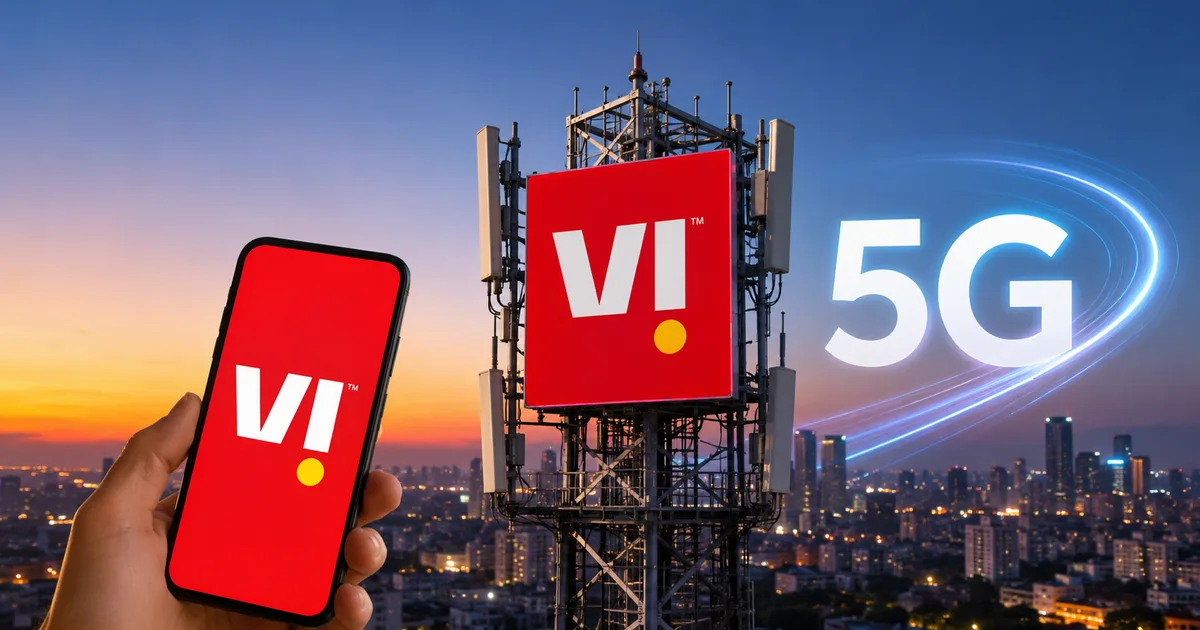
So, you're probably wondering if your Vi SIM is ever going to show that elusive 5G icon. I get it. While Jio and Airtel users have been downloading movies in seconds for the better part of two years, Vodafone Idea customers have been stuck on 4G. Sometimes very patchy 4G.
But things are finally moving. The Vodafone Idea (Vi) 5G India rollout 2026 is officially accelerating right now. They're targeting 133 cities by May 2026. This adds 90 new cities to their current roster. I think this timeline is actually possible.
I know, it sounds like too little, too late. The telecom market moves fast. But wait. There's actually a massive Rs 45,000 crore ($4.72 billion) capital expenditure plan backing this up. They've roped in Ericsson and Nokia to upgrade the network. Samsung is involved too. And there are even talks of them sharing infrastructure with BSNL. That could speed things up across the country.
We need to look at where you can actually get Vi 5G today. We'll also see what the new equipment means for your daily data speeds. Then you can decide if you should stick around or just port your number to another network.
Why the Vodafone Idea 5G rollout took this long
Let me be direct. They ran out of cash.
Building a 5G network across India is insanely expensive. Jio and Airtel threw billions of dollars at the problem immediately after the spectrum auctions. Honestly, Vi was a mess. They were drowning in AGR dues owed to the government. They bled subscribers every month. They just didn't have the capital to buy the radio equipment from Nokia or Ericsson. Let alone deploy it on thousands of cell towers.
But recently, the financial situation shifted. They managed to raise thousands of crores through their FPO. They're also edging closer to securing long-term funding from the State Bank of India (SBI). The disbursal was on hold for a bit. Now the paperwork is moving again. That cash injection is exactly what they needed. It lets them start paying equipment vendors and get hardware on the towers.
The massive Rs 45,000 crore network upgrade plan
Vi isn't just patching up old 4G towers to make them look good on paper. They're doing a massive overhaul. The management recently reaffirmed their three-year growth targets. This includes a capital expenditure of 450 billion rupees.
They're bringing in heavy hitters for this deployment. Ericsson and Nokia are supplying the radio equipment. Samsung is in the mix too. Having Samsung here is interesting, since they were a major partner for Jio in the past. For the transport network, they're working with Ciena. The transport network is the fiber and backhaul that actually carries the data from the cell tower to the main internet backbone. This is a big deal. You can have a shiny new 5G antenna on your roof. But if the fiber connection behind it is slow, your speeds will be terrible. Ciena is boosting their transport capacity. This helps handle the massive data loads 5G requires.
During the government spectrum auctions, Vi actually acquired a very healthy amount of mid-band and mmWave frequencies. So the actual airwaves were never the problem. They own enough spectrum to deliver speeds that rival Jio and Airtel. The bottleneck was always the physical hardware. They couldn't pay for the antennas to blast that spectrum to your phone. Now that the SBI funding and FPO cash are sorted, that hardware bottleneck is disappearing. In my experience, throwing money at hardware usually fixes these specific types of bottlenecks.
And what happens to their 4G network? This is something people ignore. When a telecom operator deploys 5G on a tower, they usually upgrade the 4G equipment at the same time. Vi is actively refarming their 3G spectrum to 4G to boost capacity. So even if you don't buy a 5G phone anytime soon, this Rs 45,000 crore investment means your regular 4G data speeds should improve. Call drop rates should get better too over the next two years.
Target cities for the Vodafone Idea 5G expansion
Right now, Vi 5G is live in a handful of places. They started quietly with Delhi and Bengaluru. Mumbai too earlier this year. Then they expanded to 23 more cities. They recently added another 9 to the list. And they just launched in Chennai with a phased rollout.
But the big goal is May 2026. By then, they plan to add 90 more cities. That brings the total target to 133 cities.
Where are these cities? Officially, the company hasn't released the full list. Telecom operators usually like to announce cities as they go live. But looking at their 4G revenue strongholds, you can make some very safe bets. The numbers here are a bit fuzzy, but we can guess the obvious ones.
- They'll fully cover Tier 1 metros. Think NCR and Mumbai. Pune and Chennai. Kolkata and Hyderabad. Simply because they can't afford to lose high-paying postpaid customers there.
- High-revenue Tier 2 cities are definitely on the priority list for this 90-city expansion. This includes places like Ahmedabad and Surat. Jaipur and Lucknow are on it too. Same with Chandigarh.
- Their southern strongholds in Kerala and Tamil Nadu will get heavy deployment. Especially Kochi and Thiruvananthapuram. Coimbatore is right there as well.
If you live in a Tier 3 town or a rural area, I'll be honest. You're going to be waiting a lot longer. Vi is focusing entirely on high-ARPU areas first to make their money back. If you need reliable 5G in a village today, you need a Jio or Airtel SIM.
The BSNL infrastructure sharing rumor
Here's a very interesting development that could change the timeline. There are credible reports that Vodafone Idea and BSNL are eyeing infrastructure sharing to stay competitive.
This makes total sense for both of them. Both companies are struggling against the Jio-Airtel duopoly. BSNL has thousands of towers in rural and semi-urban areas. Vi has completely weak coverage in those spots. Vi has decent urban infrastructure where BSNL struggles to maintain quality. If they share towers and fiber backhaul, they can both cut their capital costs dramatically. (Which makes sense, actually).
I'm honestly surprised the telecom ministry didn't push for this sooner. The government is the largest shareholder in Vodafone Idea now.
If this sharing agreement actually happens, the rollout could move much faster in smaller towns. BSNL is also trying to roll out its own indigenous 4G/5G network using TCS and C-DoT technology. Combining physical tower forces might be the only way they survive the next five years. You can read more about how telecom policies affect your choices in our telecom explainers section.
What about the prepaid plans and data speeds?
This is the part you actually care about. How much is this new network going to cost you every month?
Right now, Vi is offering unlimited 5G data on their higher-tier prepaid plans. Airtel and Jio did the same thing during their initial rollouts. They haven't announced a separate, more expensive 5G tariff yet. For example, say you're on their popular Rs 479 or Rs 719 daily data plans. You should theoretically be able to access the 5G network without paying extra right now.
But don't expect free 5G data forever. All telecom operators hiked their tariffs recently. We saw a massive 15-20% hike across the board. Vi is desperate to increase its ARPU to pay off its massive debts to the Indian government. Once they have a stable 5G network running in 133 cities, they'll absolutely start charging a premium for it. Or, more likely, they'll restrict the unlimited 5G benefit to plans costing Rs 600 or more per month. That would block it for budget users entirely.
As for speeds? Early tests from users in Mumbai and Delhi show gigabit speeds. They hit anywhere between 500 Mbps to 800 Mbps depending on how close you are to the tower. This is very similar to Airtel's Non-Standalone (NSA) 5G network. Vi is also using NSA architecture. That means they're using their existing 4G core network for routing calls and data management. They just attach 5G radios to the towers for the fast data link. It's much faster and cheaper to deploy than Jio's Standalone (SA) 5G network. It does have slightly higher latency, though.
For streaming YouTube or downloading large apps. Even just scrolling Instagram, you won't notice the difference between NSA and SA. For competitive mobile gaming like BGMI where milliseconds matter, Jio's SA network might still have a slight edge. I'm not sure exactly why it matters that much for regular phone usage, to be honest.
Should you port out or wait?
So, here's the final verdict on what you should do with your SIM card.
If you live in Mumbai or Delhi. Bengaluru or Chennai too, and you're generally happy with Vi's 4G coverage in your house or office, stick around. You'll likely get a 5G signal very soon. That's if you don't have it already. The network upgrades with Nokia and Ericsson are real. The money is finally flowing. The radio equipment is actively being installed on towers near you.
But if you live in a smaller city and you desperately want 5G right now because you just bought an expensive new phone, just port out. You can always port back in 2027 if Vi gets their act together and offers better plans. The target of 133 cities by May 2026 is ambitious. Telecom rollouts in India always face unexpected delays. Fiber cuts happen constantly. Equipment gets stuck in customs. Right of way permissions from local municipalities to dig roads take months. (Annoying, I know).
"Vodafone Idea is reaffirming plans to grow revenue by double digits and triple cash EBITDA over the next three years, driven by the 450 billion rupee capex plan."
That's what the management is telling their investors. To actually do that, they have to retain paying customers. The only way to retain customers in 2026 is by offering a stable, fast 5G connection. One that doesn't drop to edge inside buildings.
They know this. That's why they're scrambling to expand to 90 new cities. They're fighting for their corporate survival. Sometimes, a company fighting for its life actually delivers a surprisingly great product. They literally have no other choice.
Just make sure you have a 5G-enabled smartphone that supports Vi's specific 5G bands. They're mostly using the mid-band n78 frequency. That's standard. Most modern phones from Samsung and OnePlus support it out of the box. Vivo and Xiaomi do too. Same with Apple. You don't need to change your SIM card. Your old 4G SIM connects to the 5G network automatically once the signal is active in your area.
And please, ignore those random WhatsApp messages claiming you need to download an APK file to "upgrade" your Vi SIM to 5G. That's a banking scam. Scammers are heavily using the 5G rollout news to trick people into installing malware that steals SMS OTPs. Basically, if you want to know how these scams operate and how to secure your phone, check out our latest scam alerts. You never need to download an app from outside the Google Play Store to upgrade your mobile network. The switch happens entirely from the operator's side. If you ever face fraud, immediately report it to the 1930 national cybercrime helpline.
If you're a Vi user, check your network settings today. Switch the preferred network type to "5G/4G/3G auto". You might be surprised to see the 5G logo pop up next time you're near a major market area or a tech park. The rollout is slow. But it's definitely happening now.
And honestly, India needs a strong third private telecom operator. A Jio-Airtel monopoly would mean Rs 1000 monthly phone bills for basic internet access for all of us. Let's hope Vi actually hits that 133-city target by May 2026. Keep an eye on the official announcements from the company. We'll update you as soon as they release the exact city list for the next phase. For more updates on Indian tech policies or startup funding. Telecom news too. Browse our latest tech news section.