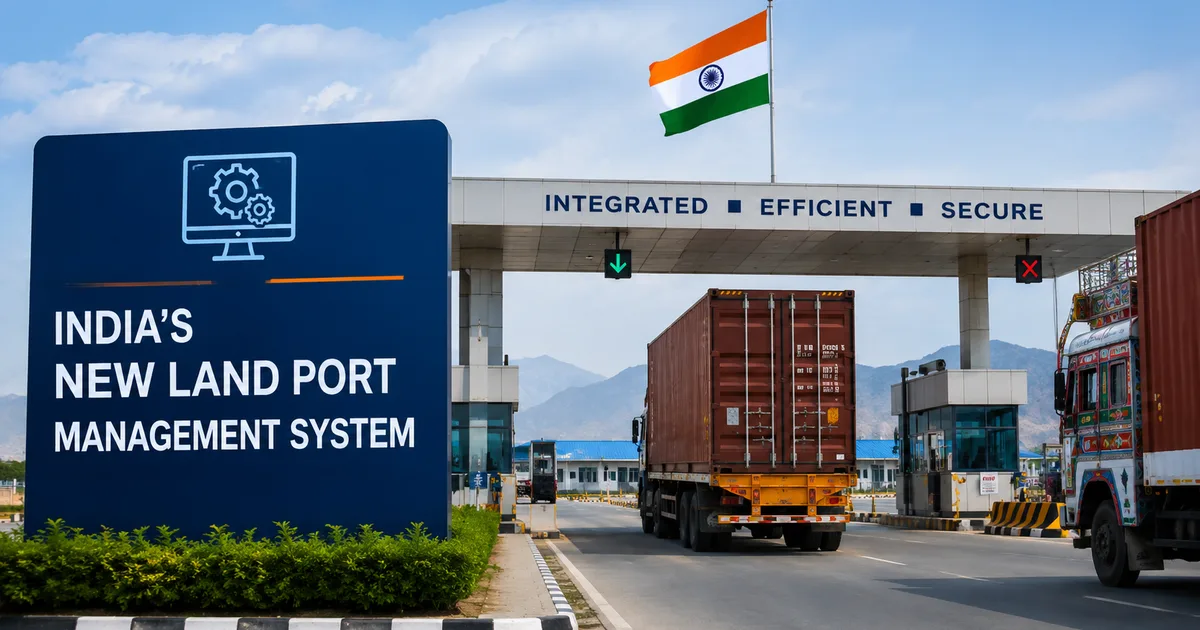
Imagine you're a truck driver carrying spices, sitting at a border checkpoint like Petrapole or Agartala. The engine's idling. The sun's beating down. You've been waiting for twelve hours just to get a single signature on a cargo sheet. Paper receipts're flying around. It's slow and costs Indian businesses a lot of money. Now multiply that by a thousand tons of cargo. To fix this mess, the government is launching the Land Port Management System tomorrow, a digital portal to manage border trade.
It's a huge shift.
Before we get into the technical details, let's look at a simple comparison. When you book a flight in India, you don't run around the airport asking the pilot to sign your ticket. You check in online and drop your bags at a desk. It's a clean, automated system (which makes sense, actually). But at our land borders, truck drivers still carry thick folders of paper from one office to another. The new portal wants to change that. If you ask me, the goal's to bring land ports to the same level of efficiency as our airports. If you want to understand how India's border trade's going digital, check out our tech explainers section for more context.
Dawki is famous for its crystal-clear Umngot river, but for traders, the real attraction is the land port that connects Meghalaya to Bangladesh's Sylhet region. Srimantapur sits in Tripura's Sepahijala district. Both are busy pipelines. The portal's going to make trade across these channels a lot smoother.
What is the Land Port Management System?
The Land Port Management System's a unified digital platform built to manage all operations at India's land border crossings. Union Home Minister Amit Shah'll launch the system on June 9, 2026. The Land Ports Authority of India developed the portal. This authority manages the Integrated Check Posts that handle trade and passenger movement across India's borders. In my experience, it's an agency that's been working on modernization for years.
India shares land borders with seven countries. We've active trade points with Bangladesh, Nepal, Bhutan, and Myanmar. Volumes've grown fast. The numbers are fuzzy, but according to the Land Ports Authority of India, EXIM trade handled through land ports grew from nearly Rs 5,000 crore in 2014-15 to Rs 82,800 crore in 2024-25, which is a growth of over 1,500 percent in a decade.
Honestly, the old manual methods can't handle this load anymore. The new portal's a digital brain designed to coordinate everything from cargo arrival to final customs clearance. It replaces old logbooks with a cloud database.
According to official reports from the Land Ports Authority of India, the new digital system integrates multiple border agencies into a single interface to reduce clearance times.
This digital transition didn't happen overnight. It's the result of years of planning and testing. Honestly, the system's designed to bring transparency to a sector that's been plagued by delays for a long time.
How the digital border trade portal works
Here's the deal: the portal's a central hub where transporters, customs officers, border security personnel, and port operators meet online. It replaces paper logs with digital workflows.
It's simple on paper, but complex in action.
The system relies on four major functions to keep cargo moving at the border crossings:
- Online slot booking lets transport companies book their entry times in advance, preventing long traffic jams at the gates.
- Digital payments allow users to pay port charges and utility fees online through UPI or net banking before the truck even arrives.
- Real-time tracking gives merchants and officials live updates on where a shipment is inside the port.
- Single-window clearance connects customs officers, border police, plant quarantine officials, and port management staff on one screen.
Improving gate operations
Look, when a truck arrives at the border, the gate operator scans a digital pass. The portal verifies the driver's identity using Aadhaar and retrieves their driving license from DigiLocker. This means a driver doesn't need to carry physical ID cards. In my experience, you don't need to get out of the truck to hand over physical papers (which is a huge relief in the summer heat). The portal routes the file to the next officer automatically.
If you want to read more about how India's digitizing its transport systems, you can browse our Indian digital guides.
Why this matters for Indian cross-border trade
When border trade gets stuck, costs go up. If a truck sits at the border for three days, the transport company charges more. The importer pays warehousing fees. So, ultimately, you pay more for imported goods at your local market. It's a chain reaction that hurts the consumer's wallet.
Let's look at the numbers. Keeping a cargo truck idling at the border costs around two thousand rupees a day in driver daily wages, fuel, maintenance, and truck rental. When hundreds of trucks wait for three days, the losses add up fast. Indian exporters lose money. But Bangladeshi buyers get frustrated too. The new portal aims to cut these delays. If we can save even one day per truck, it saves millions of rupees every month.
Our land ports handle a lot of trade with Bangladesh and Nepal. For example, ICP Agartala in Tripura is a major gateway for goods moving between Northeast India and Bangladesh. A delay there affects business across the region.
The government's also upgrading physical infrastructure at the same time. Alongside the portal launch, Amit Shah's set to inaugurate new accommodation facilities at the Srimantapur Land Port in Tripura and the Dawki Land Port in Meghalaya. I think this's a good practical step because border officials need decent places to stay if they are going to work round-the-clock shifts. These physical upgrades are just as important as the digital tools.
The integration with ICEGATE and ULIP
The tech's interesting here. The Land Ports Authority of India linked the system with major national trade databases instead of running it on a standalone server. Honestly, this connection is what makes the setup really work.
The portal connects directly with several systems:
- ICEGATE, which's the Indian Customs portal where duties're calculated and paid.
- The Unified Logistics Interface Platform, which coordinates transport data across railways, shipping, and roads.
- The national Motor Vehicle Ecosystem to verify truck registrations and driver licenses.
If you aren't familiar with Indian trade jargon, ICEGATE is the portal where customs duties are calculated and paid. The Unified Logistics Interface Platform's the digital network connecting railways, ports, highways, and waterways. Previously, these systems didn't talk to each other. The customs officer at the border had to check the details on ICEGATE and write them down in the register. In my experience, it was silly.
Now, the systems talk to each other automatically. The moment customs clears a file, the land port gate gets a green light.
The integration was tested at the Agartala Integrated Check Post in Akhaura along the Indo-Bangladesh border. It worked. The trial run showed that sharing data between customs and port authorities reduced paperwork errors a lot. For more details on these integrations, you can check our border infrastructure news page.
What changes at the borders?
For the average Indian business owner, the portal removes a lot of mystery. Previously, you couldn't tell why your shipment was delayed. Was it stuck at customs? Was the truck waiting in a queue? You had to call agents and hope for an honest answer (a real gamble).
It was a black box.
Now, you'll log into the portal and see the status of your cargo in real time. The transparency'll make it harder for corrupt agents to demand extra fees. If you ask me, this finally gives power back to the actual traders.
Tackling the digital divide
But it won't be perfect from day one. I'm not 100% sure how quickly small-scale traders along the border will adapt to the digital interface. Many small businesses don't have dedicated IT staff. They rely on local clearing agents who might resist the system because it reduces their control. The Land Ports Authority of India'll need to run training sessions at border town chambers of commerce to make the transition smoother. Honestly, it's going to take some time to get everyone on board.
Still, the shift to a digital system's necessary. You can't run a modern economy on paper ledgers.