If you walk into a major bank today and ask for a business loan of 4,000 rupees for exactly three days, the branch manager will politely ask you to leave. Traditional banks are simply not built to handle small, fast transactions. The cost of printing the paperwork, verifying your identity, and doing a background check costs more than the interest they would ever earn from that small amount. This leaves millions of small business owners going to local moneylenders who charge punishing daily interest rates.
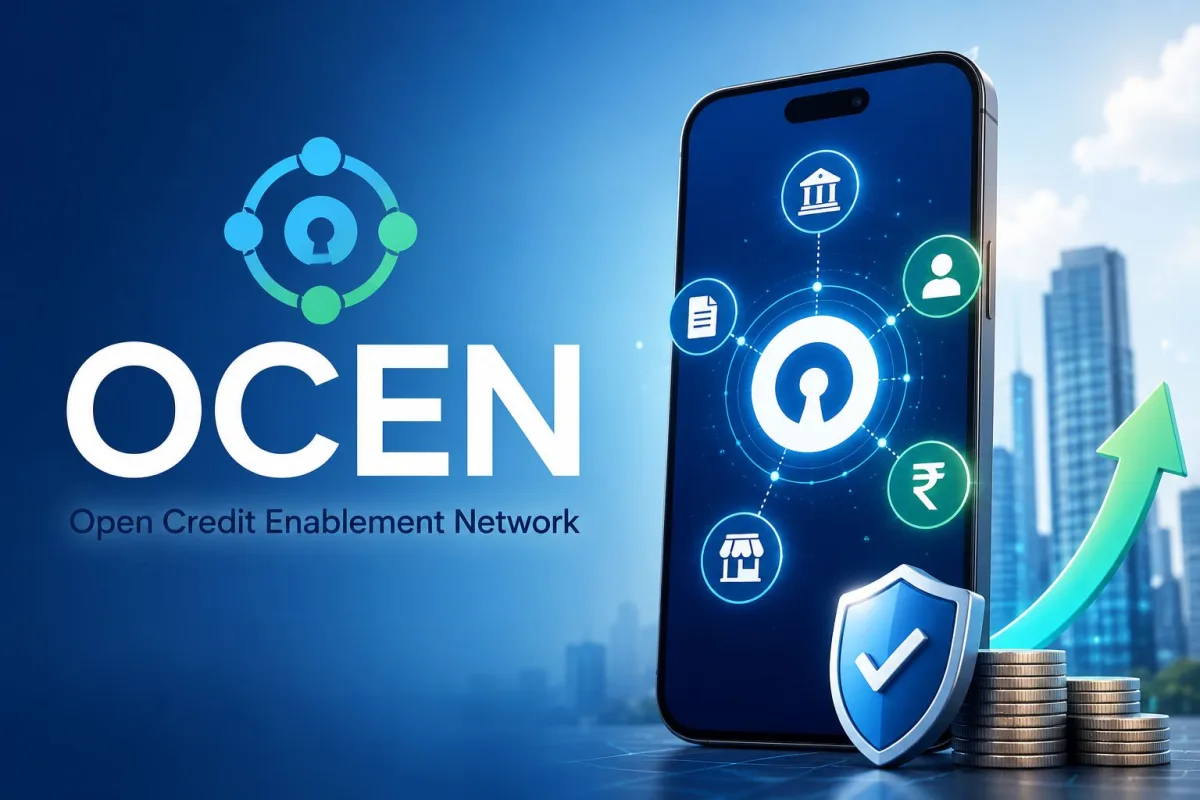
This specific problem is exactly what the Open Credit Enablement Network fixes. If you have been wondering what is OCEN and why financial news keeps mentioning it in 2026, you are in the right place. We are going to look at how this system actually works and why it changes how average Indians borrow money.
Think about how you paid for things ten years ago. Sending money to a friend meant asking for their account number, adding them as a payee, waiting 24 hours for the bank to approve it, and then sending the funds via NEFT. Today, you scan a QR code and the money moves instantly via UPI. OCEN wants to do the exact same thing for lending. It takes the slow, paper-heavy process of borrowing money and turns it into a simple digital button inside apps you already use.
The problem with traditional bank loans
To understand why we need a new network, we have to look at why the current system fails everyday internet users. Banks operate on a model called asset-based lending. They want to see that you own a house, land, or heavy machinery before they lend you money. They also have high minimum loan amounts. They want to lend 50 lakh rupees for ten years, not 5,000 rupees for ten days.
But India runs on small businesses. A vegetable vendor needs 3,000 rupees in the morning to buy fresh stock from the mandi, and she can pay it back by the evening after selling her goods. A delivery partner working for a food app might need 2,000 rupees immediately to fix a broken motorcycle chain so he can keep working that weekend. Traditional banking completely ignores these people. The geographical divide makes this worse. A recent report on India's geographic inequality trap described our economy as islands of gold in a sea of shadow. People in large urban centers have access to dozens of credit cards, while rural entrepreneurs have almost zero formal credit access.
How OCEN changes the math
OCEN is a digital framework created by the government and financial regulators to standardize how loans are processed. It acts as a common language between the apps you use every day and the banks that hold the money.
Instead of you going to a bank branch, the loan comes to you right when you need it. This concept is called embedded finance. If you use a food delivery app to run your restaurant, that app knows exactly how many orders you get, how much money you make, and how reliable your business is. Under this new network, that food delivery app can offer you a loan directly on your dashboard.
The app itself is not giving you the money. The app simply connects your business data with a bank in the background. The bank uses that data to instantly approve the loan, and the money drops into your account. You pay it back directly through the app's daily settlements.
The four main players in the network
The system works by splitting the lending process across four different groups. This separation is what makes the technology so fast.
- First, there is the borrower. This could be a retail shop owner, a freelancer, or a gig worker who needs a small amount of capital quickly.
- Second, there is the loan service provider. This is the consumer app the borrower interacts with daily. It could be an accounting app, a digital ledger app, an e-commerce marketplace, or a ride-hailing platform.
- Third, there are the technology service providers. These are the software companies that build the digital plumbing. They make sure the data flows securely between the consumer app and the bank without anyone tampering with it.
- Fourth, there is the lender. This is the traditional bank or non-banking financial company that actually provides the capital. They sit completely in the background.
Because the bank does not have to spend money finding the customer or doing physical background checks, their costs drop to almost zero. This makes it profitable for them to offer tiny loans for very short durations.
The rise of sachet loans
This drastic reduction in processing costs has created a new financial product known as sachet loans. Just like how shampoo companies realized they could reach millions of Indian consumers by selling tiny one-rupee sachets instead of large expensive bottles, banks can now sell credit in tiny digital sachets.
A small merchant can borrow 500 rupees at 9 AM and repay it with a few rupees of interest by 9 PM. They do not need to provide collateral. Instead of asset-based lending, this is cash-flow based lending. The bank trusts the borrower because the loan service provider can prove the borrower has a steady stream of daily income.
This data sharing is powered by another digital public infrastructure called the Account Aggregator framework. With your explicit consent, your bank transaction history, GST filings, and digital payment receipts are securely packaged and sent to the lender. The lender's algorithm reads this data and makes an approval decision in seconds.
The 2026 landscape for digital credit
The timing of this rollout is critical. The 2025 India Embedded Finance Databook report showed the market growing past 24 billion dollars, driven almost entirely by these embedded lending models. We are seeing major banks modernize their core systems specifically to handle the massive volume of small API calls generated by this network.
The Reserve Bank of India has also integrated this concept with its broader Unified Lending Interface. You can read our explainer on the Unified Lending Interface to understand how land records and state government data are being plugged into these same lending algorithms to help farmers get instant agricultural credit without submitting paper documents.
What are the risks of frictionless credit?
Making it incredibly easy to borrow money naturally creates new problems. When you remove all the friction from taking a loan, you also remove the time people used to spend thinking about whether they actually needed the money.
There is a real risk of over-leveraging. A small business owner might take a micro-loan from a food delivery app, another from a digital payment app, and a third from their accounting software. Because the amounts are small, they might not realize how quickly the high-frequency interest is eating into their total profit margins.
We also have to talk about data privacy and aggressive recovery tactics. While the technology framework is highly secure, the apps acting as loan service providers have access to massive amounts of behavioral data. If a borrower defaults on a small daily loan, there are strict rules about how these companies can collect the debt. The regulators have banned apps from accessing your phone contacts or photo galleries to prevent the kind of harassment we saw with illegal loan apps a few years ago. If you ever encounter an app asking for your contact list to process a loan, you should immediately check our guide on identifying loan app scams and report them to the national cybercrime portal.
How to use this technology today
You do not actually download an app called OCEN. That is not how it works. You simply continue using the business and payment apps you already rely on.
If your digital ledger app or your payment gateway dashboard suddenly shows a new feature offering instant credit based on your daily sales, you are likely looking at an OCEN integration. When you click apply, the app will ask for your consent to fetch your financial data via an Account Aggregator. Once you approve with an OTP, the system matches you with a lender, and the money arrives via immediate payment systems.
If you run a small business, the best way to prepare for this shift is to digitize as much of your cash flow as possible. Accept digital payments, file your GST correctly, and use digital ledgers. The algorithms that approve these instant loans cannot read cash transactions in a physical notebook. They need digital footprints. You can keep an eye on our tech news section as more platforms roll out these credit features throughout the year.
This technology fundamentally shifts how capital moves through the lower tiers of the economy. It gives a local dairy owner the exact same access to working capital as a large corporate franchise, entirely through the smartphone in their pocket.