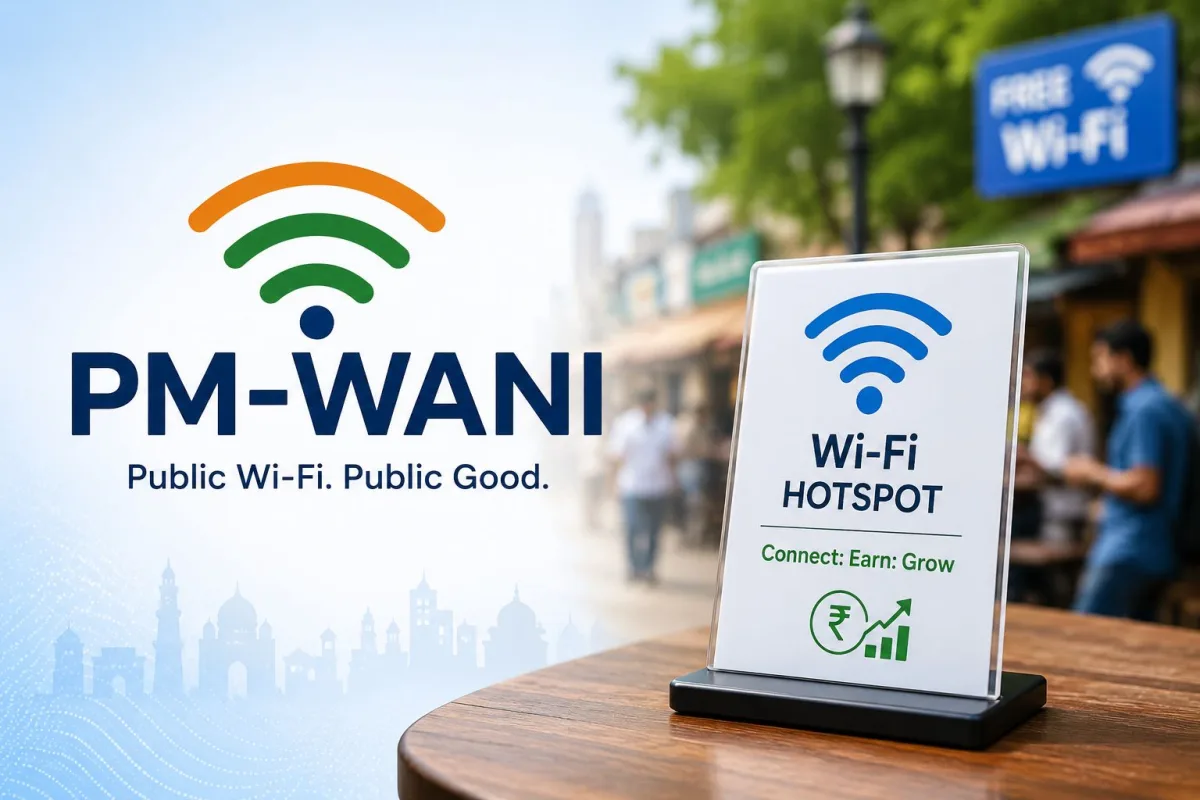
Imagine you run a small kirana store in Karol Bagh, or a dhaba near a state highway, or a waiting area at a coaching centre in Kota. People come in, sit around, check their phones. You have a broadband connection running anyway, Jio Fiber or BSNL, maybe 100 Mbps, and you're using a fraction of it during slow hours. This is exactly the kind of situation PM-WANI was designed for.
PM-WANI stands for Prime Minister Wi-Fi Access Network Interface. The Union Cabinet approved this scheme in December 2020 with a genuinely simple goal: allow anyone to set up a commercial public Wi-Fi hotspot without needing a license or paying any registration fee. No paperwork mountain. No waiting months for government approval. Just put up a router and start sharing internet access.
As of early 2026, PM-WANI has crossed 4 lakh public Wi-Fi hotspots across India, confirmed by Telecom Minister Jyotiraditya Scindia. That number sounds impressive until you realise how much further there is to go. TRAI recently released a consultation paper flagging that deployment is well below targets, and is actively working on what's being called PM-WANI 2.0 to fix the economics and push wider rollout. The scheme is real, the opportunity is real, but it's also still a work in progress.
What PM-WANI actually is (and what it isn't)
FACTLY, the Indian fact-checking organisation, has specifically flagged a common misunderstanding worth clearing up: the Government of India is not offering or installing free Wi-Fi under PM-WANI. The scheme creates a framework for private individuals and small businesses to do it commercially. The government opens the regulatory door. You bring the router and the broadband connection.
Before PM-WANI, setting up a commercial Wi-Fi service required an ISP license. Getting one was expensive, slow, and completely impractical for a corner shop or a petrol pump. That barrier is now gone for the smallest operators, called PDOs. Anyone can legally share their internet connection for a fee, as long as they go through the proper channel.
The broader vision is interoperability. Connect to a PM-WANI hotspot in Bengaluru, and you should be able to connect to one in Patna using the same app, same account. A single Wi-Fi ecosystem across the country, built by millions of small operators. That's the aspiration, and getting there is the hard part. Which is why TRAI's 2.0 consultation matters. For more context on India's digital infrastructure push, check our latest news coverage.
The four players in the PM-WANI ecosystem
There are four distinct roles in how PM-WANI works. Understanding them will save you a lot of confusion later.
- A PDO (Public Data Office) is the person who actually installs the hotspot. A shopkeeper, a tea stall owner, a housing society, a school. You provide the physical space and the broadband connection. Think of it like a franchisee, except with no franchise fee.
- A PDOA (Public Data Office Aggregator) manages multiple PDOs. They handle software, billing systems, and technical support. Companies like WIOM operate in this space. As a PDO, you'll register through a PDOA, not directly with the government.
- An App Provider makes the app that end users download to find, connect to, and pay for PM-WANI hotspots. Think of it as a marketplace for Wi-Fi sessions across all registered hotspots in the country.
- The Central Registry, managed by C-DOT (Centre for Development of Telematics), maintains a live database of all registered PDOs, PDOAs, and App Providers. This is what makes the whole ecosystem interoperable in practice.
For most people reading this, the relevant role is PDO. You don't need to think about the other layers unless you're planning to build something at a larger scale.
How to set up a PM-WANI hotspot
The process is more straightforward than most government schemes, and I say that as someone who has spent too much time on government portals.
Start by finding a registered PDOA operating in your city. WIOM is one of the better-known ones, and Jio is also active in this space. The C-DOT website and the DoT portal have a current list of registered PDOAs, though some are more active in certain states than others. Worth checking before you commit to one.
Once you've picked a PDOA, the setup goes roughly like this:
- Register with the PDOA through their app or website. You'll need KYC documents. Aadhaar is the standard requirement, though some PDOAs may ask for additional business details.
- Get a compatible Wi-Fi router or access point. Some PDOAs supply hardware directly; others let you use your own if it meets their technical specs.
- Connect the router to your existing broadband connection. Most PDOAs recommend a minimum of 25 Mbps available bandwidth.
- Configure the hotspot through the PDOA's app, setting your network name, access type (free or paid), and data session limits per user.
- Your hotspot gets registered in the Central Registry and starts appearing in PM-WANI-compatible apps for nearby users.
If your PDOA is responsive, the whole process can be done in a day or two. No license application. No government queue. That's a real improvement over how this worked before 2020.
One caveat worth being clear about: PM-WANI doesn't give you internet access. You still need a proper broadband connection from a licensed ISP. If your location only has 4G available, check with your PDOA whether mobile data can work as the backhaul. Some allow it; some don't. (I couldn't find a definitive official answer on this, so ask your PDOA directly.)
How much can you realistically earn from a PM-WANI hotspot?
This is where things get less clear, and honestly, anyone promising a specific guaranteed figure is overselling it.
The typical model: users buy data sessions through a PM-WANI app, maybe ₹10 for 1 GB or ₹50 for a day pass, though pricing varies by PDOA. That revenue gets split between the PDOA and you. A typical PDO revenue share is somewhere between 30% and 60%, depending on your specific agreement with the PDOA you sign up through.
In high-traffic locations like railway station waiting rooms, busy markets, or college campuses, some PDOs reportedly earn ₹2,000 to ₹5,000 per month. In low-traffic spots, the figure is closer to ₹200 to ₹500. I couldn't find verified official averages from any government source, so treat those as rough benchmarks, not guarantees.
The business case is strongest when your broadband is already paid for and any extra revenue is a bonus on top. The incremental cost of running a hotspot is low. Even ₹500 a month from bandwidth you're paying for anyway is essentially passive income. For a broader look at evaluating digital income opportunities in India, our guides section has more context.
Why deployment is still sluggish in 2026
4 lakh hotspots sounds like a lot. India has over 600,000 villages. The math doesn't quite add up.
TRAI's consultation paper was direct about this. The economics for PDOs in rural and low-traffic areas don't work well right now. India's mobile data is among the cheapest in the world, largely because of Jio's market entry in 2016 which pushed prices down across the entire industry. Convincing someone to pay for a Wi-Fi session when they can use a 5G plan at ₹2 to ₹3 per GB is a genuinely hard sell in many markets. Honestly, I'm not sure exactly why this pricing problem wasn't more front-and-centre when the scheme launched.
Some PDOAs have also struggled to build reliable billing and support infrastructure, which makes the experience pretty bad for both PDOs and end users. That compounds the problem.
The PM-WANI 2.0 proposals aim to fix this. TRAI has specifically suggested enabling seamless access so users don't have to manually log in every time they're near a hotspot, and bundling Wi-Fi charges into third-party apps rather than requiring a separate PM-WANI app (annoying, I know). Both changes would improve the user experience substantially, which should drive more usage and better economics for PDOs over time.
These proposals were still at the consultation stage as of May 2026. Whether they move through quickly or slowly is worth tracking. You can find updates in our explainers section as the policy develops.
Who should actually consider setting up a PM-WANI hotspot
If you run a business where people wait, PM-WANI is worth a serious look. Shops, salons, small restaurants, coaching centres, clinics, housing societies. The setup cost is low, the regulatory barrier is gone, and even ₹500 a month from bandwidth you're already paying for is real money.
High-footfall spots near metro stations, colleges, bus stands, or busy markets have noticeably better potential. The most important decision, after deciding to do this at all, is picking a PDOA that's active and reliable in your specific city. That experience varies significantly between operators, so ask around or look for reviews from existing PDOs before committing.
And if you're in a smaller town where no PDOA is currently active, that's actually a gap worth noting. As PM-WANI 2.0 reforms push through, more PDOAs are likely to expand into tier-2 and tier-3 markets. Getting in early in those areas could mean better positioning and less competition for users.
The infrastructure is in place. The scheme is live and working. What PM-WANI needs most now is the 2.0 reforms to make the economics work outside of big cities, where the gap between cheap mobile data and accessible public Wi-Fi is largest. If those reforms land, the hotspot count could realistically move from 4 lakh toward 40 lakh over the next few years. That's a big if. But a real one.