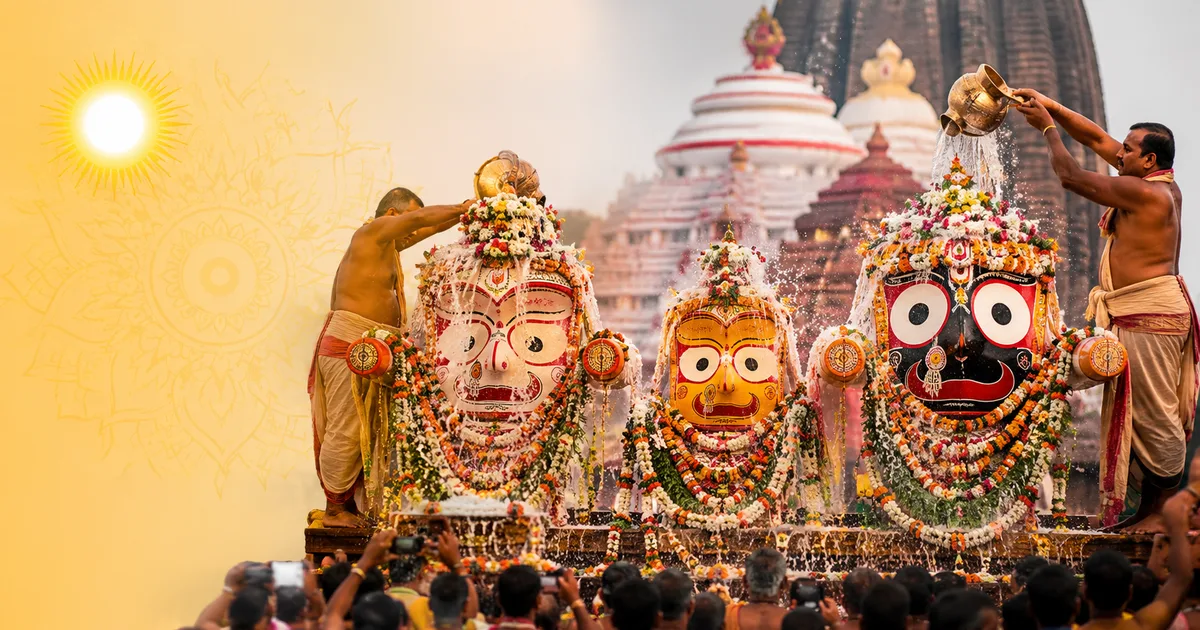
You know that feeling when summer peaks in Odisha? The heat hits different. The humidity makes the air feel heavy. And suddenly everyone you know is talking about the one thing that brings millions to Puri. That's right, we're talking about Lord Jagannath stepping out of the sanctum sanctorum for a proper grand bath. If you've ever been to Puri around June, or even watched it on TV with your family, you know exactly the kind of energy I'm talking about.
This bathing ritual is massive. It's Deba Snana Purnima. Honestly, this is one of the most visually striking events in the entire temple calendar. It's even more popular than the Rath Yatra for some people (which makes sense, actually). That is because it's the only time you see the deities so clearly from outside the temple. So, what is Snana Purnima 2026 all about? Why does the Jagannath Bathing Festival matter so much? Let's look at the history and the rituals. We'll also cover what you can expect this year.
What is Deba Snana Purnima?
Simply put, Deba Snana Purnima is the birthday of Lord Jagannath. King Indradyumna started this festival when he first installed the wooden deities in the temple, according to texts like the Skanda Purana. Think of it as a massive public royal bath. It's for Lord Jagannath, Lord Balabhadra, Devi Subhadra, and the Sudarshana Chakra.
Thing is, normally the deities stay inside the main temple. You can only see them if you go inside, fight the crowds, and get a brief glimpse. But on Snana Purnima, they are brought out. They go in a massive procession called Pahandi to a special bathing altar called the Snana Bedi. This altar is positioned so you can stand outside on the Grand Road (Bada Danda) and get a completely clear view of the Lords. The numbers here are a bit fuzzy. But the crowds are easily in the lakhs.
This is their moment for a lot of devotees. Especially those who can't enter the temple. They finally get a direct view (darshan) of their deity. I think this is an inclusive tradition. It breaks down the barriers between the sanctum and the street. It brings the divine directly to the people.
Snana Purnima 2026: date and timings
You need the dates if you're planning to visit Puri or just watch the live telecast. In 2026, Deba Snana Purnima is on June 29. The Shree Jagannath Temple Administration (SJTA) got the schedule done early. They put extensive security and crowd management plans in place. Arabinda K Padhee, the Chief Administrator, confirmed that preparations are moving along for a smooth festival.
The rituals start early. Very early. We're talking pre-dawn preparations. The Pahandi procession kicks off before the sun is up. Then the bathing rituals happen throughout the morning. You need to be glued to your screen or find a spot on the Grand Road by sunrise if you want to see the main events.
Look, the crowds are a mess. The Odisha Police always tightens security ahead of the Snana Yatra. This year is the same. Expect tight barricades and a sea of people if you go. Just be prepared for the heat and the wait.
The rituals: how the divine bath works
The whole process is incredibly detailed. It isn't random. Every single step has centuries of tradition behind it. Here is how it actually happens.
The Pahandi procession
The deities are escorted from the Ratna Singhasan (the bejeweled throne inside) to the Snana Bedi before the bath. This is a serious physical feat. It's the Pahandi procession. The deities are swayed back and forth. They are carried by Daitapati servitors to the rhythmic beats of ghantas (cymbals) and massive drums. The physical effort required by the servitors is intense. The atmosphere is loud with thousands of devotees chanting in unison.
The water from the Golden well
The water doesn't come from a tap. It comes from the Suna Kua (Golden well) near the northern gate of the temple. This well is only opened once a year just for this festival.
The servitors draw exactly 108 pitchers (kalash) of water. The math is specific. They get 35 for Lord Jagannath, 33 for Lord Balabhadra, 22 for Devi Subhadra, and 18 for Lord Sudarshana. They don't use plain water either. They mix it with sandalwood paste and fragrant herbs. I can only imagine the scent filling the air around the temple.
The grand bath and Gajanana Besha
The actual bathing happens once the deities are safely seated on the Snana Bedi. The priests pour the 108 pitchers of holy water over them. After the bath, the deities are dressed in the Gajanana Besha. This is the Hati Besha (Elephant Attire).
Lord Jagannath and Lord Balabhadra get massive headgear. They look like Lord Ganesha. The story goes that a scholar from Maharashtra, Ganapati Bhatta, visited Puri on Snana Purnima. He was disappointed because he worshipped Ganesha and didn't see Ganesha in Lord Jagannath. So Lord Jagannath appeared in the elephant form. Honestly, seeing the huge elephant masks on the deities is a core memory for anyone who witnesses it.
Anasara: the divine fever
Here's where the story gets really relatable for the average Indian household. You take a massive public bath with 108 pitchers of cold water in the peak of summer. What happens? You catch a cold. And apparently the gods catch a cold too.
Lord Jagannath and his siblings get sick after Deba Snana Purnima. They get a fever. They are moved to a secret room called the Anasara Ghar for the next 15 days. The temple doors are closed to the public then. There is absolutely no darshan.
This 15-day period is Anasara. The temple physician (Raja Baidya) treats them with herbal medicines (Phuluri Tela) and fruit-based diets. They don't get the regular Mahaprasad. Devotees worship the Patti Dians (traditional scroll paintings of the deities) inside the temple instead.
Many devotees also travel to the Alarnath temple in Brahmagiri. It's a short distance from Puri. People believe Lord Jagannath is there during his sick leave. They offer a sweet rice pudding called Kheer there.
In my experience, this part is deeply fascinating. We treat our gods like family members who need rest and medicine. It brings the divine down to a human level that you don't see often.
Why Snana Purnima matters today
You might wonder why millions still tune in for a ritual that is centuries old. It's about deep cultural connection. This festival is the official start of the Rath Yatra cycle for many Odias and Hindus worldwide. Without the bath, there is no fever. Without the fever, there is no recovery (Naba Jaubana Darshan). And without that recovery, there is no Chariot Festival.
Plus, the scale of management required to pull this off is huge. The Odisha government and the SJTA work in overdrive. The police help too. We're talking about managing lakhs of people in a concentrated area. It's a massive logistical exercise involving crowd control and sanitation.
"Preparations are underway for the upcoming Snana Purnima and Ratha Yatra, the temple's grand chariot festival, ensuring maximum coordination among all agencies for a smooth experience for devotees." - Arabinda K Padhee, SJTA Chief Administrator
Controversies also keep the traditions in the news. The Puri Gajapati Maharaja recently wrote to the Prime Minister about ISKCON's off-calendar Rath Yatras. He stated they violate religious traditions. These debates show how deeply people care about the exact timing. It's a living tradition that people defend passionately.
Navigating the festival: practical tips
You need a plan if you're actually going to Puri for Snana Purnima in 2026. It isn't a casual weekend trip.
- Book early: Hotels in Puri get booked out months in advance for June and July. Don't expect to find a room on arrival.
- Use public transport: Taking your own car near the temple is a nightmare. Park far away and use autorickshaws or walk.
- Stay hydrated: June heat in Odisha is brutal. Carry water and wear cotton clothes. Always protect your head.
- Beware of scams: Sadly, big festivals attract scammers. Watch out for sketchy VIP pass scams online. If someone promises you guaranteed front-row access for a hefty UPI payment, it's a fraud. There is a push to link donor passes with Aadhaar for verification and store them in DigiLocker. This prevents black market sales. Always trust official SJTA announcements. Read our guide on scams to stay safe.
- Be patient: You will be in crowds for hours. It's part of the experience.
The digital devotee experience
Not everyone can make it to Puri. That's fine. The way we consume religious festivals has changed. You don't need to be physically present to witness the grandeur today.
Pretty much every Odia news channel broadcasts the event live from the early morning. You can catch high-definition live streams on YouTube from official channels. People share clips on Reddit and WhatsApp. Instagram too. It's a digital experience that connects Odias from Delhi to Dallas (which is wild, honestly). Check out our other explainers if you want to understand how tech is changing culture.
Basically, Deba Snana Purnima is the beginning of the biggest spiritual journey of the year in Odisha. The energy is undeniable whether you're standing on the Grand Road or watching from your AC room. Some traditions hold strong when the world changes.
If you found this useful, you might also want to read our news section for more updates on tech and culture. Or check out our tools directory for useful Indian apps.