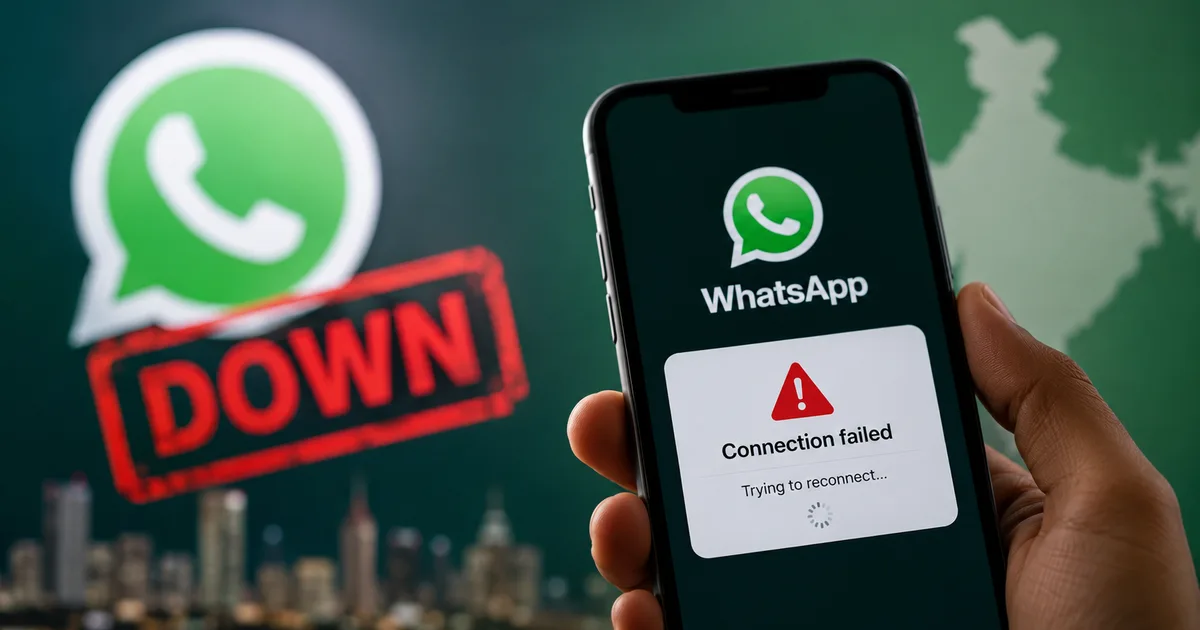
If you opened WhatsApp this morning and got nothing but a spinning wheel, you're not alone. WhatsApp went down on June 1, 2026, with reports of outages flooding in from Mumbai, Delhi, Bengaluru, Hyderabad, Pune, and smaller towns too. Messages sat on one grey tick. Voice calls dropped before connecting. Hundreds of thousands of small business owners who run their entire customer communication on WhatsApp Business found themselves suddenly, frustratingly offline.
India has roughly 500 million WhatsApp users. That's more than any other country on earth. And when Meta's servers go down, the disruption here is on a different scale entirely.
India accounts for the largest share of WhatsApp's global user base, at roughly 500 million active users. A Meta infrastructure outage here doesn't just disrupt personal chats. It disrupts small businesses, informal supply chains, and everyday UPI payments.
What actually happened with WhatsApp on June 1, 2026
Reports started coming in through tech news channels and social platforms from early morning on June 1. Users across India and parts of Asia reported messages stuck on one grey tick, meaning they weren't being delivered at all. Voice and video calls weren't connecting either. Mashable reported that Instagram and Facebook also experienced serious issues at the same time, which is the tell-tale sign of a Meta-wide infrastructure failure rather than a WhatsApp-specific bug.
When all three apps go down together, it's almost always something in the shared backend. Not a WhatsApp update gone wrong. Not a problem with your phone. Something deeper in Meta's infrastructure.
Meta hadn't released a detailed incident report at the time of writing. From past patterns, these outages usually start with a bad configuration change pushed to production, or a network routing error cutting off communication between data centers. Hardware failures cascade outward sometimes too. I'm not sure exactly why the specific cause always takes this long to surface publicly, but it does come out eventually.
Why WhatsApp outages hit Indian users harder than anyone else
In most countries, a WhatsApp outage is an inconvenience. In India, it can genuinely disrupt work and income.
Think through how much of daily Indian life runs on WhatsApp. Your kirana owner takes orders on a WhatsApp group. Your doctor sends prescriptions through it. School announcements, colony committee alerts, office team updates, festival invitations. All of it on WhatsApp. India has built an informal but deeply load-bearing layer of its digital economy on top of a single American messaging app. Which is, honestly, worth pausing on.
WhatsApp Pay handles UPI transactions for millions of users, though the NPCI caps WhatsApp's share of total UPI volume at 10% of the market. Even that limited slice is enormous daily transaction value. And WhatsApp Business API is used by large and mid-size Indian companies to send delivery updates, OTPs, customer service messages, and promotional content (which covers a surprising chunk of everyday business communication). When Meta goes down, all of that stops simultaneously.
This is why a one-hour Meta outage gets more coverage in India than a full-day outage elsewhere. The exposure is just deeper here.
How to check if WhatsApp is really down (and not your internet)
Before you restart your router and toggle airplane mode, here's a quick way to figure out what's actually happening.
- Open YouTube or Google Maps. If they load normally, your internet connection is working fine.
- Visit downdetector.in and search for WhatsApp. You'll see a real-time graph of user reports from across India, broken down by issue type.
- Search "WhatsApp down India" on X (formerly Twitter) to see whether others are reporting the same problem.
- Try WhatsApp Web at web.whatsapp.com from a laptop browser. Sometimes the mobile app has issues while web still works, or the other way around.
- Switch between Wi-Fi and mobile data (Jio, Airtel, Vi, BSNL). Occasionally a routing issue affects one carrier before others.
If Downdetector shows a spike in reports and your other apps are loading normally, it's Meta's problem. Nothing you do on your end will fix a server-side outage. The only option is to wait it out.
Why does Meta's infrastructure fail at all?
WhatsApp handles over 100 billion messages per day globally. To do that, Meta runs enormous data centers across multiple continents, all connected by a private network with custom routing and a content delivery system that pushes media files closer to users in each region. When any part of this breaks, things go wrong fast and at scale.
The most famous example is the October 2021 outage that took WhatsApp, Instagram, and Facebook offline for almost six hours worldwide. The cause was a Border Gateway Protocol (BGP) configuration error. BGP is the routing system that tells internet traffic where to go. Meta's engineers pushed a network update that accidentally removed the routes connecting Meta's data centers to the rest of the internet. The whole network went dark, and engineers couldn't even log in remotely to fix it because the internal systems were also offline.
More recent outages have been shorter but follow similar logic. The August 2025 Facebook login problems that hit Indian users, reported by the Economic Times, were tied to a server-side authentication failure. Same pattern: one shared system fails, multiple apps are affected.
Thing is, there's also the dependency problem. WhatsApp, Instagram, and Facebook share authentication systems and user profile databases. A failure in any of these shared components breaks all three apps simultaneously. That's a deliberate design trade-off, not sloppy engineering. But it does mean one failure point can have outsized effects.
What to do when WhatsApp is down in India
If you need to send a message urgently, Telegram and Signal are the most practical alternatives. Telegram has a solid user base in India, so there's a decent chance your contacts are already on it. Signal is better for privacy-focused smaller groups. And regular SMS and phone calls still work perfectly, since those run on entirely separate network infrastructure from Meta.
For payments, you don't need WhatsApp at all. Google Pay, PhonePe, BHIM, and Paytm all connect directly to NPCI's UPI infrastructure and are completely unaffected by Meta outages. Your transactions go through without delay. If you're setting up one of these apps for the first time, our UPI app setup guides have step-by-step walkthroughs.
Business owners running customer communication through WhatsApp Business API have the harder situation. When Meta goes down, that channel goes dark entirely. The practical fix is to already have a fallback in place before the next outage. Even just an email address listed on your website or a short notice on your Instagram page. One disruption like this is usually enough of a nudge to set something up. It doesn't need to be complex.
Is this going to keep happening?
Probably, yes. And that's not a particularly harsh verdict on Meta. Every large-scale internet service goes down sometimes. Meta's infrastructure is vast and deeply interconnected, which makes it both powerful and brittle in specific ways. The more features WhatsApp adds, from payments to new business tools, the more complex the system gets and the more potential failure points there are.
There's also a geopolitical layer worth knowing about. Russia blocked WhatsApp in 2025 for defying local regulatory requirements, according to the Times of India. Iran asked its citizens to delete the app entirely. India isn't heading in that direction, but it does show how much of our daily communication runs through a single American company's servers. That's a dependency worth being aware of, if you ask me.
The sensible response isn't to abandon WhatsApp. It's to spend fifteen minutes this week reducing your single-app dependency. Set up Telegram with your most important contacts. Link your bank account to one more UPI app. Add an email address to your WhatsApp Business profile. Our explainers on staying connected when apps go down go into more detail on building a simple digital backup plan.
WhatsApp will come back up. It always does. But the next time it doesn't, you'll know what's happening and exactly what to do about it.