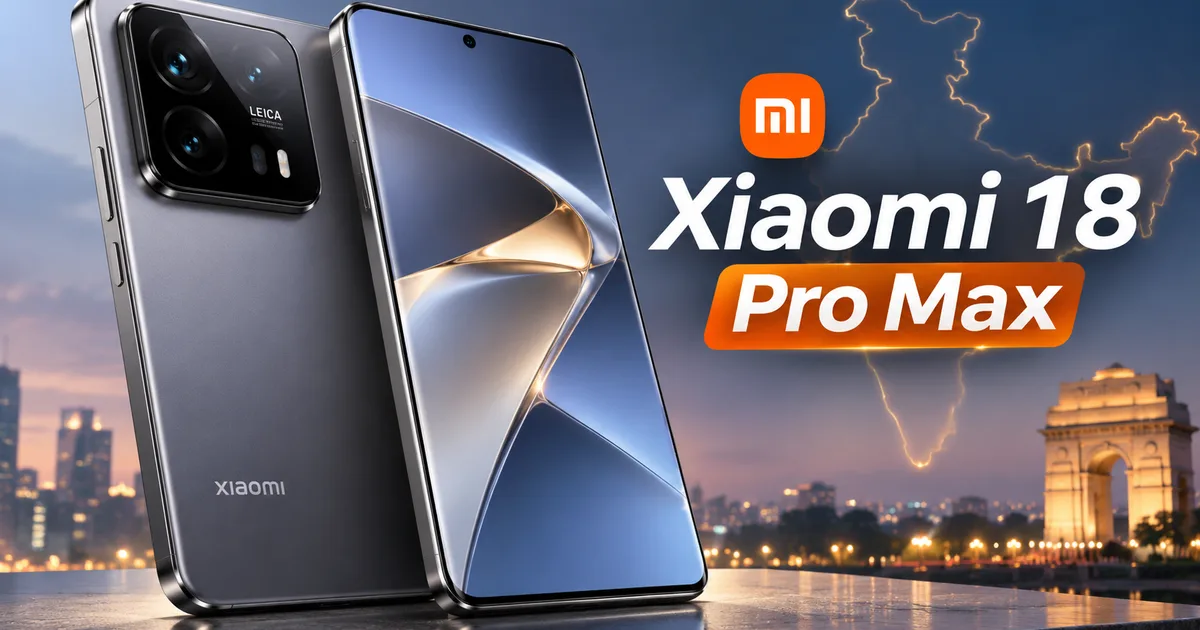
Xiaomi just did something it refused to do last year. On November 17, 2026, at a launch event in Paris, the company officially brought the Xiaomi 18 Pro Max and its smaller sibling, the Xiaomi 18 Pro, to international markets. Both phones first debuted in China back in September, and for the first time ever, Xiaomi is shipping its rear-screen flagship design outside its home country. Remember the Xiaomi 17 Pro series? That stayed locked inside China. This time, Europe, Australia, the Gulf, and parts of Asia are getting it.
Before you get too excited, look at the price tag.
In Europe, the Xiaomi 18 Pro Max starts at EUR 1,599. Convert that straight to Indian rupees, and you're already hovering around Rs 1.48 lakh before you even think about Indian GST or component duties. Honestly, it feels wild typing that number next to the name Xiaomi. I still remember standing in flash sale queues on Flipkart trying to buy a Redmi phone for Rs 12,999. Those days are clearly over for Xiaomi's top shelf.
And there's a catch in the spec sheet that has buyers pretty annoyed. Global customers are paying more money while getting a noticeably smaller battery than what Chinese buyers got two months ago. So let's break down what this phone actually has, what works well, what feels like a compromise, and when it might finally show up in India.
What makes the rear display more than a party trick
The headline feature on the Xiaomi 18 Pro Max sits right next to the rear camera module. It's a 2.9-inch LTPO AMOLED touchscreen (the regular 18 Pro has a 2.7-inch version) with an adaptive refresh rate that scales from 1Hz to 120Hz. Xiaomi wrapped it in Corning Gorilla Glass Victus 2. That's reassuring, honestly, because putting a second glass screen on the back of a phone usually sounds like a repair bill waiting to happen.
Thing is, second screens on phones have a rough history. Most brands try a back screen once and quietly drop the idea next year after nobody touches it past week two. Xiaomi is trying to avoid that trap by making this screen useful for daily habits.
First, it works as a live camera viewfinder. Instead of using the 50MP front selfie camera, you flip the phone around and check your framing on the 2.9-inch panel to snap a shot with the massive 200MP rear main sensor. (Way better than squinting at a tiny reflection in the camera glass.) If you shoot Instagram Reels or family Diwali photos where everyone insists on squeezing into one frame, that's a huge upgrade over any standard front camera.
Second, it handles quick glanceable tasks. You can read incoming notifications, check live updates, pin text notes, or leave photos on the back. Think about boarding passes at Bengaluru airport or a UPI QR code for a small shop owner. You can also track a Swiggy order while your phone rests face down during an office meeting. You don't have to keep waking up a giant 6.9-inch screen just to check if your cab arrived.
Xiaomi also showed off AI-generated mini apps for the rear display. You type a text prompt, and the phone builds tiny interactive widgets on the fly. During the Paris event, Xiaomi demonstrated a card that spits out random compliments when tapped and a basic fruit-slicing game. Look, I'll be honest here. If you ask me, that part is classic launch-stage filler. It's fun for five minutes while showing off the phone to your cousins, and then you'll probably never open the fruit game again. The viewfinder and notification alerts are what will actually stick.
Xiaomi 18 Pro Max specs and hardware breakdown
Even if you ignore the back screen completely, the front and internals of this phone are stacked. Xiaomi didn't hold back on raw silicon, and it actually separated the Pro Max from the standard 18 Pro in a few meaningful ways.
- A 6.9-inch main display on the Pro Max compared to 6.4 inches on the regular Xiaomi 18 Pro
- Snapdragon 8 Elite Extreme Gen 6 processor, an overclocked step up from the standard Snapdragon 8 Elite Gen 6 in the smaller Pro
- 12GB of RAM paired with either 256GB or 512GB of internal storage
- A hefty 229g build weight, climbing to 234g if you pick the Cosmic Blue colourway
- 100W wired fast charging and 50W wireless charging, though no charger comes inside the global box
That weight is worth noticing. At 229g (or 234g in blue), plus a protective case, you're carrying roughly a quarter of a kilogram in your jeans pocket. That's heavy. If you prefer one-handed typing while holding a metro rail handle, the 198g Xiaomi 18 Pro is going to feel much friendlier.
One feature on the front screen that caught my eye is what Xiaomi calls Privacy Display. Tap one toggle, and the screen narrows its viewing angles so the person sitting beside you has a much harder time reading what you're doing. If you commute on the Delhi Metro or a packed BMTC Volvo bus in Bengaluru, you know how nosy co-passengers can get. Typing your banking password or entering a UPI PIN in public always feels slightly awkward, and I think a built-in privacy toggle is overdue.
Still, don't treat this like magic. Xiaomi's own fine print admits that screen content can still be visible from certain angles. Think of it like pulling a curtain halfway across a window. It stops casual glances, which is handy, just not foolproof.
Dual 200MP Leica cameras and LOFIC tech
Xiaomi's partnership with Leica still carries a lot of weight for mobile photography fans. This year both Pro models have a triple-camera setup built around two 200MP sensors. You get a 200MP main camera alongside a 200MP periscope telephoto lens, and there's a 50MP ultrawide shooter as well.
The telephoto specs look seriously impressive on paper. It has a 75mm-equivalent focal length with 3.2x optical zoom, and it stretches up to 12.8x lossless zoom according to Xiaomi's spec sheets. It also focuses as close as 12cm for macro photography. That close-focusing telephoto setup is one of the best tricks in modern phone photography. You can shoot crisp close-ups of food or jewellery without blocking the light with your own shadow.
Here's where the Pro Max pulls ahead of the regular 18 Pro. Its 200MP main sensor has LOFIC technology, which stands for Lateral Overflow Integration Capacitor (I know, sounds complicated, it's not). Basically, when a pixel gets hit with way too much bright light, LOFIC gives that extra electrical charge somewhere to go instead of blowing out the photo into a harsh white blob.
For everyday Indian lighting, I think that actually matters a lot. Imagine taking a photo outside at 2 PM in May with bright sky behind someone standing under a dark shade, or shooting at an Indian wedding where blinding LED stage lights sit right next to dim banquet tables. Standard phone sensors either turn the sky pure white or crush faces into muddy shadows. LOFIC helps keep both ends intact. If you like digging into how camera sensors and mobile chips actually work under the hood, you can browse our detailed tech explainers for plain-English breakdowns.
The battery downgrade nobody asked for
Now let's talk about the part that genuinely irritates me. When Xiaomi launched the 18 Pro Max in China in September, it had a massive 8,500mAh battery. That number turned heads everywhere. When the global model went official on November 17, that capacity dropped to a 7,050mAh battery.
That's a 1,450mAh cut. Not a small rounding error. You're losing around 17% of the battery capacity simply because you live outside China. The regular Xiaomi 18 Pro got a similar global trim down to 6,000mAh. Xiaomi hasn't published an official explanation for the gap, and I'm not sure exactly why the company stayed quiet about it, though international shipping rules and stricter European safety thresholds on single-cell lithium-silicon packs are usually behind these regional cuts.
To be fair, 7,050mAh is still huge compared to what Apple and Samsung put in their flagships. Most Indian users will easily clear a full heavy day of 5G hotspot use and YouTube streaming without sweating, even with Google Maps navigation running in traffic. But paying more money globally for a visibly trimmed battery always leaves a sour taste.
Xiaomi's own spec pages reveal a strange twist: even though the 18 Pro Max battery is 17.5% larger than the 18 Pro's 6,000mAh cell, Xiaomi rates both phones at nearly identical longevity, 1.51 days for the Pro Max versus 1.52 days for the Pro.
Read that again. That bigger 6.9-inch display and the larger 2.9-inch rear screen team up with the overclocked Snapdragon 8 Elite Extreme Gen 6 chip to eat up every single extra milliamp-hour. If you want better battery endurance than the smaller Pro, skip the Pro Max. You buy this phone for the bigger canvas and the LOFIC main camera, along with that slightly faster 100W wired charging.
And remember to keep Rs 3,000 to Rs 4,500 aside for a charger. Xiaomi confirmed on its global spec pages that there's no charging brick inside the box (annoying, I know). If you already own an older Xiaomi 90W or 120W HyperCharge adapter lying at home, great. If you're switching from an iPhone or Samsung, your old 25W brick is going to feel painfully slow on a 7,050mAh cell.
Expected India price and launch timeline
So when can you walk into a Croma store or open Amazon India to buy one? Right now, Xiaomi India hasn't announced an official India launch date. The November 17 Paris rollout covered Europe, the Gulf, Australia, and select Asian markets. In Australia, the 512GB Pro Max is listed at A$1,999 with a launch coupon valid through November 30, 2026.
I couldn't find a confirmed BIS certification date for the Pro Max yet, so the numbers on timing are a bit fuzzy and an immediate December release in India looks unlikely. Going by Xiaomi India's usual playbook, flagship global phones announced in November tend to land in India sometime in Q1 2027, likely between January and March. Meanwhile, leaks from 91Mobiles suggest Xiaomi is also preparing the cheaper Xiaomi 18T for India, which could arrive closer to that window.
If you ask me, pricing is where things get scary for Indian wallets. Before the global event, Smartprix cited tipsters claiming the standard Xiaomi 18 Pro could launch in India at Rs 1.6 lakh to Rs 1.7 lakh. Wait a second. If the smaller Pro lands anywhere near Rs 1.6 lakh, where does that push the Pro Max?
Let's do the rough math. European pricing puts a EUR 200 gap between the 18 Pro (EUR 1,399) and the 18 Pro Max (EUR 1,599). In Australia, the gap is A$200. Even if Xiaomi India prices things slightly below European VAT-inflated rates, you're realistically looking at Rs 1.55 lakh on the very optimistic end. And if those tipster numbers hold up, it could easily hit Rs 1.75 lakh to Rs 1.85 lakh.
At that price bracket, Xiaomi isn't competing with OnePlus or Vivo anymore. It's walking straight into Apple's backyard. Anyone ready to spend Rs 1.7 lakh on a phone is also watching iPhone 18 Pro Max leaks very closely, because resale value and long-term trade-in prices matter a lot once you cross the one-and-a-half-lakh mark in India. On the flip side, if you like Xiaomi's ecosystem but have zero interest in spending used-car money on a phone, waiting for something like the upcoming Redmi Note 17 Pro makes way more sense for everyday use.
Should Indian buyers actually wait for this phone
Here's my honest take. Hardware-wise, the Xiaomi 18 Pro Max is one of the most interesting slab phones released in 2026. Most ultra-expensive phones have become boring glass rectangles where the only yearly upgrade is a slightly faster chip and a new shade of titanium. Putting a sharp 2.9-inch screen on the back, pairing it with two 200MP Leica cameras, adding a big battery, and throwing in a one-tap Privacy Display actually makes phones feel fun again.
But fun gets expensive fast.
You're dealing with a missing in-box charger, a 1,450mAh battery cut compared to China, a likely Indian price tag near Rs 1.7 lakh, and the usual software baggage. (Yeah, that's a lot to swallow.) Even tech enthusiasts in GSMArena comment threads keep pointing out that Xiaomi still ships too many pre-installed apps on HyperOS. You can debloat them in settings, sure, though nobody paying Rs 1.7 lakh wants homework right after unboxing their phone.
If you're a mobile photographer or content creator who desperately wants to shoot front-facing 4K video using a 200MP LOFIC sensor, keeping an eye on the Q1 2027 India announcement makes total sense. Everyone else? Wait for independent Indian battery tests and official rupee pricing before setting aside your savings. We'll track Xiaomi India's official word and local pricing as soon as it drops in our latest tech news coverage.