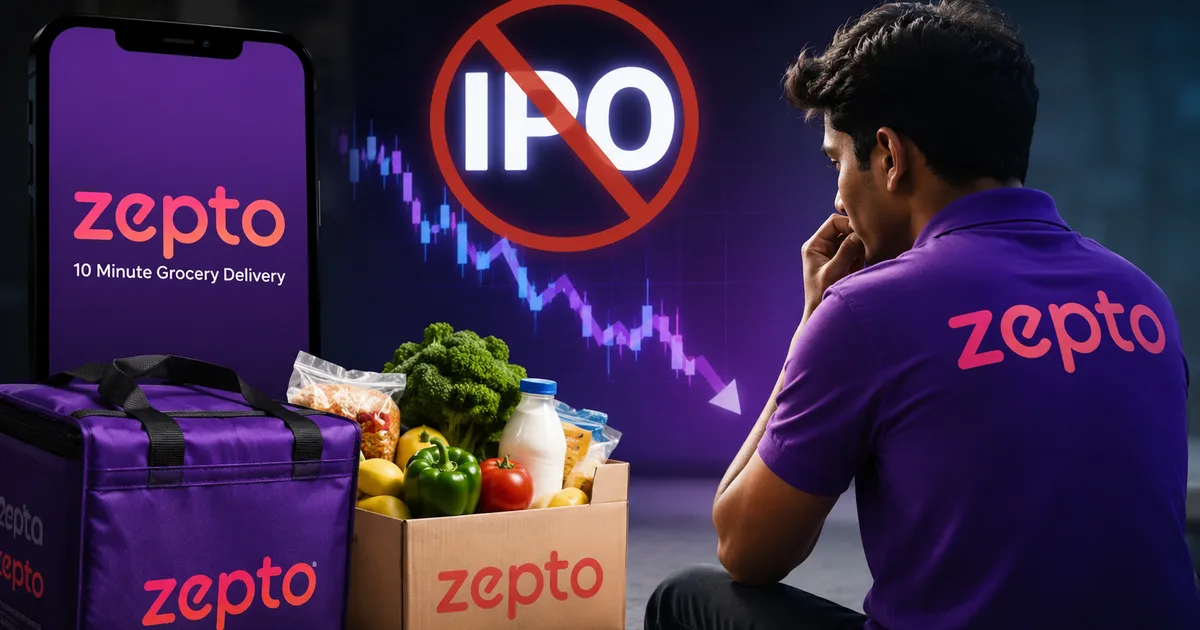
Zepto pauses 2026 IPO plans, and honestly, I'm not entirely surprised. If you've been tracking the Indian quick commerce space lately, you know the market is absolutely brutal right now. You order groceries in 10 minutes, and behind the scenes, these startups are burning cash like there's no tomorrow. Now, Aadit Palicha and Kaivalya Vohra's startup has decided to hit the brakes on its public listing.
Instead of rushing to Dalal Street, Zepto wants to raise around ₹1,000 crore in a pre-IPO funding round. The valuation is a massive $4.5 billion. But why delay the IPO? The reasons behind this delay tell us a lot about the current state of Indian startups. It's a mess out there.
Valuation concerns and market reality
Here's the deal. Going public means more than ringing a bell at the BSE. You have to convince retail investors your business actually makes money. And right now, quick commerce profitability is still a massive question mark.
The updated draft red herring prospectus (UDRHP) filed with SEBI showed Zepto planned an ₹8,010 crore fresh issue. But reports say the company got pushback on its valuation expectations. Institutional investors are getting smarter. They saw what happened with earlier tech listings like Paytm. You simply can't list at a sky-high valuation if the path to consistent profits isn't crystal clear. (Which makes sense, actually.)
So by pausing the IPO and choosing a private ₹1,000 crore raise from existing investors, Zepto gets breathing room. They can build more dark stores and improve their unit economics. Hopefully they can show better numbers before facing public market scrutiny.
I think this is a smart move. Raising private capital gives them at least another 12 to 18 months of runway without the quarterly pressure of public shareholders asking about EBITDA margins.
The true cost of 10-minute deliveries
Think about the logistics for a second. You open your app. You select a packet of milk and maybe a charging cable. Within 10 minutes, a delivery partner is at your door in the sweltering heat or pouring rain of Mumbai or Bengaluru. Making this happen takes a really dense network of dark stores.
These dark stores are small warehouses packed with inventory. They're located right in the middle of expensive residential neighborhoods. Rent is high. Electricity for cold storage is expensive. Delivery partner payouts are going up because of inflation and rising fuel costs. Adding all this up means the cost of delivering that single packet of milk is super high.
Zepto initially planned to use a big chunk of that ₹8,010 crore from the IPO to fund a massive dark store blitz across India. Now they only have ₹1,000 crore coming in from the pre-IPO round. They'll have to be much more calculated about where they expand next.
In my experience, we're likely going to see a slowdown in expansion into smaller tier-2 and tier-3 cities. Instead, Zepto will probably double down on dominating specific high-income pin codes in Delhi NCR, Mumbai, and Bengaluru where average order values are much higher. You can read more about how startups manage their capital in our explainers section.
The mystery of unit economics
You hear this term "unit economics" thrown around a lot by venture capitalists. But what does it actually mean for a company like Zepto? It's pretty straightforward. Does the company make a profit on a single order before factoring in corporate overhead like the CEO's salary or office rent?
For a long time, the answer in quick commerce was a solid no. Startups were losing money on every single delivery just to get customers. They hoped that once you got addicted to 10-minute deliveries, you'd stop caring about discounts and pay a premium for the convenience.
We're finally starting to see that shift happen. To reach profitability, quick commerce platforms typically focus on a few main areas:
- Increasing the average order value with premium items like electronics.
- Charging small platform and delivery fees on every order.
- Negotiating better bulk margins directly with FMCG brands.
Basically, Zepto needs this extra time before their IPO to prove these unit economics actually work at scale. They have to show a mature dark store is generating free cash flow. Once they can prove that consistently across hundreds of stores, the public markets will be much more welcoming.
What this means for the quick commerce battle
Zepto is fighting a multi-front war against Blinkit and Swiggy Instamart. Tata BigBasket is in the mix too. Blinkit has been expanding fast under Zomato's umbrella. And Swiggy's own public listing is changing the dynamics of the food delivery and quick commerce sectors.
Zepto needs capital to keep fighting this war. But the ₹1,000 crore they're raising now is just a fraction of what they initially wanted from the public markets. They'll have to be slightly more targeted. They're still growing. But the era of reckless expansion is definitely over.
For you, the consumer, this means the discounts might slowly start shrinking. Startups have to show a path to profitability eventually. So expect higher delivery fees, more surge pricing during rains, and a massive push towards higher-margin items.
Notice how your Zepto app now pushes electronics and high-end skincare right at the top? That's by design. Selling a ₹2,000 face serum gives them a much better margin than selling a ₹50 packet of coriander. This shift in inventory is exactly how they plan to boost their bottom line before going public.
The regulatory and market environment in 2026
We also have to look at the broader Indian startup ecosystem in 2026. Retail investors have been burned before. SEBI is keeping a very close eye on tech IPOs right now. The regulator wants to make sure retail money is protected from highly speculative ventures.
Plus, the Indian market is shifting. We're seeing more traditional businesses list successfully, while tech companies with high cash burns are getting tougher questions from institutional buyers. Zepto's decision to wait it out might just be reading the room correctly.
It's definitely better to delay an IPO and list strong later than to force a listing now and watch the stock price crash on day one. (I know, sounds obvious, but you'd be surprised how many founders let their egos dictate IPO timing.)
And let's be real about the overall funding environment. Global investors are tightening their belts. Money is no longer free. Startups can't just promise future growth anymore. They need to show actual revenue today. The days of zero-interest-rate money are gone, and the quick commerce sector is feeling the pinch.
The impact on employees and stock options
There's another angle here nobody really talks about. The employees. Many early employees at these startups work long hours with the promise of lucrative Employee Stock Ownership Plans (ESOPs). When an IPO happens, these stock options turn into real cash. A delayed IPO means these employees have to wait longer to get paid.
This can cause retention issues. If you're a top-tier engineer or a logistics expert at Zepto, and your payout just got pushed back by a year or two, you might start looking at offers from other tech companies. Keeping team morale high during a delayed listing is going to be a tough challenge for the leadership team.
But the pre-IPO funding round might include a secondary component. This lets some early investors or employees liquidate a small portion of their shares. I'm not sure exactly why we don't have confirmed details on that yet, but it's a common practice to keep top talent happy. If you're interested in how tech compensation works, take a look at our tools to understand startup equity better.
Quick commerce vs traditional e-commerce
Let's take a step back. We should compare this to traditional e-commerce players like Amazon or Flipkart. Amazon can afford to take two days to deliver your package because their warehouse is outside the city limits where rent is cheap. Their delivery routes are highly optimized, carrying hundreds of packages in one trip.
Zepto operates on the promise of instant gratification. A rider might make a trip for just one order. Basic economics makes this more expensive to run. The only way it works at scale is if users consistently order high-value items, not just emergency tomatoes.
The push into non-grocery categories is a clear sign. Quick commerce is trying to eat into the market share of traditional e-commerce. If you need a new phone charger, and Zepto can get it to you in 10 minutes for roughly the same price as Amazon, you'll probably choose Zepto. But changing consumer behavior takes time and money. Zepto is trying to secure that money right now.
The role of pre-IPO investors
Raising ₹1,000 crore from existing investors is a strong signal of trust. These investors have already poured millions into the company. By committing more capital now, they're basically saying they believe in the long-term vision. They're willing to wait for their exit.
It also protects the company's valuation. Going to the public markets right now might have resulted in a down round listing. That means the company would be valued lower than its last private funding round. That looks sketchy for any startup. By staying private a bit longer, they protect their $4.5 billion price tag and give themselves a chance to justify it.
We've seen this playbook before. Many successful Indian tech companies opted for one last private round before finally going public. It lets them clean up their balance sheets and settle any outstanding regulatory issues. They can present a much cleaner narrative to retail investors.
What happens next?
Zepto is officially in talks with its existing backers to secure that ₹1,000 crore at a $4.5 billion valuation. If this goes through smoothly, they'll continue to aggressively expand their network while trying to rein in costs. They're also trying to diversify their revenue streams. They want to add more private-label brands because those offer significantly better margins.
As for the IPO, it's likely pushed to late 2026 or even early 2027. They'll need to show at least a few quarters of near-break-even or actual profitability. Only then can they command the valuation they want from public markets. You can follow more on startup funding trends in our news category.
"A delayed IPO is always better than a failed one. Companies need to respect public market money, especially retail investors."
This is a classic case of reality catching up with hyper-growth. Quick commerce is here to stay in India. The convenience is just too addictive. But the businesses running it are finally having to act like traditional, profit-focused companies. And for the Indian startup ecosystem, that maturity is exactly what we need right now.
Keep an eye on how Blinkit and Swiggy react to this. The quick commerce wars are far from over. But the battleground is shifting from pure growth to actual sustainability. The winner won't be the one who delivers the fastest. It will be the one who can do it without bleeding money on every order.
We'll keep tracking this space closely. If you want to understand the broader impact of tech policies, check out our deep dives into the latest regulations in our guides section.