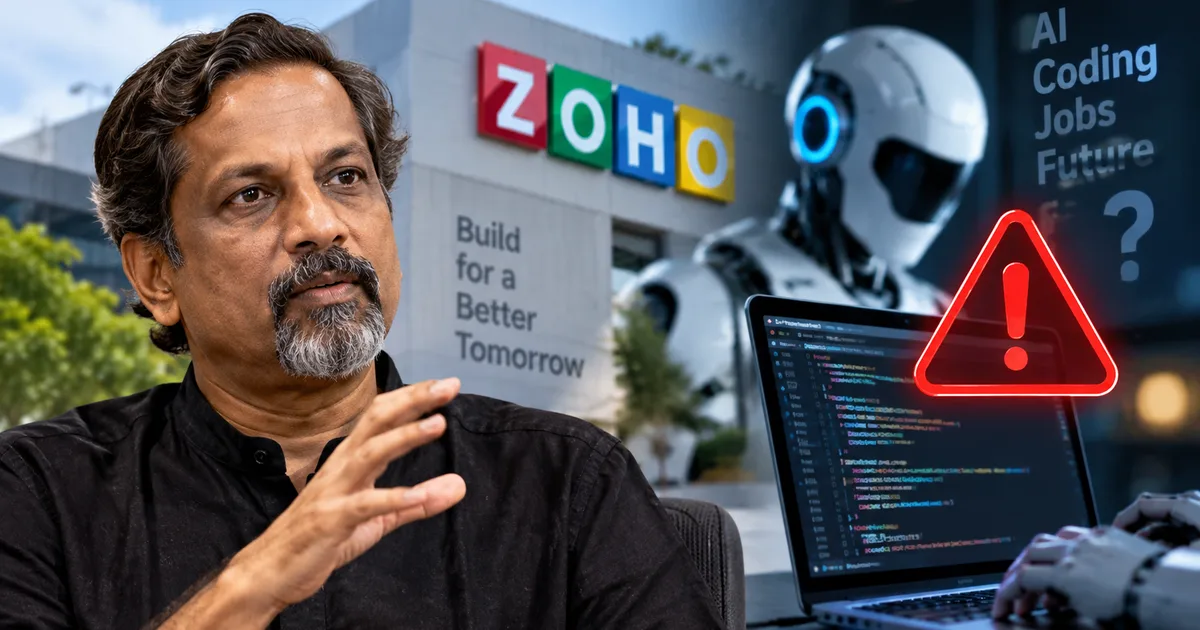
I read through the latest comments from Sridhar Vembu today. If you work in the Indian IT sector, you should probably pay attention to the Zoho CEO Sridhar Vembu AI coding warning 2026. The man rarely minces his words. Right now, he's telling software engineers that coding alone is no longer enough to keep a roof over your head.
Look, we've all seen the viral posts on X about how fast AI can build a complete application. Someone with zero programming background built an app called the '10 Minute Gita' just by prompting a machine. That's exactly what Vembu is pointing at. He tells his own engineers to use these tools. But he draws a very hard line. If you let the machine do everything, you lose your understanding of the underlying logic. And then you're going to be out of a job.
Honestly, he's completely right. We have an army of developers in Bengaluru and Hyderabad who treat code like a factory assembly line. You get a requirement. You write the syntax. You push it and go home. That model is dead. The market doesn't need human syntax generators anymore.
The reality of coding in 2026
You might think I'm exaggerating. I'm not. The code generation tools we have right now are incredibly fast. They don't take tea breaks. They don't complain about the traffic on the Outer Ring Road. They just generate code.
But here's the catch. The code they write is a black box. If you don't know how to debug it when it breaks in production, you're useless to a company. Vembu made this explicitly clear. He backed a warning from a Meta engineer. Layoffs will continue. Companies are realizing they need fewer people to do the same amount of work. The Latest Tech News is filled with reports of companies quietly reducing their engineering headcount across India. In my experience, these quiet cuts are the scariest kind.
This isn't a future problem. This is a today problem. Ignoring it will only hurt you.
Why Vembu is ringing the alarm bells
Vembu is looking at the economics of this whole boom. Writing code faster is just one part. The cost of running these models is massive. He recently warned about a 'sticker shock' coming for all of us.
Companies are buying up GPUs and memory chips. So the prices of regular smartphones and laptops are going to shoot up. We could be looking at a situation where a decent developer laptop jumps by ₹30,000 to ₹40,000. The global supply chain is just strained by hardware demands.
Tech companies have skyrocketing server bills. They have to cut costs somewhere else. That 'somewhere else' is the engineering team. Indian IT services companies operate on thin margins. Their hardware costs go up. Their software subscriptions cost thousands of rupees per employee. They have to recover that money. How do they do it? By hiring fewer people.
I think a lot of fresh graduates don't want to hear this. They spent four years in an engineering college learning Java or Python. They paid lakhs in fees. Now a guy who runs one of India's biggest software companies is telling them to find alternative livelihoods (which makes sense, actually). That's a tough pill to swallow. But hiding from the facts won't save your career.
The productivity paradox and tech layoffs
There's another angle to this. Nobody is talking about it enough. Vembu called it a productivity paradox. We're pouring hundreds of billions of dollars into these systems. Are we actually getting the returns? I'm not sure exactly why we expect instant magic.
We hear stories every day from mid-level managers in IT hubs like Gurugram and Chennai. They buy enterprise licenses for these coding assistants. They expect their teams to suddenly ship features twice as fast. The reality is different. The code gets written quickly. But then it goes into testing. The QA team finds weird bugs. A human would never write these bugs. Then the engineer has to spend three days reverse-engineering what the machine did. That isn't productivity. That's just shifting the bottleneck from writing to debugging.
Some tech companies are firing workers for no real reason. They just want to please Wall Street. They want to look like they're adopting new technology aggressively. So they cut 10 percent of their staff. Then they announce a new initiative. It's a script we've seen play out multiple times this year.
"I tell our engineers to use AI, but never lose understanding of the work."
That's the core message from Vembu. You have to understand the work. You can read more about how this fits into the broader picture in our guide on the Zoho CEO Sridhar Vembu 2026 Statement: AI's Impact on the Indian Tech Job Market Explained. It's a mess for everyone involved.
What Indian developers actually need to do
So what do you do now? Do you just quit and start a farming business? Probably not. Vembu does talk a lot about rural expansion and agriculture. But if you want to stay in tech, you need a different plan.
You can't just be a syntax translator anymore. You have to adapt.
Build alternative skills
You need to know how systems fit together. You need to understand architecture. The machine writes the individual components. You need to be the person who knows how to connect the database and the security layers safely.
Look, I'm not saying you should ignore these new tools. You absolutely have to use them. But you have to use them like a senior developer uses a junior developer. You give it discrete tasks. You review its work aggressively. You don't just take its output and push it to production without a second thought. Because when the server crashes at 2 AM, your boss isn't going to call a chatbot. They're going to call you. If your only excuse is 'that's what the machine wrote', you might as well pack your bags.
Security is a massive issue right now. A code generator will happily write a script with a massive vulnerability if you prompt it poorly. You're the safety net. We've seen what happens when things go wrong in our coverage of Tech Explainers. You don't want to be the engineer who pushed unverified code that leaked millions of user records.
Understand the Indian context
You also need domain knowledge. If you're building a fintech app in India today, you need more than React or Node.js. You need to understand how the UPI stack actually processes a transaction.
You need to know the failure rates of Aadhaar eKYC. You need to understand how to integrate with DigiLocker for document verification. A tool built in San Francisco doesn't inherently understand the nuances of the RBI's data localization rules. It doesn't know why a ₹500 transaction might fail on a rural network in Bihar. You do. Or at least, you should.
This is where your human value is. You have context. You know the local market. A machine just predicts the next logical word in a sentence.
Are layoffs going to get worse?
Honestly, yes. I don't see this slowing down. The pressure from investors is too high.
Companies will keep trying to replace junior developers with automated tools. Indian IT giants are reducing their intake of freshers.
The days of TCS or Infosys hiring 40,000 graduates in a single drive are looking like ancient history. The companies want smaller teams of highly experienced engineers who can oversee output.
If you're a junior developer earning ₹6 LPA, your job is exactly the one the company wants to automate. It sounds brutal. But that's the reality of the market. They want one senior engineer earning ₹25 LPA who can do the work of five junior developers.
There's a silver lining here. The companies that fire all their human engineers and rely purely on automated code generation are going to build terrible software. Their apps will be slow and insecure. Users will eventually leave them. So the companies that survive will be the ones that understand the balance. They'll employ smart humans who use automation to do the boring work. The humans will focus on the hard problems. Your goal is to be one of those smart humans. Don't be the person doing the boring work.
- Stop calling yourself just a coder.
- Start learning about system design and architecture.
- Focus on business logic and Indian compliance regulations.
- Treat code generation as an assistant, not a replacement for thinking.
Vembu's warning is a wake up call. It's time to stop acting like knowing a programming language is a superpower. It's just a basic requirement now. The real superpower is knowing how to solve business problems. Start looking at your job differently.