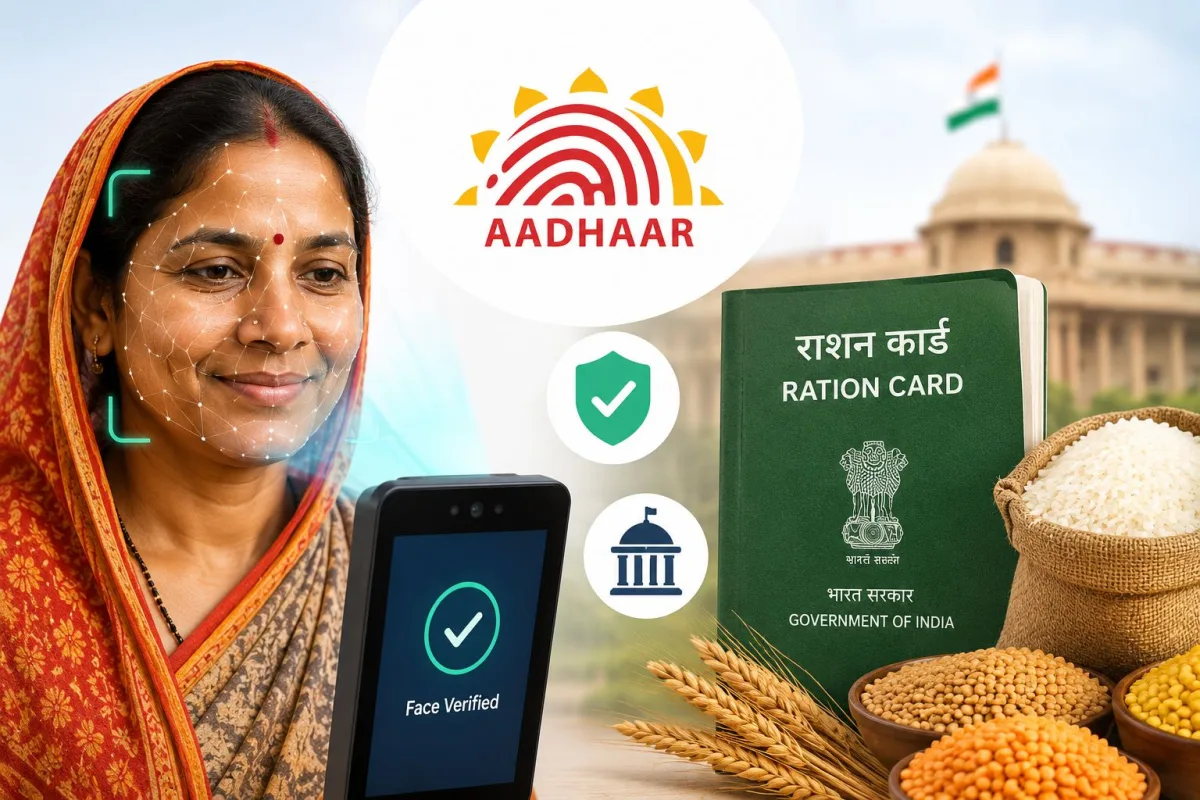
If you've visited a ration shop in Himachal Pradesh recently, you may have noticed something different at the counter. Instead of pressing your finger on a biometric device, the shopkeeper holds up a tablet or phone, you look at the camera, and the system verifies your identity in seconds. This is Aadhaar face authentication in action, and it's quietly becoming one of the bigger shifts in how India delivers government services in 2026.
Himachal Pradesh was the first state to formally roll out face-based identity verification for ration distribution under the Public Distribution System (PDS). But they won't be the last. The Union government has been pushing facial recognition as a backup and primary authentication method through UIDAI for a few years now, and 2026 is when it's really picking up speed.
What is Aadhaar face authentication and how does it work?
UIDAI, the authority that manages Aadhaar, has multiple ways to verify your identity: fingerprint scan, iris scan, OTP to your registered mobile, and face authentication. Face auth was added as a fourth method to solve a real problem. Millions of Indians, especially manual labourers, farmers, and elderly people, have worn-down fingerprints that biometric readers simply can't scan reliably.
The way it works is pretty straightforward. A government service operator, say a ration shop owner, a hospital registration desk, or a government service centre, uses a certified app (typically the AadhaarFaceRD app from UIDAI) on a device. You look at the camera, it captures a live image, and that image is matched against the photo UIDAI has on record for your Aadhaar number. The match happens on UIDAI's servers, not on the device. No photo is stored locally.
UIDAI requires what's called a 'liveness check', so a printed photo of you won't work. The system checks for eye movement or other signals to confirm you're actually present. This matters for the obvious reason: you don't want someone holding up a photo of a beneficiary and claiming their ration.
In early 2026, UIDAI ran the IndiaAI face authentication challenge to improve accuracy. HyperVerge won that challenge, and UIDAI then selected six organisations for video-call-based authentication prototypes. So the technology is still being refined. It's not fully solved.
Which government services now use face authentication in India?
The clearest use case right now is the Public Distribution System, basically your ration card benefits. Himachal Pradesh has gone the furthest here, making face auth the primary method at fair price shops. Other states are at various stages of piloting or rolling out similar systems.
Beyond rations, face authentication is available for:
- Ayushman Bharat health scheme verification at empanelled hospitals
- EPFO (Employees' Provident Fund) life certificate submission for pensioners — this one is genuinely useful for pensioners who can't travel to submit jeevan praman in person
- Doorstep banking services where bank correspondents verify customers
- PM-KISAN beneficiary verification in some states
- State government welfare scheme disbursements where fingerprint failure rates were high
The Puducherry government recently launched a digital currency pilot for food subsidies that also uses Aadhaar-based verification, though their approach involves a separate token system alongside biometric checks.
Ayushman Bharat is another area where face auth is being pushed hard. When you go to an empanelled hospital, staff verify your Ayushman card by checking your Aadhaar identity. Several states now accept face authentication as an alternative when fingerprints fail, which happens more than people realise (especially with elderly patients, honestly).
How to use Aadhaar face authentication at a ration shop
You don't actually need to do anything to 'set up' face authentication. Your Aadhaar photo is already in the UIDAI database from when you enrolled. What matters is that the ration shop or service centre has a device with the AadhaarFaceRD app and an active internet connection.
Here's what the process looks like from your side:
- Tell the operator your Aadhaar number (or they may scan your Aadhaar QR code)
- Look directly at the front-facing camera on their device when asked
- Stay still for 2-3 seconds while the liveness check runs
- The system confirms your identity — usually within 5-10 seconds if connectivity is good
- Your transaction proceeds normally
Good lighting helps. If you're standing in a dark ration shop, the camera may struggle. Some operators have figured this out and will step outside or use a torch. Others haven't. Connectivity is the other variable. In areas with poor 4G coverage, face auth can fail or time out, which is why UIDAI still allows fingerprint as a fallback.
What if face authentication fails?
This is the question that matters most for ordinary beneficiaries. A face auth failure doesn't mean you get turned away. UIDAI's guidelines say that operators should try alternative authentication methods, fingerprint, iris, or OTP to your registered mobile number, before denying service.
The problem in practice is that some operators, especially at the ground level, may not know this or may not bother. If you face a situation where you're being denied rations or services due to authentication failure, you have a few options:
- Ask specifically for OTP-based authentication if your mobile number is linked to your Aadhaar
- Request a manual override through the supervisor at the distribution centre
- File a grievance through the UIDAI portal at uidai.gov.in or call their helpline at 1947
- Contact your state's food department grievance portal
The right to food subsidy can't be denied solely on the basis of a biometric failure. This has been UIDAI's position since at least 2018. But enforcement at the last mile is patchy.
Privacy concerns worth knowing about
I'm not going to pretend there aren't legitimate concerns here. The India Forum published a piece in early 2026 on datafication and the erosion of citizenship rights, and the core argument, that mandatory biometric systems create exclusion for those who don't match cleanly, is one that civil society has been raising for years.
On the specific question of what UIDAI does with your face scan: according to UIDAI's published documentation, the face image captured during authentication is used only for that specific transaction and is not stored. The match score is returned as a yes or no, not the image itself. Whether you trust that assurance depends on your level of trust in government data systems generally.
UIDAI states that face authentication data is processed in real-time and not retained post-authentication, consistent with the authentication framework under the Aadhaar Act 2016. No biometric data is stored at the operator's device.
The DPDP Act 2023, India's data protection law, classifies biometric data as sensitive personal data. But the Aadhaar Act has its own framework that the DPDP rules defer to in places. The exact overlap, and what protections you actually have, is something I couldn't find a clear official answer on. It's still being worked out (annoying, I know).
The new Aadhaar app and what's changed in 2026
UIDAI launched a revamped Aadhaar app in late 2025, formally dedicated to the nation through a PIB announcement. The app now supports offline KYC, mobile number updates from home in limited cases, and improved face authentication flows for end users.
Separately, there was speculation in early 2026 that UIDAI was planning a physical redesign of the Aadhaar card itself. The IT Ministry clarified that no such plan was in motion and that the speculation was 'not correct'. So your existing Aadhaar card is still valid. Nothing to do there.
One thing that actually changed: the government quietly dropped a proposal to pre-install the Aadhaar app on all Android phones sold in India. MediaNama reported this in early 2026. That plan, which would have required OEMs to bundle the app, ran into pushback and was shelved. For now, you download the app voluntarily from the Play Store or App Store if you want it.
Should you be worried about face authentication replacing other methods?
Honestly, for most people, face authentication is more convenient than fingerprint scanning, especially if you've ever stood at an AePS terminal for five minutes while a machine refuses to read your thumb. The technology works reasonably well in decent light. And for elderly beneficiaries who've had fingerprint failures for years, it's a real improvement.
The concern is about what happens when it becomes the only option. Right now, UIDAI policy is that face auth supplements other methods, it doesn't replace them. As long as that holds, the system is more inclusive than what came before. If states start mandating face-only authentication, or if operators on the ground behave as if it's mandatory, that's when problems start.
Watch for updates from your state's food department if you rely on PDS benefits. And if you use DigiLocker or the Aadhaar app, keep them updated. The face auth SDK gets updated periodically and older versions can fail even when your face is perfectly fine.
For pensioners using Jeevan Pramaan: the face-based life certificate option through the app is genuinely one of the better things the government has done in this space. You can submit your annual life certificate from home, via the Jeevan Pramaan app, without going to a bank or post office. If you know a pensioner who still makes that annual trip, point them to this guide.