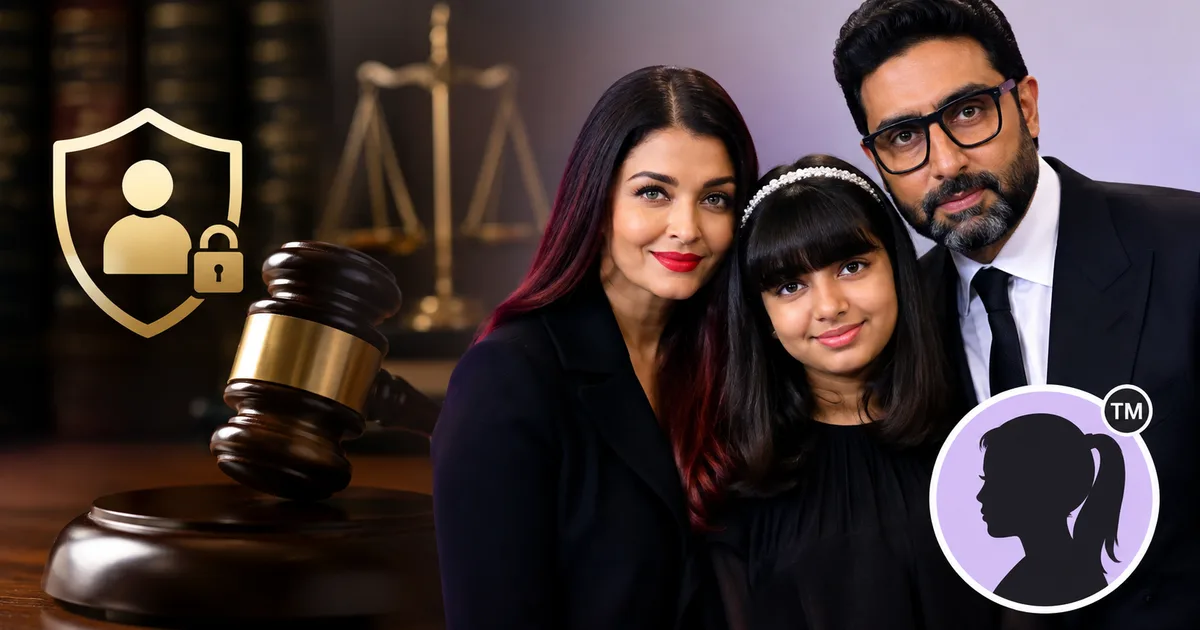
You've probably seen them. Those absolutely wild YouTube thumbnails claiming a Bollywood star has a secret child, or that some famous kid is secretly sick. It's sick. And it's exactly what the Aaradhya Bachchan Personality Rights Case 2026 is trying to stop. The Delhi High Court is now looking at this mess. The questions they are asking will probably change how Indian internet users deal with fake news forever.
Honestly, I'm surprised it took this long. When Abhishek Bachchan and Aishwarya Rai went to court back in 2023 over fake videos about their daughter's health, it felt like a dam was finally breaking. But what happened recently in the Delhi High Court is way more interesting than a normal celebrity lawsuit. It's about how the law handles reputation in the internet age.
The court asked a very specific question. They asked if a famous family name's reputation "flows down generationally." And they also said that personality rights are acquiring "amoebic proportions." That's a fancy way of saying things are getting completely out of hand (which makes sense, actually).
The Delhi High Court ruling and observations
During the recent hearings, the court made a few observations that really stand out. First, they questioned whether a famous family name's reputation flows down generationally. The judges were basically asking if a child automatically inherits the legal protections of their incredibly famous parents and grandparents. I think this is a huge deal.
Second, the court stated that personality rights are acquiring amoebic proportions. That's a perfectly accurate description. The concept of personality rights is stretching and changing shape trying to cover all the weird new ways people exploit each other online. The law was written for newspapers and television. It has no idea what to do with a teenager in a tier-two city generating deepfakes for Telegram groups.
Let's talk about that amoebic comment for a second. In the past, personality rights were simple. A brand couldn't use Sachin Tendulkar's face to sell soap without paying him. But today, the internet allows anyone to manufacture an entire narrative around a famous person using AI tools and voice cloning. The court is recognizing that the old definitions just don't work anymore. If you ask me, the courts are playing catch-up.
Why this matters for everyday Indian users
You're probably thinking that you aren't a Bachchan, so why should you care? I get it. This case is about establishing the rules for how tech platforms operate in India.
When the Delhi High Court issues a ruling on personality rights, it sets a legal precedent. That precedent eventually shapes the policies that companies like Google and Meta have to follow. If the court decides that platforms are financially liable for the fake news they host, you'll see an immediate change in what gets recommended on your feeds. I'm not sure exactly why it takes a massive lawsuit to get here, but it does.
Right now, if someone creates a fake profile of you on Instagram or spreads malicious rumours about your small business on WhatsApp, you have very little recourse. You can report the account and maybe get a generic automated rejection email. By forcing the courts to define the limits of online reputation, this case might eventually make it easier for regular people to get harmful content taken down. We need clear legal frameworks, not community guidelines written in California.
The business model of YouTube fake news
The really frustrating part of this entire situation is the economics. These YouTubers aren't spreading lies because they hate the Bachchan family. They're doing it because the YouTube algorithm rewards engagement. Nothing drives engagement quite like outrage and morbid curiosity.
A sensational video about a celebrity illness can easily rack up millions of views in a few days. In the Indian market, that translates to thousands of rupees in ad revenue. Some of these channels operate like small factories. They churn out dozens of fake videos a week. They know exactly how to manipulate the system.
I've seen channels that look completely legitimate at first glance. They use professional-looking graphics and AI voiceovers. They mix in real news with complete fabrications. The algorithm gets confused and treats them as an authoritative source. It's a highly profitable business model. And until the platforms face real legal consequences, they won't shut it down. Honestly, the numbers here are a bit fuzzy, but the profit margins are huge.
The link between fake news and financial scams
You might wonder how a fake video about a celebrity connects to your wallet. The answer is simple. These viral videos are often used as bait. Scammers know that people are naturally curious about celebrity gossip. They use that curiosity to drive traffic to malicious websites or WhatsApp groups.
I've seen countless examples where a fake news video has a link in the description promising more details. When you click that link, you're taken to a fake news portal that asks you to verify your age using your Aadhaar number, or prompts you to download an APK file. Once you install that file, the scammers have access to your SMS messages. They can read your OTPs and drain your bank account via UPI before you even realize what has happened (annoying, I know). CERT-In has issued multiple advisories about these exact financial scams. But the scams keep happening.
This is why the government's push for digital literacy is necessary. We've built incredible public infrastructure like UPI and DigiLocker. They make life incredibly easy. I use UPI to pay for everything from a cup of tea to my electricity bill. But that same convenience makes it easy for scammers to operate. When platforms like YouTube allow fake news to thrive, they are creating a playground for financial criminals.
The deepfake problem is getting worse
The 2026 tech landscape is completely different from when this lawsuit was first filed in 2023. Back then, the fake videos were mostly bad photoshops and cheap text-to-speech voiceovers. Today, the internet is flooded with highly realistic deepfakes.
We've seen AI-generated videos of prominent Indian journalists endorsing sketchy investment apps. We've seen deepfakes of Bollywood actors promoting gambling sites. The technology to create these videos used to require an expensive computer and a degree in machine learning. Now, anyone with a smartphone and an internet connection can generate a convincing fake video in about ten minutes. In my experience, these fake videos are only getting harder to spot.
Thing is, this makes the Delhi High Court's job incredibly difficult. If they restrict personality rights too much, they leave people vulnerable to deepfake extortion. If they make the rules too strict, they risk crushing the legitimate creator economy. It's a massive balancing act. There are no easy answers.
"The legal framework must evolve to address the realities of algorithmic content distribution. The current system places an unfair burden on the victim to constantly monitor the internet for defamatory content."
I read that quote in a tech policy newsletter last week. It sums up the situation perfectly. The burden of proof is entirely backward right now.
Tech policy and the DPDP Act
This brings us to the broader tech policy landscape in India right now. We have the Digital Personal Data Protection (DPDP) Act, which focuses on privacy and data handling. But data privacy is very different from reputation management.
The DPDP Act tells companies how they can store your Aadhaar number or your phone contacts. It doesn't stop a random YouTuber from creating a defamatory video about you. For that, we still rely on the Information Technology Rules and the Indian Penal Code. The problem is that these laws are reactive. You have to wait for the damage to be done before you can file a complaint.
What we actually need is proactive moderation. The tech companies have the resources to build AI systems that flag this kind of content before it goes viral. They just choose not to deploy them aggressively because it costs money and hurts their engagement metrics. If you ask me, they'd rather wait for a court order.
How to protect yourself online
While we wait for the legal system to catch up, you have to be your own content moderator. If you're dealing with online harassment or fake profiles, there are a few things you can actually do.
- Report everything immediately on the platform, but don't stop there. The in-app reporting tools are mostly useless.
- Go to cybercrime.gov.in and file an official complaint. The process is entirely online and actually works better than you might think.
- Call the 1930 helpline if you're the victim of a financial scam. Do this within the first hour if possible.
- Document everything. Take screenshots of the offending content, the user profiles, and the URLs. Once they delete the video, the evidence is gone.
In my experience, these steps might seem tedious. But they're currently your only real defense.
The limits of the law
One of the biggest challenges the Delhi High Court faces in this case is the sheer scale of the internet. Even if they order YouTube to take down all videos containing fake news about Aaradhya Bachchan, new ones will pop up the next day. It's an endless game of whack-a-mole.
You can block a specific URL, but the creator will just upload the video to a new channel. You can ban the creator. But they'll just create a new email address. Unless the courts mandate some form of identity verification for creators who monetize content, this cycle will continue indefinitely.
Look, this case also touches on the tricky balance between protecting reputation and protecting free speech. The judges have to be careful not to create a ruling that powerful politicians or corporations can use to silence legitimate criticism. If the definition of personality rights becomes too broad, any critical commentary could be labeled as a violation of those rights. I think it's a mess.
Looking ahead at the tech landscape
The Aaradhya Bachchan case is going to drag on for a while. These landmark legal battles always do. But the questions being asked right now are the right ones.
We're watching the Indian legal system try to map old-world concepts of reputation and dignity onto a digital landscape that changes every week. The outcome will likely influence the next set of IT Rules. It'll definitely influence how Google operates its video platform in this country.
For now, the best thing you can do is be skeptical of everything you see on your feed. If a thumbnail looks too sensational to be true, it almost certainly is. The internet is a machine built to grab your attention and sell it to advertisers. It doesn't care about the truth. And it certainly doesn't care about the reputation of an innocent child. We have to be the ones who care.