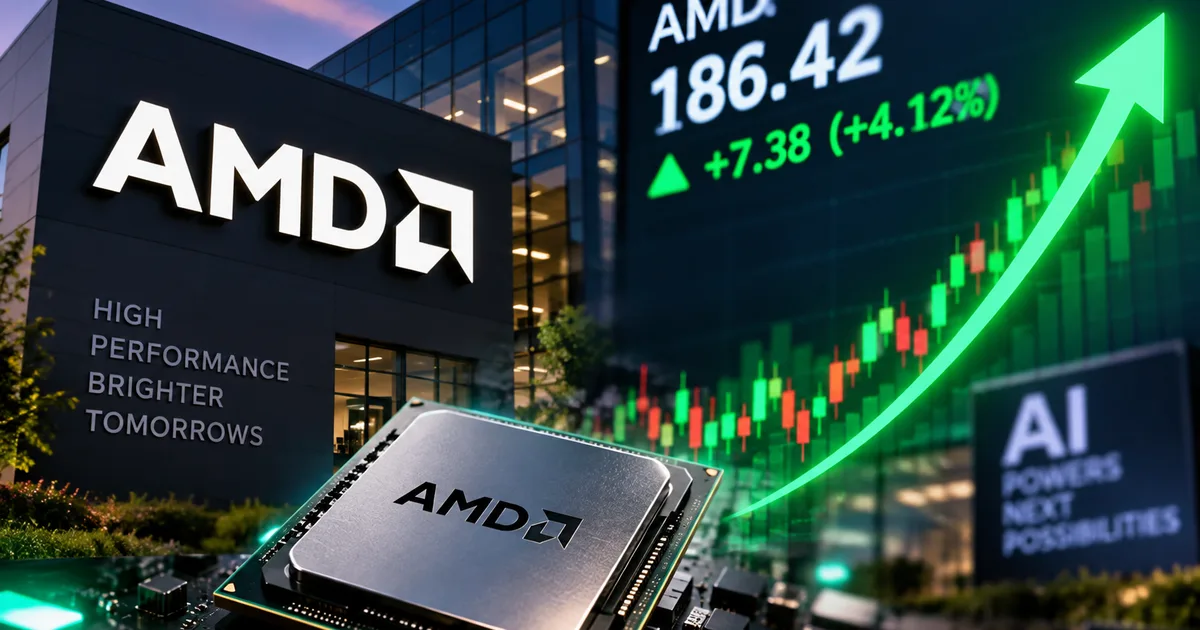
If you've been watching the global tech markets this week, you probably noticed the massive jump in AMD's valuation. Yes, the AMD share price surge September 2026 is officially here, and it just pushed the chipmaker past the historic $1 trillion market capitalization mark. Honestly, this is one of the more interesting stories in tech right now. And mostly because Nvidia has been taking all the oxygen in the room for the past two years.
I looked at the numbers this morning. AMD closed at $615.52 on Monday, September 21. They jumped almost 10% in a single day on a massive trading volume of over 44 million shares. And if you're wondering why this matters for us in India, where most retail investors don't directly buy US stocks, the ripple effects are huge. These chips power the data centers that run every AI tool we use. Everything from ChatGPT on our phones to local Indian AI startups building tools in vernacular languages.
So, what exactly is driving this insane run? Let's break it down (minus the Wall Street jargon, of course).
The real reason behind the AMD stock surge
A lot of people point to a recent analyst note from Piper Sandler. They initiated coverage with an "Overweight" rating and a $600 price target. But honestly, analysts upgrade stocks all the time. And retail investors rarely move the needle this much. The actual fuel for this rocket is their data center business. In my experience, institutional money is pouring in because the underlying numbers are genuinely shocking.
Look at their Q2 2026 numbers. AMD brought in $11.54 billion in total revenue. That's up 50% year-on-year. And that is a solid number on its own. But the real story is the Data Center segment. It hit $6.7 billion. That's up 107% from last year. This tells us one thing very clearly. Big tech companies are buying AMD's AI chips as fast as the foundries can make them.
And there's a fascinating detail buried in the financial filings that most casual observers miss entirely. AMD has signed specific warrant agreements with OpenAI and Meta. Basically, they promised these companies hundreds of millions of shares at a ridiculously low price tied to performance milestones. We're talking literally one cent here. If you want to know more about what OpenAI is planning locally, check out our explainer on the Sam Altman 2026 OpenAI India Strategy: Regional AI Centers Explained. The point is, AMD is deeply embedded with the absolute biggest AI players on the planet. They aren't just selling to them. They're financially intertwined.
What is the AMD AI chip strategy?
For a long time, if a company wanted to train an AI model, they bought Nvidia GPUs. It was almost a monopoly. If you asked an engineer in Bengaluru to build a heavy AI model, their first request was a server rack full of Nvidia hardware. But AMD has been quietly building out its alternative ecosystem. I think people really underestimated them.
They recently launched Helios. That's their first rack AI system designed to compete directly with Nvidia's enterprise offerings. And they scored a massive win this month. Microsoft is their newest buyer. Microsoft is aggressively expanding its Azure AI infrastructure, and they're using AMD chips to do it. This breaks the Nvidia monopoly. The market loves it when a monopoly gets challenged. Competition means better pricing. And better pricing means the entire AI industry can scale faster.
There are also unconfirmed reports from supply chain sources like TrendForce. They're saying AMD might increase prices on its accelerators and data center chips by about 10% in the fourth quarter. I'm not sure exactly why, and I couldn't find a clear official answer on this from AMD themselves. But if it happens, it will definitely boost their profit margins. This makes sense given that their manufacturer, TSMC, is also reportedly raising costs to keep up with the intense demand (which makes sense, actually). When you're the only other viable alternative to Nvidia, you have pricing power. And it looks like AMD is finally starting to flex it.
Impact on the Indian tech sector
You might be thinking this is great for Wall Street. But what does this mean for me in Bengaluru or Hyderabad? Actually, quite a bit.
First, it impacts the fundamental cost of AI development in India. Many Indian startups rely heavily on cloud services from AWS or Azure. Right now, running heavy AI workloads is incredibly expensive. That's because Nvidia chips are expensive to rent. If AMD can provide a cheaper, comparable alternative, cloud providers will buy them in bulk. Eventually, those cost savings should trickle down to Indian companies building AI apps for everything from agriculture to fintech. If you're tracking how the government is responding to these hardware costs and import rules, you should definitely read about India's AI Chip Import Policy 2026: Nvidia and AMD GPU Rules.
Second, we're seeing a massive shift in the hardware itself. AMD just announced new processors for what they call "agentic AI" computers. This means laptops and desktops that can run AI tasks locally. Right on the machine. You won't always need a constant internet connection to a cloud server. For Indian professionals dealing with patchy internet in tier-2 cities or strict data privacy rules in corporate banking sectors, this is a big deal. You'll soon be able to run complex AI assistants directly on your work laptop.
We're also seeing a major push in high-performance computing (HPC) research in India. Institutions like IITs and CDAC require massive computing power for climate modeling and space simulations. When AMD brings high-end computing components to the market at a lower price point, it directly enables better research funding allocation here in India. We get more compute for the same rupee.
What this means for everyday consumers
Beyond the enterprise data centers, AMD's aggressive push into AI is going to change the computers we buy next year. With the introduction of the Ryzen AI Max PRO 400 Series processors, they're forcing laptop manufacturers to build machines specifically designed for AI workloads (annoying for Intel, I know).
Right now, if you buy a premium laptop in India, you're looking at prices easily crossing ₹1,50,000 for something that handles heavy creative work or local AI processing. AMD's strategy has historically been about offering better value for money than Intel. If they apply this same aggressive pricing strategy to their new AI-enabled consumer chips, we might see capable AI PCs dropping below the ₹80,000 mark much sooner than expected. The numbers here are a bit fuzzy, but this makes advanced computing accessible to a much larger segment of Indian students and small business owners.
Can they keep this momentum going?
This is where I get a bit skeptical. The stock is currently trading at a price-to-earnings ratio of nearly 129. That's incredibly high by any historical standard. Investors are paying a massive premium because they expect AMD to keep doubling its data center revenue quarter after quarter.
Here is the reality check on their valuation:
- If their new AI chips fail to perform as well as Nvidia's Blackwell architecture in real-world software deployments, the stock will tank. Hardware specs are one thing. But software optimization is where Nvidia still has a massive lead with their CUDA platform.
- If the AI investment bubble pops and mega-cap companies like Microsoft or Meta decide to slow down buying billions of dollars worth of servers, AMD gets hit hard. They're highly dependent on just a handful of massive buyers right now.
- The fully diluted share count, once you include those warrants given to OpenAI and Meta, pushes their actual valuation even higher than the headline numbers suggest. People looking at the standard market cap are missing about 320 million shares that are basically promised at one cent each.
For ordinary retail investors sitting in India and looking at US tech funds, jumping in now feels sketchy. The stock is already priced for absolute perfection. Every future earnings report needs to be a blowout. Or the market will punish them.
But from a pure technology standpoint, seeing strong competition in the AI chip space is exactly what we need. It forces innovation. For more updates on how global tech shifts affect our daily lives, keep an eye on our Latest Tech News section.
The AMD vs Nvidia battle is going to define the next five years of computing. Right now, Wall Street is betting billions that AMD is a very serious contender. They are definitely not just a runner-up.