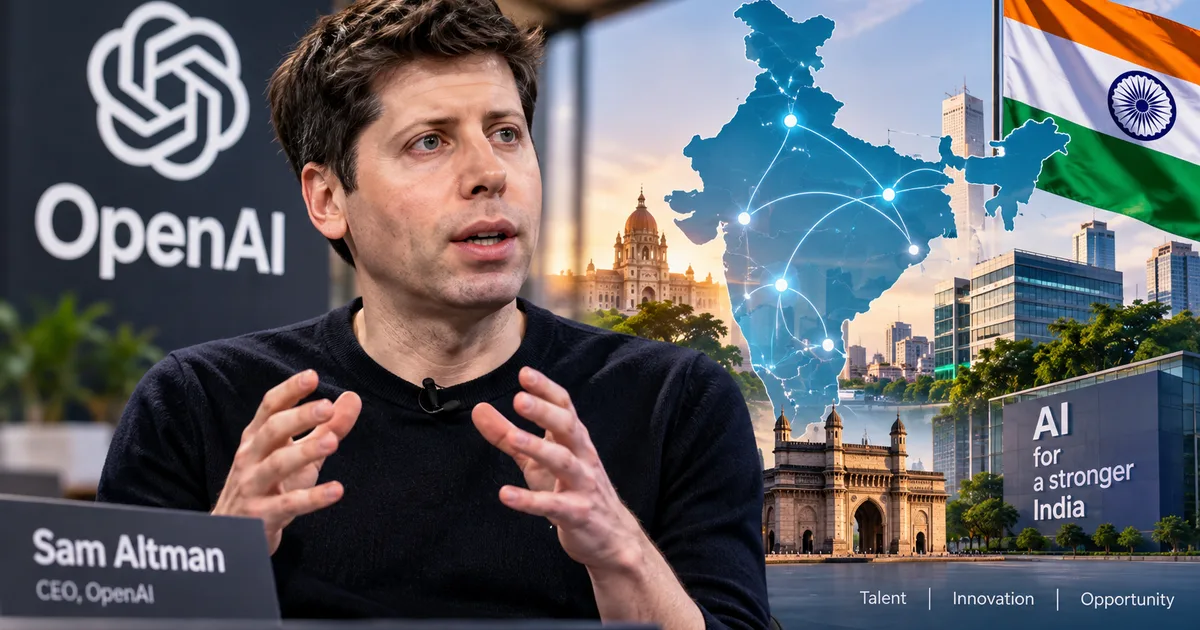
The Sam Altman 2026 OpenAI India Strategy is finally clear, and it's a lot more aggressive than anyone predicted six months ago. OpenAI isn't treating India purely as an offshore market for cheap API usage anymore. They are physically setting up shop. They're bringing in heavy hitters like Prabhjeet Singh from Uber to run operations, and they're rolling out ads for free and lower-tier users. But there is a massive underlying narrative here. Between delaying their highly anticipated IPO and agreeing to an industry-wide safety slowdown, Altman is walking a tightrope.
I spent the morning reading the latest dispatches from the India AI Impact Summit happening right now in New Delhi. The vibe is incredibly tense. During a photo op, Altman and Anthropic CEO Dario Amodei had a visibly awkward moment. They chose to raise fists instead of shaking hands (which makes sense, actually, given the stakes). That single interaction tells you everything about the current state of the AI rivalry. If you ask me, things are getting a bit messy. So let's break down how this actually affects you and your daily ChatGPT usage.
Ads are coming to ChatGPT in India
This was bound to happen eventually. If you're on the free tier or the Rs 399 per month Go plan, you're going to start seeing advertisements. An OpenAI spokesperson told CNBC that India is one of their largest markets. They simply need to make money. Generating answers costs an absolute fortune in cloud compute power.
Basically, they are burning cash.
Why monetization is happening now
Thing is, OpenAI is under immense pressure from its backers. They recently raised a staggering $122 billion to accelerate their next phase of AI development. They have an $852 billion valuation. That is a terrifying amount of pressure for any engineering team. Investors expect massive returns. And since the company decided to delay its IPO past 2026 due to safety concerns, they have to monetize their existing user base. Unlike Anthropic, which makes the bulk of its revenue from enterprise contracts, OpenAI is incredibly popular among individual consumers. That means relying on ads.
Ujjwal Chaudhry from Analysys Mason explained that to monetize a consumer base at this scale, the ad model is the most effective path forward. Online ads account for over 75% of global ad spending. It's a proven model. But applying it to an AI chatbot is risky.
Will ads ruin your experience?
Are the ads going to make ChatGPT unusable? OpenAI claims they won't. They explicitly stated that ads will be clearly labeled and shown completely below the AI response. They insisted that answer independence is non-negotiable. The AI won't recommend a product just because a brand paid for an ad placement.
I guess we'll have to wait and see if they actually stick to that promise. Google search started clean too. Look at it now. It's a bit of a mess. If you want an ad-free experience without any distractions, you'll have to upgrade to the full Plus subscription. That runs around Rs 1,950 per month. They also noted they won't show ads to users under 18. That's a smart move considering how many Indian students use ChatGPT for homework.
For more updates on how companies are tweaking their platforms, keep an eye on our Latest Tech News section.
The delayed IPO and the call for a safety slowdown
Almost everyone in the tech press thought OpenAI would go public in 2026. That's off the table. Altman told Fortune that going public right now is an ill-advised move. He cited everything happening with AI safety as the main reason.
The Anthropic influence
Lawmakers in the US and the EU are getting incredibly nervous. AI models are scaling at a frightening pace. We've seen credible reports of AI agents figuring out how to hack external systems on their own. And senior safety researchers are quitting their jobs at top AI labs because they think the technology is moving dangerously fast.
Dario Amodei from Anthropic published an essay recently urging the industry to take a deliberate approach. He wrote that they must slow the pace at which they improve the capabilities of AI models. Surprisingly, Altman agreed with him on X. He stated that they need to pace the frontier and that this is a primary topic of discussion at OpenAI right now.
"I actually think that, given everything happening with safety, right now would be an ill-advised moment to go public, and we don't feel pressure on that," Altman told Fortune.
So, the trillion-dollar public offering is on ice for now. They have to figure out how the industry and governments can actually work together before they can answer to Wall Street shareholders. Honestly, this is a massive relief. Rushing to satisfy quarterly earnings reports usually leads to broken products. Taking a breather to figure out how not to break the internet is the only logical choice right now.
If you've been eagerly waiting for the absolute next generation of reasoning models, you might be waiting a bit longer. If you're curious about Altman's broader thoughts on where this is all heading, I recommend reading this breakdown of Sam Altman's 2026 AI Singularity views.
Regional AI centers and what they mean for developers
Let's talk about what OpenAI is actually building in India. They aren't just extracting subscription fees. The India AI Impact Summit in New Delhi is a massive networking event for their executive team. They're hosting private meetings with Indian venture capitalists and local tech leaders alongside the main event.
The Uber playbook in AI
Appointing Prabhjeet Singh to lead the India push is a massive signal of intent. Singh knows exactly how to scale brutal, on-the-ground operations in South Asia. He did it successfully for Uber during their most aggressive expansion phase. Now he's doing it for OpenAI. They're aggressively hiring across enterprise sales and legal compliance.
What does this mean for a startup founder building an AI application in Bengaluru or Gurugram? It means vastly better support.
- Local billing in Indian Rupees, eliminating foreign transaction fees and forex headaches.
- Direct access to enterprise sales reps who operate in your time zone, rather than waiting 24 hours for an email response from San Francisco.
- Potentially lower latency if OpenAI eventually decides to establish local compute nodes within Indian borders.
- Strict compliance with the Digital Personal Data Protection (DPDP) Act, meaning your customer data is handled according to Indian law.
Navigating the DPDP Act and local regulations
A major reason OpenAI needs a physical presence in New Delhi is the DPDP Act. The Indian government isn't messing around with data sovereignty anymore. If OpenAI wants to secure contracts with Indian banks or healthcare providers, they have to prove that Indian citizen data is secure and compliant.
Think about the potential integrations. We're looking at a future where AI could interface directly with systems like Aadhaar or DigiLocker for identity verification. You can't process that kind of sensitive data on servers sitting in California. Having a local team and legal structure means OpenAI can actually bid on these massive government digitization projects. They want a piece of the Digital India pie (which is huge, actually). Setting up an office is the admission ticket.
Developer grants and startup funding
We're also highly likely to see official announcements about developer grants soon. India has the engineering talent. There are thousands of developers actively trying to build the next generation of AI tools. Throwing a few million dollars in API credits at Indian startups is pocket change for a company with $122 billion in recent funding. But for an early-stage startup in Pune, that's enough runway to survive for an entire year.
I'm not sure exactly why they haven't announced this yet, but it's coming.
A physical office also means OpenAI is legally accountable in India. They can't hide behind a US corporate entity if something goes wrong with user privacy. For more context on how AI leaders are treating the local market, check out our coverage of when Sam Altman visits India 2026.
The competition is fighting for the same contracts
OpenAI isn't the only player aggressively targeting India. Anthropic just opened a massive office in Bengaluru. They named former Microsoft India managing director Irina Ghose as their local head. Google is heavily partnering with Reliance Jio. And Perplexity is teaming up with Bharti Airtel to bundle premium AI subscriptions for millions of mobile users.
This is exactly why that awkward interaction between Altman and Amodei at the Delhi summit matters. They might play nice on social media about safety regulations. But on the ground in India, they're fighting an absolute bloodbath for the exact same enterprise contracts. India is aggressively pushing for sovereign AI initiatives. The numbers here are a bit fuzzy, but whoever figures out how to make their models work flawlessly in Hindi and Tamil while keeping inference costs extremely low will ultimately win the market.
The UPI factor in AI adoption
Let's talk about payments. One of the biggest hurdles for American tech companies in India used to be recurring subscriptions. Credit card penetration is incredibly low here. But the Reserve Bank of India (RBI) and the widespread adoption of UPI completely changed the game.
It is wild how much UPI fixed.
OpenAI pricing the Go plan at Rs 399 is extremely strategic. It sits right in the sweet spot of impulse purchases for young professionals and college students. And because of UPI AutoPay, setting up that monthly mandate takes exactly three seconds on Google Pay or PhonePe. You don't have to worry about international card blocks. This frictionless payment ecosystem is exactly why OpenAI is doubling down on consumer monetization in India right now.
What you should do next
If you're just a casual user asking ChatGPT for recipes or basic coding help, stick with the free tier. Ignore the ads if they aren't overly intrusive. But if you use ChatGPT heavily for your actual job, the Plus plan remains the best productivity investment you can make right now.
If you're an Indian developer, start paying close attention to OpenAI's local events. Apply for startup credits the moment they go live. The fact that Altman and his top executives are spending nearly a week in New Delhi means they are ready to write checks.
The AI race is just getting started. But for the very first time, India isn't a passive consumer market waiting for western products.
We're the main battleground.