The Anthropic Claude Enterprise 2026 India launch is finally happening, and honestly, it's about time. Anthropic just opened their first India office in Bengaluru. They officially recognize India as their second-largest market globally. For Indian businesses tired of paying dollar-pegged subscription fees for AI, the new localized pricing and in-country inference are massive changes.
I've been tracking AI rollouts for a while. Usually, India gets treated as a total afterthought. We get the features six months late. And then we pay standard US pricing converted to INR, plus GST, plus those awful international transaction fees on our credit cards (annoying, I know). Not this time. Anthropic is going aggressive. They dropped the Claude Opus 5 price significantly. And they locked in massive partnerships with TCS and Wipro. So, what exactly are you getting with the Enterprise tier? How much will it actually cost your company in Rupees?
Why the Bengaluru office actually matters
Let's skip the corporate talk for a minute. When an American AI company opens an office in India, it usually just means they hired a sales team. They want to chase enterprise contracts. But the Bengaluru setup looks different to me. Anthropic is focusing heavily on Indic languages and local partnerships. They teamed up with organizations like Karya and Digital Green. If you've ever tried using older AI models for Hindi or Marathi, you know they sound like a broken translation tool. Claude has always been slightly better at nuance. Now they're actively pushing that advantage.
And then there's the AI Tools & Software competition. OpenAI and Google dominated the conversation for months. But with this launch, Anthropic isn't just selling to individual developers or curious users. They're targeting the big Indian IT firms. Look, Wipro just set up an Applied AI Center of Excellence specifically for Claude models. TCS launched a Global Premier Partnership to scale Enterprise AI. They are building a massive footprint in the enterprise space. They're doing it fast.
This matters for regular businesses. When the big IT service providers adopt a technology, they build the infrastructure and integration tools that eventually trickle down to everyone else. The ecosystem grows. You don't have to build custom API wrappers from scratch if Wipro and TCS are already standardizing the deployment models.
The impact of Karya and Digital Green partnerships
Anthropic isn't just throwing money at big IT firms. They're also partnering with organizations like Karya and Digital Green. I think this is a really smart move. Karya works on building high-quality, ethically sourced datasets in Indian languages. They make sure the people providing the data actually get paid fairly. This means Claude's Hindi and Bengali capabilities aren't just scraped from random corners of the internet. They are trained on high-quality, verified language data. If you're building a customer service bot for rural India, you need an AI that understands local nuance. Textbook grammar just doesn't cut it.
Digital Green focuses on agriculture and rural development. By partnering with them, Anthropic shows that Claude isn't just for software engineers in Bengaluru. Or finance bros in Mumbai. They want the AI to be useful for agricultural advisory services and grassroots organizations. When an AI company invests in local datasets, the output quality jumps dramatically. The numbers here are a bit fuzzy right now, but the early signs look good. We saw this jump when Google started pushing regional languages hard. But Anthropic seems to be taking a much more ethical approach to data collection.
Localized pricing: no more dollar shocks
Here's the deal. Paying $30 or $50 per user per month hurts when the exchange rate fluctuates. If your subscription is $50, you aren't just paying 4,200 Rupees. You're paying bank fees and currency conversion charges. Plus tax on top of tax. Anthropic has started localizing Claude pricing for India. They haven't published the exact tier-by-tier INR breakdown for every single feature yet. But we know they're pushing aggressively to undercut competitors.
For context, they recently launched Claude Opus 5 priced at literally half the cost of Fable 5. That's a massive price cut for a top-tier model. It forces the whole market to adjust. When you bring that pricing philosophy to the Enterprise tier in India, you make AI accessible to businesses that couldn't justify the software expense before.
If you're running a small agency or a mid-sized startup, they also introduced "Claude for Small Business." This fills the massive gap between individual pro accounts and heavy enterprise contracts. Those enterprise contracts usually require a minimum of 100 seats. In my experience, that middle ground is a complete mess. You either share a single login, which is a security nightmare. Or you pay for enterprise features you won't ever use. The Small Business tier gives you administrative control without the enterprise price tag (a huge relief, honestly).
In-country inference: the data privacy fix
This is probably the biggest technical update, if you ask me. Anthropic is bringing in-country Claude inference to India through Amazon Bedrock. In the coming weeks, your requests will be processed on servers actually located in India if you use the India endpoint on AWS.
"A top ask from organizations here has been for options to keep their data local. By bringing Claude to AWS servers in India, Anthropic is directly answering that demand and pushing enterprise adoption forward."
Why should you care? Two reasons. First, speed. Less latency means your apps respond faster. The data doesn't have to travel to Virginia and back when you type a prompt. Second, data sovereignty. Indian banks and healthcare providers just can't send sensitive data to servers in the US. The regulations don't allow it. By keeping the data inside Indian borders, Anthropic made Claude a viable option for a ton of highly regulated industries.
Technical advantages of local AWS inference
Let's talk tech for a second. The Amazon Bedrock integration for local inference is a massive deal for Indian startups. Normally, you have to worry about the round-trip time if you build an AI application. Sending a complex prompt from Mumbai to a server in North Virginia takes time. You wait for the model to process it and send the response back. That delay makes real-time applications like voice assistants feel clunky.
With local inference, that physical distance disappears. Your data stays in the country. The processing happens locally. And the response time drops. If you're building an app that relies on instant feedback, this changes everything. Most development teams won't even need to learn a new API to switch over since Amazon Bedrock is already a standard enterprise platform.
Also, don't ignore the legal side. India's Digital Personal Data Protection (DPDP) Act is getting stricter about how companies handle user data. Sending customer information overseas for AI processing is a legal minefield. Anthropic removes that headache completely by processing everything locally. You can confidently tell your enterprise clients that their data never leaves the country.
What this means for developers
If you build tools for Indian clients, this AWS integration is huge. You don't have to jump through compliance hoops to explain where the data is going. You just check the box for the Mumbai region on AWS (which makes sense, actually). Then you are compliant with local data residency laws. If you're looking to integrate other models, you might also want to check out the Google Gemini AI 2026 Update: India features and pricing for a comparison of what is coming down the pipeline.
Inside the team workspace features
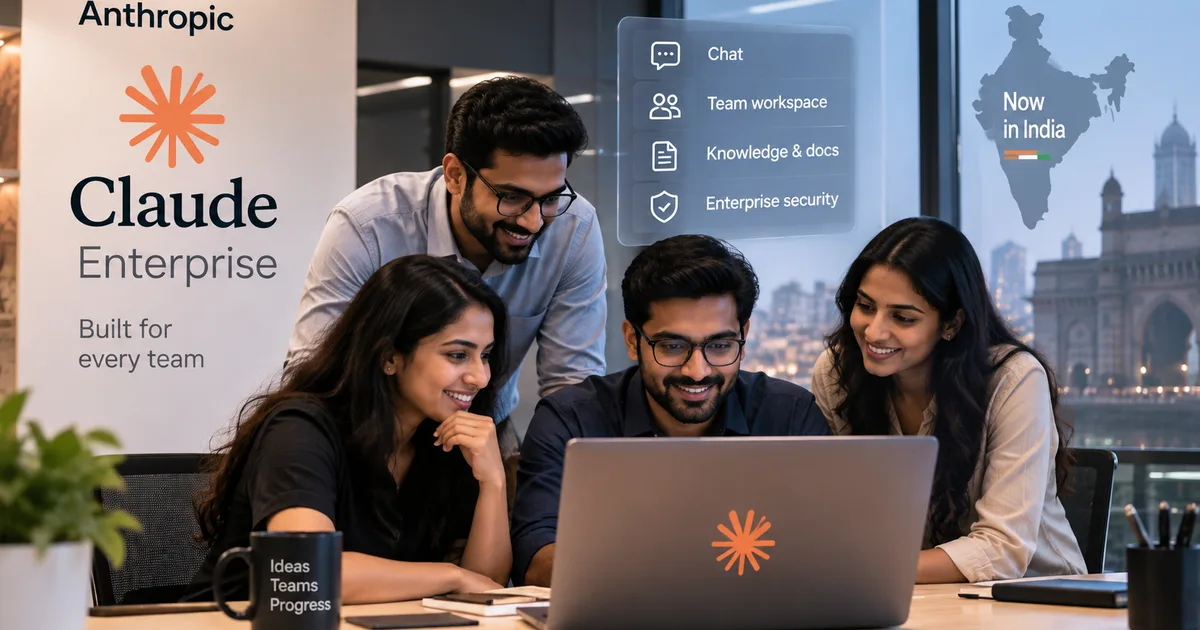
The Enterprise plan isn't just about API access or data residency. It's about how your team actually works together. Anthropic completely rebuilt the Claude workspace to focus on collaborative work. Here's what you actually get when you upgrade.
Admin controls and security
You get single sign-on (SSO) and role-based access control. Basic stuff. But absolutely necessary if you have more than ten employees. You can finally stop people from using personal emails to access company AI tools. When an employee leaves, you just cut their SSO access. They don't take your company's prompt history with them.
Shared project knowledge
This is my favorite addition. Instead of every employee uploading the same PDF manuals or financial reports into their own individual chat windows, you can create a shared knowledge base. You upload the company style guide once. Everyone in the workspace can instantly reference it. It saves a ridiculous amount of time. You just tell Claude to reference the Q3 marketing guidelines, and it knows exactly what you're talking about.
Claudeforce integration
Salesforce and Anthropic launched something they call Claudeforce. If your sales team lives inside Salesforce, this basically builds Claude directly into their CRM workflow. It drafts emails and summarizes account histories without them switching tabs. Nobody wants to copy and paste data between different windows. Claudeforce stops that entirely.
How Claude compares to the competition
Right now, the Indian enterprise AI market is crowded. Everyone is trying to sell a subscription. Here's a quick breakdown of how Claude Enterprise stacks up against the usual suspects.
| Feature | Claude Enterprise 2026 | Main Competitors |
|---|---|---|
| Data Hosting | In-country inference via AWS India | Mixed, many still route to US servers |
| Language Support | Strong Indic language focus (new Bengaluru office) | Hit or miss on local dialects |
| Pricing | Localized INR pricing | Usually strict USD pricing |
| Partner Ecosystem | TCS, Wipro, Salesforce | Varies heavily by vendor |
If you're still weighing your options for individual use, the Claude Opus 4.8 India: Pricing, Access and Features in 2026 guide we did earlier covers some of the baseline capabilities of the Opus model family. You don't necessarily need an enterprise plan if you're just testing the waters.
Should your business upgrade?
It depends. If you're a freelancer or a solo founder, stick to the Pro plan. You don't need SSO. You certainly don't need to pay for team features. But if you manage a team of five or more people, the Enterprise or Small Business tiers make a lot of sense now. The shared knowledge base alone will save your team hours every week.
The real deciding factor will be the final INR pricing tiers. I'm not sure exactly why they are delaying the numbers, but if they stick to their strategy of undercutting the competition, they'll capture a massive chunk of the Indian market. And with the new Bengaluru office driving local partnerships, expect to see a lot more India-specific features dropping soon.
Honestly, the biggest takeaway here isn't just a new product tier. It's the fact that Anthropic is taking the Indian market seriously enough to build local infrastructure. We aren't just an outsourcing hub for these companies anymore. We are the primary consumer market. That's a massive shift in how global tech operates. It's a win for anyone building tech in India.
We'll keep updating this post as Anthropic releases the exact Rupee amounts for the enterprise tiers. For now, if you're running AWS, start looking at that Bedrock integration. It's going to make your compliance team very happy.