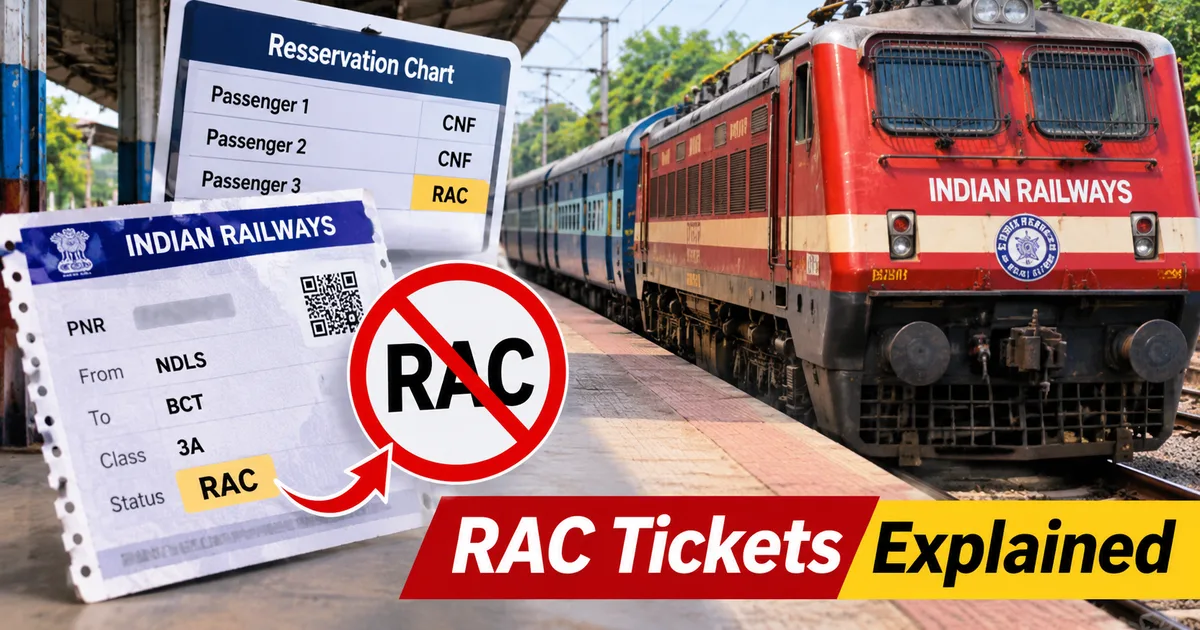
Picture this. It's 11:15 PM on a packed express train rolling out of New Delhi, and you're perched on the edge of Berth 23 in a 3AC coach. You booked your ticket three weeks ago on the IRCTC Rail Connect app and paid ₹1,680 via UPI, only to watch your status freeze at RAC 9 when the final chart came out. Now you're staring at a complete stranger's knees for the next fourteen hours. That familiar, back-breaking misery is why the Indian Railways plan to scrap RAC tickets has suddenly moved to the top of the Railway Board's agenda.
Nobody wants to pay full price for half a bed.
But for decades, millions of Indian train travellers have just accepted this messy compromise as a normal part of life. Now, reports from The Times of India and The Economic Times say the Railway Ministry is looking at whether to scrap or completely fix the Reservation Against Cancellation (RAC) system. Passenger complaints are piling up. A parliamentary panel even stepped in with a sharp rebuke, so in my experience, when both the public and lawmakers get this annoyed, the days of two adults squeezing onto one narrow strip of rexine are probably numbered.
What is Reservation Against Cancellation and how does the RAC algorithm work?
Look, railway booking acronyms can be confusing. RAC is basically the awkward middle child between a Confirmed (CNF) ticket and a Waitlisted (WL) ticket. It's like an airline selling two people the exact same window seat at full price, gambling on the math that somebody else on the flight will cancel before takeoff. Except an airline crew wouldn't actually force two strangers to share half a seat cushion if nobody cancels.
Indian Railways does it every day.
When you buy a ticket on IRCTC, the backend software run by CRIS (Centre for Railway Information Systems) grabs berths from the confirmed pool first. Every full bed in a coach goes first. Once those are gone, the Passenger Reservation System (PRS) moves to the RAC bucket. Landing here means you're legally allowed to get on the reserved coach, which is way better than having a waitlisted e-ticket that auto-cancels the second the chart comes out. (The railway booking rulebook is a total maze if you ask me, which is why we break down everyday systems like this in our detailed tech explainers.)
So, this is how the software splits up a coach to fit RAC passengers:
- In a standard Sleeper class coach, seven side-lower berths are held back for the RAC pool, which lets 14 passengers board by pairing two people per berth.
- In a Third AC (3A) coach, five side-lower berths are usually designated for RAC, putting 10 passengers into shared seating.
- In modern LHB (Linke Hofmann Busch) coach configurations, six berths are typically allocated to the RAC category.
- In a Second AC (2A) coach, three side-lower berths are set aside for RAC, accommodating six travellers across those three spots.
In the daytime, a side-lower berth folds up into two seats facing each other with a small gap between them. That works fine at 2:00 PM while you're drinking railway chai. The real mess starts at 10:00 PM. You fold those seats flat into one narrow bed, and suddenly two people who both paid 100% of the ticket fare are stuck figuring out where to put their legs without kicking each other in the shins all night.
Why the Indian Railways plan to scrap RAC tickets is gaining momentum
Do the math on this. Say a 3AC ticket from Mumbai to Patna is ₹2,100. If two passengers get stuck on RAC and have to share Berth 15 for the whole overnight trip, Indian Railways pockets ₹4,200 for that one bed. You don't get space to lie down flat, and you usually have to haggle just to get a pillow or a blanket kit, yet Indian Railways makes double the money on that exact same spot.
Honestly, I think it's sketchy that this pricing setup lasted until 2026 without a huge passenger revolt.
"There's a view that when a passenger isn't getting full sleeping space, it may not be appropriate to charge the full fare," a senior official told The Times of India while confirming the internal review.
And this sudden rethink didn't just happen out of nowhere. A parliamentary panel recently looked at train operations and said flat out that charging full price to people who stay in RAC after chart preparation isn't fair. They pushed the Railway Ministry to build a refund system for anyone who pays full fare upfront but never gets their own berth.
The awkward reality of sharing a side-lower berth overnight
Money aside, the actual physical setup on the train is a daily headache for both passengers and railway staff. Have you ever seen a Train Ticket Examiner (TTE) walk into a coach at 11:00 PM and realize a random guy and a solo female traveller are assigned to the exact same side-lower berth? It happens all the time.
Now, the PRS booking algorithm tries to group people sensibly and balance the coach weight, much like how modern safety gear relies on automated precision in the Indian Railways Kavach 4.0 rollout. Still, the code misses obvious gender mismatches during chart prep, and I'm not sure exactly why. Last-minute cancellations mess it up. The software just pairs the next two numbers on the RAC list. Then the poor TTE is left scrambling with a handheld terminal in a packed coach, begging other sleepy passengers to swap beds so two strangers aren't stuck in a really awkward spot all night (annoying for everyone involved, I know).
Then you have the daytime turf war. From 6:00 AM to 10:00 PM, the passenger from the Side Upper (SU) berth has every legal right to climb down and sit on the bottom seat. It gets cramped fast. You end up with two RAC passengers and the Side Upper passenger, which means three grown adults are squeezing onto two small cushions while trying to watch their bags underneath. If you ask me, it's no surprise that fights break out on long-distance trains every week over who gets an inch of legroom.
How modern trains and next-gen PRS tech make RAC obsolete
Why does RAC even exist? You have to look back at when Indian Railways invented the system decades ago, back when railway clerks used manual paper ledgers and clunky early computers. Staff printed reservation charts on paper and pasted them onto coach doors hours before departure. Once that train left its starting station, there wasn't any real-time digital network to tell the next five stations down the track that three people in Coach B2 were no-shows.
So, stuffing extra people into the coach as an RAC buffer was actually a pretty smart offline fix. When someone didn't show up, the TTE already had a paying passenger sitting right there ready to take the empty berth.
But that old problem is dead. Today, Indian Railways uses upgraded next-gen PRS tech synced across precise network clocks, which is the same kind of digital backbone we talked about when covering the mandatory Indian Standard Time rules. TTEs walk around with 4G-enabled Handheld Terminals (HHTs) linked straight to CRIS servers. Say a passenger misses their train at Bhopal. The TTE taps a screen, and that empty berth goes up to the cloud and gets assigned to the next station's booking quota in a few seconds.
Actually, Indian Railways is already killing off RAC on its newest trains. Just check the booking rules for the Vande Bharat Sleeper trains and the Amrit Bharat Express (where minimum second-class fares start at ₹36). Neither train has RAC tickets. On the Vande Bharat Sleeper, there's no RAC and no waitlisted boarding at all. You get a confirmed berth of your own, or you don't board. If you keep up with the latest Indian tech news on public transit, I think the pattern is pretty obvious: the Railway Board is using its new trains as a testing ground before changing the rules for older mail and express trains.
Three options the Railway Board is considering for RAC ticket rules
Right now, the Railway Board hasn't dropped a final circular banning RAC on all regular express trains. The timeline and internal numbers here are a bit fuzzy. Still, officials looking at the system are weighing three main options:
- Scrapping the RAC category completely across all trains, which would mean every booked passenger either gets a confirmed individual sleeping berth or stays on the waiting list until a full berth opens up.
- Keeping the RAC boarding facility alive for people who have to travel urgently, but linking it to an automated partial refund system so passengers who don't get a full berth by the end of their journey receive a 50% or proportional fare refund directly back to their UPI account or original payment method.
- Overhauling the seat-allocation software to strictly block unrelated male and female passengers from sharing a side-lower berth, while converting those shared berths into lower-priced daytime sitting tickets on shorter routes.
Thing is, getting rid of RAC completely has a huge catch that ministry officials don't really want to talk about out loud. India simply doesn't have enough train berths during peak holiday seasons. Think about the crazy rush during Diwali or Chhath Puja, or even the May summer holidays and winter break. On a standard 22-coach express train, the RAC quota lets around 100 to 140 extra people legally get on board and go home, even if they have to sit up the whole way.
Kill RAC overnight without putting hundreds of new trains on the tracks first, and those 140 people per train just get dumped into the Waitlist bucket. Their e-tickets will auto-cancel four hours before departure. They're stuck at the station. (Which, honestly, is why I think the partial refund idea makes way more sense for Indian travellers right now than a total ban.)
What train passengers should expect when booking on IRCTC
So what does this mean for your next trip? Basically, until the Railway Board puts out an official notice changing the Commercial Manual for regular mail and express trains, you're stuck with the old rules on standard routes. You have two choices if your ticket stays at RAC after chart prep. You can board the train and share that side-lower seat, or cancel online up to 30 minutes before the train's scheduled departure for a full refund minus a flat ₹60 clerkage fee per passenger.
Get on the train with an RAC ticket today, though, and you won't see a single rupee refunded. You'll pay full price even if you spend 24 hours sitting bolt upright next to a guy who snores like a diesel engine, which happens way too often in my experience. And if you're buying tickets for the new Vande Bharat Sleeper or the Amrit Bharat Express, remember the booking software doesn't have an RAC buffer at all, so you'll want to book those berths as early as you can.