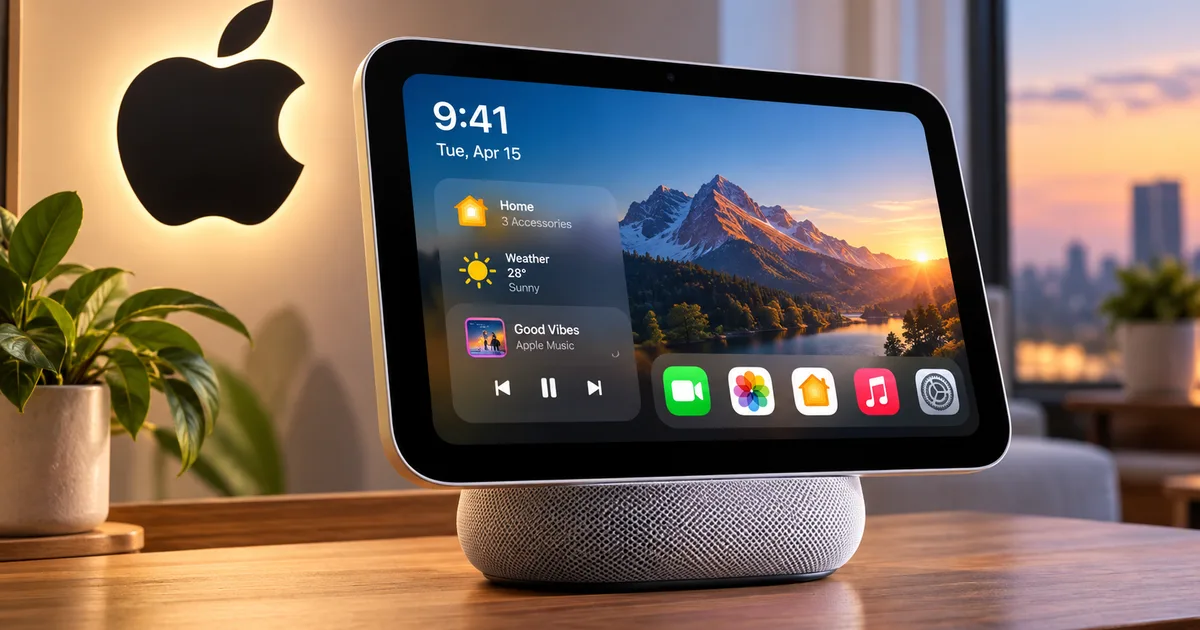
Picture your living room or kitchen counter on a busy weekday morning in an Indian household. Your mother wants to check whether the morning milk packet arrived, someone is calling on FaceTime from abroad, you need to check your office calendar while pouring chai, and your hands are sticky with flour. For years, Apple users in India tried balancing an old iPad against a toaster or shouting across the living room at a voice speaker that often misheard names. That routine changes now with the Apple HomeView smart display 2026, which Apple introduced on October 13, 2026, at its Welcome Home product event.
It's Apple's first dedicated tabletop screen for shared living spaces. And honestly, after watching Amazon Echo Show and Google Nest Hub gadgets sit on Indian counters for years, Apple is coming in with a totally different take on the category.
What is the Apple HomeView smart display?
Basically, HomeView is a dedicated digital reception desk for your flat. It isn't an iPad that your kids will haul into the bedroom, run down to zero percent, and leave wedged behind sofa cushions. Instead, it stays plugged into the wall in a central spot, like a dining sideboard or a kitchen counter.
The screen stays on all day.
It listens for household commands, shows your doorbell camera feed when delivery boys ring at the security gate, flips switches on appliances, and handles quick family calls. If you ask me, most smart screens sold in India end up as glorified photo frames after a week. Amazon's Echo gadgets keep pushing recipe ads and sponsored shopping banners across the glass, which gets irritating fast. And Google Nest Hub basically fell behind because Google stopped updating the hardware here. Apple is pitching HomeView as an uncluttered station tied directly into your iPhones, iPads, Macs, and Apple TVs.
If you have read our in-depth tech explainers on home networking, you know that keeping shared gadgets simple is tough. Apple's answer here is zero third-party clutter. It doesn't run an App Store with millions of downloads. It just handles everyday household stuff like Notes, Reminders, Calendar, Home controls, FaceTime, and Apple Music.
Apple HomeView features: hardware, display, and audio
The hardware is split into two pieces connected by a heavy stainless steel hinge. Up top, you get a 7-inch Liquid Retina display. Down below sits a rounded speaker base wrapped in acoustic fabric.
That hinge lets you tilt the screen back and forth to match your eye line, whether it's low on a coffee table or perched up high on a kitchen shelf. In my experience with countertop gadgets, a stiff hinge makes all the difference when you're tapping buttons in a rush. Apple sells four finishes for this edition: Silver, Starlight, Rose Pink, and Space Gray.
Display and distance-aware interface
The screen panel goes up to 500 nits of peak brightness during daylight hours, which helps when your kitchen window lets in harsh afternoon glare. At night, it dials all the way down to 0.3 nits. So it won't blind you if you keep it on a bedside table.
Here's the clever bit.
HomeView uses what Apple calls a distance-aware interface. Basically, the screen senses how close you are and swaps what it shows. Stand six feet away in the hallway, and you'll see massive clock digits along with current weather icons. But step within arm's reach to touch the glass, and those giant numbers shrink down to reveal lighting toggles and detailed calendar notes.
It works surprisingly well. (Sounds like a gimmick on paper, I know, but anyone who has squinted at tiny text across a kitchen counter will appreciate it right away.)
Speaker architecture and room audio
Audio on smart displays is usually terrible. Most brands toss in a cheap, tinny little speaker just so you can hear voice responses.
Apple took a different route. The display enclosure holds two full-range drivers, while the base has a down-firing woofer paired with dual passive radiators. It has Spatial Audio and puts out plenty of low-end punch, filling a typical 200-square-foot Indian living room without rattling. Serious listeners will still grab over-ear headphones or budget wireless audio accessories when listening in private. But for morning devotional tracks or casual podcasts while cooking, HomeView sounds noticeably richer than an Echo Show 8, at least in my experience.
Wall-mounted model and Schneider accessories
Along with the countertop model, Apple is selling a wall-mounted version in Silver and Space Gray for the same $299 sticker price. You can't just stick it up with double-sided tape, though.
It needs dedicated mounting gear made with Schneider Home. You have two options:
- The Schneider Power Mount USB-C costs $59.95 and plugs into an existing exposed wall outlet through a slim cable.
- The Schneider Power Mount AC Wired costs $79.95 and connects directly into your home's concealed electrical wiring.
- A certified electrician is recommended to install the AC wired plate flush inside standard Indian modular switch boxes.
Concealed wiring is standard in most Indian flats. Even so, you'll need to call your local electrician to cut into the wall and sink a junction box if you want that completely wire-free look in your hallway.
Face recognition and privacy: how multiple profiles work
Shared household tech in India always runs into privacy headaches. If your dad asks the counter screen for the day's schedule, you don't want your bank OTP texts or private calendar notes showing up for everyone having breakfast.
HomeView fixes this with local face recognition powered by the A18 chip in the base. It handles up to six household profiles.
Walk up to make chai, and the camera spots your face. Instantly, the glass switches over to show your personal widgets and work reminders. If your sister walks into frame instead, it flips straight to her reminders.
And there's an extra security layer here. Your text messages and sensitive reminders only appear if the camera sees your face AND your unlocked iPhone is right there nearby. If your phone is charging in the other room, the screen simply won't reveal private data. Honestly, I think that is very smart engineering.
"Apple HomeView is designed to be shared by everyone in the home yet feel completely personal to each user," said Greg Joswiak, Apple's senior vice president of Worldwide Marketing.
On-device processing with the A18 chip
People naturally get sketchy about putting an active camera and mic in the middle of their home. With Amazon and Google, little audio clips routinely head off to cloud servers for processing.
Apple does things locally. All camera and microphone data stays locked inside the Secure Enclave on the A18 processor. Face mapping and wake-word detection run entirely on the hardware itself. Nothing goes to an outside server, and third-party apps get zero camera access. (Which, if you ask me, is exactly how any home device ought to work.)
FaceTime video calls and family connectivity
Putting video calls on a shared screen is great when you're talking to grandparents or relatives abroad. HomeView has an ultra-wide camera with Center Stage, so it pans and zooms around as you walk between the fridge and the stove.
Look, we have to talk about WhatsApp.
Almost all everyday family calling in India runs on WhatsApp. HomeView doesn't support third-party video apps at launch, which means no WhatsApp calls on this screen. If your relatives use iPhones, FaceTime runs smoothly with sharp video and crisp voice isolation. But if half your family uses Android phones, you're still stuck holding your phone like before.
Upgraded Siri AI capabilities
The display runs a revamped edition of Siri powered by Apple Intelligence, branded as Siri AI. It's far more natural than the robotic assistant we've put up with for the last ten years.
It understands follow-up questions without making you repeat the wake phrase every few seconds. It also has onscreen awareness. Say your brother drops an address in Messages. You can just point at the screen or ask, "How long will it take to drive there?" and Siri pulls up route directions right away.
Thing is, Siri AI is still in beta and only works in English right now. It handles Indian accents quite well without stumbling, but there's no native support for Hindi, Tamil, Telugu, or Marathi yet. I'm not completely sure when broader regional languages will arrive, though Apple will probably push updates for that by mid-2027.
Apple HomeView price in India and launch date
Let's talk numbers.
In the US, HomeView is $299 for either the tabletop or wall-mounted model. But in India, retail pricing sits at ₹39,900, as confirmed by coverage in The Economic Times and News9Live. That's a steep markup over a straight currency conversion, mostly because of import customs duties and local GST slabs.
To put that in perspective, ₹39,900 is enough cash to grab two capable everyday Android smartphones or an iPad Air during festive sales. It definitely isn't an impulse buy. If you ask me, that price tag will make a lot of buyers hesitate.
Pre-orders opened on October 13, 2026, on Apple's official online store in India, supporting UPI payments, no-cost credit card EMI plans, net banking, and trade-in credits. Retail deliveries and store availability at Apple BKC in Mumbai and Apple Saket in New Delhi start on November 13, 2026.
Living with HomeView in an Indian household
So how does this gadget actually hold up in an Indian flat? Pretty well, honestly, as long as your place covers a few basics.
First, think about power cuts. In cities like Bengaluru, Noida, Pune, or Chennai, short power trips happen all the time. HomeView doesn't have an internal battery (annoying, I know), so it needs constant mains power, but it reboots in seconds once your inverter kicks in. And because it runs as a Matter hub over Thread, local appliance routines keep running even when your broadband connection drops out.
Thread networking is a lifesaver in Indian apartments with thick concrete walls. Instead of congesting your 2.4GHz Wi-Fi router, Thread devices build a low-power mesh that passes signals along from one room to the next.
Then there's appliance support, which has gotten way better in India recently. You don't have to hunt down expensive imported gear anymore. Matter-certified smart plugs and switches from brands like Wipro, Havells, Crompton, and Syska connect right to the Apple Home app without any clunky bridge hubs.
You can set up simple automations with ease:
- Turn off your geyser smart plug automatically after twenty minutes in the morning.
- Schedule your living room mosquito repellent liquid vaporizer to start every evening at sunset.
- Dim your hallway ceiling lights and lower your BLDC fan speed when saying goodnight to Siri.
- Monitor your front entrance video doorbell feed directly on the 7-inch display while working in the kitchen.
If you're setting up smart home routines for the first time, our practical smart home guides show you how to set up Matter switches without calling in an expensive technician.
Is the Apple HomeView worth buying in India?
HomeView is a premium, niche gadget. It isn't trying to be a TV, and it certainly isn't trying to replace your iPad.
Get it if your family is already locked into the Apple ecosystem. If everyone at home carries an iPhone and shares Apple Music family plans, HomeView ties the whole setup together into a clean household dashboard.
Skip it if you're mostly using Android phones, or if you just want a small counter display to play YouTube recipe videos while making dal. An Echo Show 8 or a cheap Android tablet propped against a stand does that exact job for a fraction of the cost.
For now, it's a solid, well-made piece of hardware with serious privacy chops. But until Apple rolls out Hindi and other Indian languages, it's going to stay a luxury pick for dedicated Apple households.