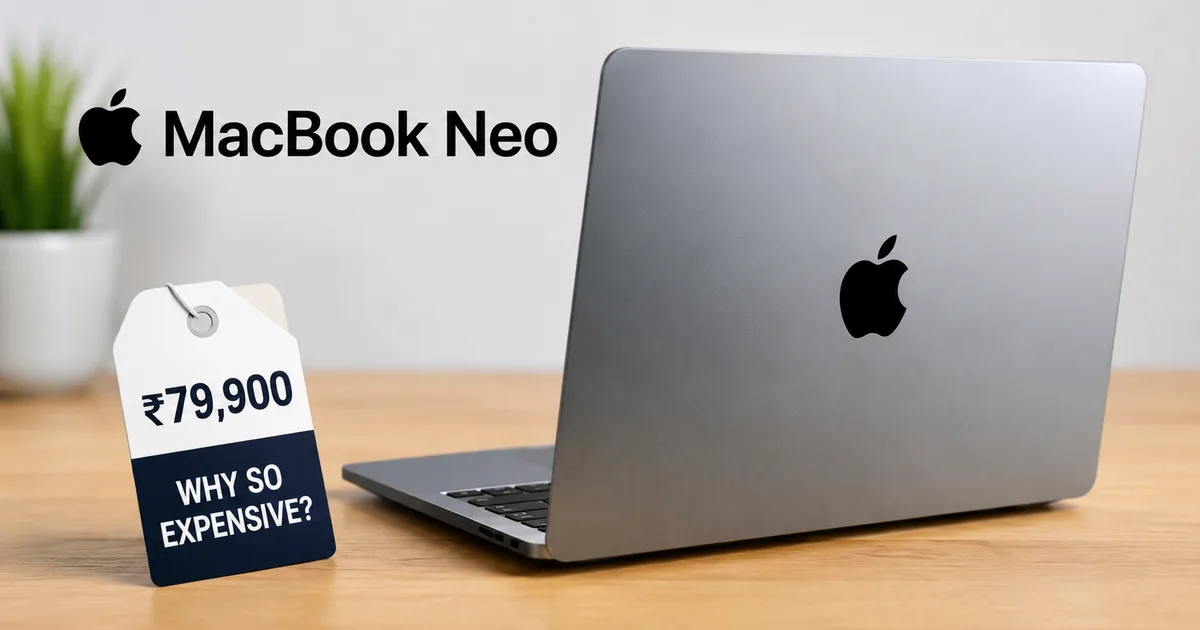
If you planned to buy Apple's entry-level laptop this month, I've got bad news. The latest Apple MacBook Neo price hike India announcement has sent shockwaves through the budget segment, and it pushed the starting price from its original tag straight up to ₹79,900. It's a steep hike. If you're a college student who wants to buy your first Mac, or a freelance developer who tracks expenses, this hurts. Why did Apple do this, and why now? Honestly, the reasons run deep into global supply chains and AI demands.
Why the MacBook Neo price in India went up overnight
Apple recently updated its online store and retail pricing across India. The change was swift and quiet. If you look at the catalog today, the entry-level MacBook Neo starts at ₹79,900. It's a big hike from the old price. Honestly, it shocked a lot of buyers. I think that for a laptop that is the cheap entry point into the macOS ecosystem, this price hike changes the equation for thousands of Indian consumers, though the exact numbers here are a bit fuzzy.
The hike isn't just for the Neo. Nearly the whole Mac lineup's seen a price hike. The new Mac mini M4 and various iPad models are more expensive now, and so is the Apple HomePod. For example, the M5 processor MacBook Air's price went from ₹1,19,900 to ₹1,49,900. That's a flat ₹30,000 hike for a machine that many professionals rely on (which is crazy, if you ask me). In some high-end configurations, the price hikes go as high as ₹1,00,000. It's a massive hike that makes a Mac-based setup much harder to afford.
Oddly, iPhones are spared from these price hikes for now. You can still buy the latest iPhone models at their launch prices. But if you want a machine for school, college, office work, or personal projects, you'll have to shell out a lot more. Thing is, this happens right when students are preparing for the new academic year and looking for student discounts. While Apple's got college student offers, the base price is now so high that even with discounts, the final amount is higher than what the retail price was last month. In my experience, you can check the latest tech policy updates to see if import regulations played any role. But the main driver is global.
Understanding the Apple budget laptop price hike
If you want to understand why this Apple budget laptop price hike happened, you have to look at what's inside these machines. The price hikes range between 20% and 42% across the affected lines. Honestly, ETV Bharat reports that these hikes are directly tied to the higher costs of AI-linked components. I'm not sure exactly why, but we're in the middle of a massive global push for artificial intelligence. So every tech company is fighting for the same resources.
The unified memory architecture squeeze
Specifically, building high-speed memory and storage has become way more expensive. When you buy a Mac, you get Apple's unified memory architecture. You can't upgrade this RAM later. The memory's soldered directly onto the chip, close to the processor. Because it's highly integrated, Apple needs high-grade silicon. But today, the supply of chips needed for this unified memory is a mess. AI servers and data centers buy these memory modules in massive quantities, which forces other brands to fight over what's left.
This memory squeeze has driven prices up for everyone. But Apple's got a reputation for keeping high profit margins. So they just pass these costs directly to you. In the past, companies might've absorbed minor price hikes. But when component costs rise by double-digit percentages, the retail price has to show it. Apple CEO Tim Cook addressed this directly.
During the recent earnings briefing, Apple CEO Tim Cook stated that price hikes across multiple device categories were unavoidable due to the soaring costs of memory chips and storage components.
This statement shows that the company wasn't willing to take a hit on its margins. They chose to raise prices globally. Honestly, the impact in India's particularly harsh because of how import taxes are structured. When the base price of a laptop goes up, the customs duty and GST calculated on that price also go up. It's a compounding effect. If you ask me, a small bump in production cost becomes a massive jump at the cash counter in Croma or on Apple's online store.
How memory shortages make these devices expensive
You might wonder why a global shortage of RAM chips impacts a laptop buyer in Mumbai or Bengaluru so directly. Here's the deal: memory chip manufacturers have shifted their focus. Companies like Samsung and SK Hynix now devote their production lines to high-bandwidth memory. Nvidia and other chipmakers need this specialized memory for their AI graphics cards. It's far more profitable for chipmakers to sell memory to AI data centers than to supply standard modules for consumer laptops (which makes sense from a business standpoint, I guess).
Why AI servers get first preference
So, the capacity to manufacture consumer-grade memory has shrunk. Less supply meets stable demand. And prices shoot up. ET Telecom reports that memory costs've skyrocketed in recent quarters. This shortage affects more than the M5 processor MacBook Air and the Neo. In my experience, it impacts the Mac mini and even the iPads that now use the same M-series chips as the laptops.
The situation is also a mess because of Indian import dynamics. India imports all its MacBooks as finished goods. Unlike some iPhone models that are assembled locally in facilities in Tamil Nadu or Karnataka, Macs arrive fully built. So they attract a standard 22% basic customs duty. When you add the 18% GST and other local fees, a price hike at the factory level gets inflated by around 40% by the time the product reaches Indian retail shelves.
If Apple assembled MacBooks locally under the government's PLI scheme, the story might've been different. But right now, we're at the mercy of global supply chains. You can read more about how supply chains affect prices to understand the macroeconomics behind this. Basically, the Indian buyer pays a premium for global logistics, local taxes, custom duties, and component shortages (annoying, I know).
What this means for your wallet and shopping plans
What this means for your wallet and shopping plans
So, should you still buy a Mac in 2026? It depends on your workload. If you're a developer who needs macOS to compile iOS apps, you don't have much choice. You'll have to pay the new price. But if you're a student or a writer who needs a laptop for basic office tasks and web research, a Windows laptop starting at ₹45,000 makes more sense, if you ask me. You can browse our guide to buy laptops to compare alternative machines that are cheaper.
If you want a Mac, don't buy it directly from the Apple Store at retail price. Look for authorized resellers. Honestly, platforms like Amazon, Flipkart, physical stores like Vijay Sales, or local retail chains often have older stock. They might sell their stock at old prices for a few weeks before they update systems. You can also look for bank offers. Many credit cards in India offer cashback of ₹5,000 or ₹10,000 on Apple gear to help with the hike. When you buy with student discounts, you'll need to verify your student status with your institutional ID or college admission details.
Another option's the refurbished market. In my experience, companies like Cashify or local dealers in cities like Delhi and Mumbai offer certified pre-owned Macs. A one-year-old MacBook's still an excellent machine. And it'll cost you a lot less than the ₹79,900 Apple now demands for the entry-level model.
If you want to save money, here are a few practical strategies:
- Look for bank cashback offers that can shave off up to ₹10,000 from the retail price.
- Buy from third-party resellers who might still have older inventory at pre-hike prices.
- Consider certified refurbished models from trusted Indian buyback platforms.
Look, this price hike's a reminder of how dependent we're on global supply chains. When memory prices go up in East Asia, students in India pay the price. Until we see local production of these computers (which won't happen anytime soon, if you ask me), we'll have to deal with these sudden price hikes. Keep an eye on local retail deals and use your credit card reward points. But don't rush into buying unless you absolutely need it today.