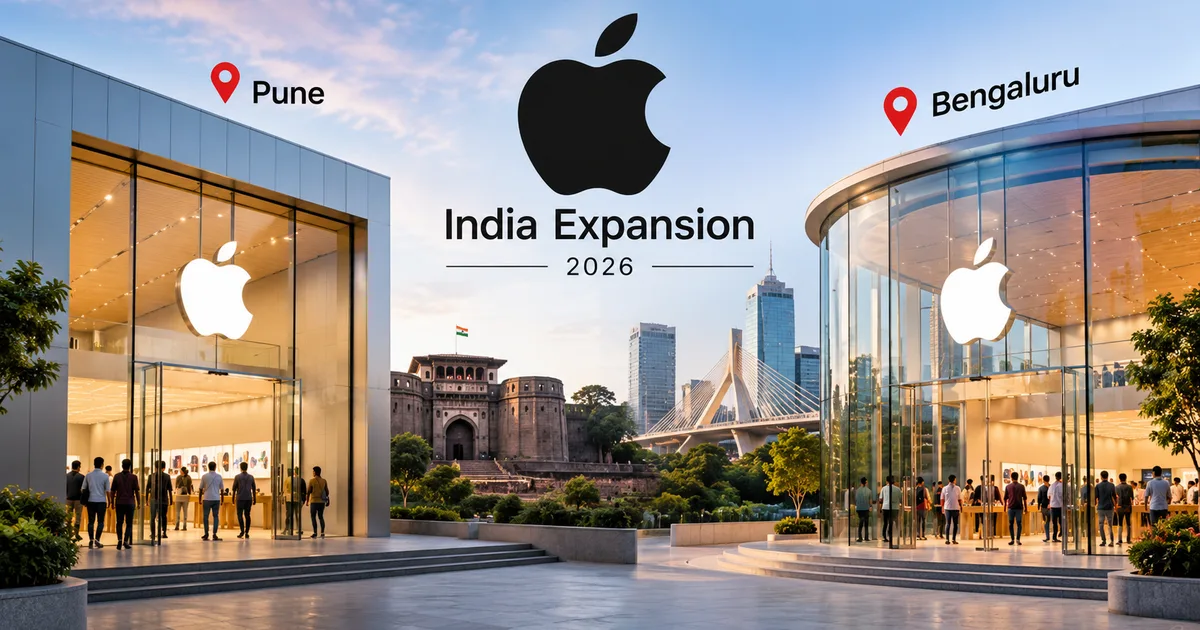
If you want to buy an iPhone today, you probably just open Flipkart or walk into a local Reliance Digital. But Apple wants you to buy directly from them. The Apple Store India expansion 2026 plan is taking shape, and it looks like Pune and East Bengaluru are next on the list. I've been tracking their retail footprint for a while. They hit the market hard with BKC in Mumbai and Saket in Delhi back in 2023. Then we saw two more stores open in 2025 (including the Borivali outlet). Now they're targeting the next tier of major tech hubs.
This makes total business sense. Apple's annual sales in India recently crossed the $10 billion mark. That's a massive number for a market that was historically dominated by budget Android phones. And a big chunk of this growth comes from their retail push. When people walk into an actual Apple Store, they just spend more. They buy the accessories and get the extended warranties. They often upgrade to a Pro model too. Honestly, I've seen it happen with my own friends.
Why the new Apple Store Pune and Bengaluru locations make sense
Bengaluru already has an Apple Store. But East Bengaluru is a different beast entirely. It has massive tech parks and thousands of highly paid IT professionals. Traveling across Bengaluru traffic to visit a single store is a total nightmare. So opening a second store in the eastern part of the city just makes logistical sense for their target demographic.
Pune is a similar story. It has a massive student population and a booming IT sector. The city has seen a huge surge in premium smartphone sales over the last three years. I'm honestly surprised Pune didn't get a store in 2025. People there have the disposable income.
And they have the desire for premium tech.
Buying a premium phone in India has fundamentally changed. Five years ago, dropping a lakh on a phone meant you saved up for months. Today, you walk into a store and scan a QR code with your UPI app. You set up a no-cost EMI in three minutes using your Aadhaar and PAN. The financial friction is completely gone. Apple knows physical stores are the best place to guide customers through these financing options. Their store staff are trained to explain HDFC bank cashbacks and EMI schemes clearly. In my experience, that kind of face-to-face interaction is what pushes a customer from a standard model to a Pro model.
The new store design and pickup experience
The stores opening in 2026 will look slightly different from the ones you've seen in Mumbai or Delhi. According to a recent report from Business Today, Apple is planning a major retail redesign globally. They're bringing back a more traditional look for the Genius Bar.
"The design resembles the Genius Bars of the past but with an all-wood look. There will be two counter heights for accessibility, while the wall behind the bar will include storage drawers and large posters highlighting new products."
I think this is a smart move. The current setup in some stores can feel a bit messy when you just want technical support. The new design is going to feature an all-wood look with counters at two different heights. This makes the space much more accessible for everyone. They'll also have storage and product images directly behind the employees.
They're adding dedicated pickup zones too. If you order something online and want to get it in person, you'll go to a specific wooden section. Employees will have dedicated drawers for these orders. It sounds minor. But anyone who has waited around in a crowded Apple Store just to pick up a pre-paid charger will appreciate this.
You can read more about these kinds of industry shifts in our Latest Tech News section.
The focus on quick pickups shows Apple knows Indian consumers value their time.
The hardware driving Apple India sales and retail growth
You can't talk about retail stores without talking about what they are actually selling. The iPhone 18 Pro and iPhone 18 Pro Max just debuted this September. They have the A20 Pro chip and a new 48MP Fusion Main camera with a variable aperture. That variable aperture is a big deal. Six laser-cut blades physically move to change how much light hits the sensor (which makes sense, actually).
When you have camera hardware that complex, people want to see it in person before they drop over Rs. 1,30,000. That's where physical stores win. You can walk in and test the variable aperture. You can see the new glacier and burgundy colors under good lighting. And you can try out the new Siri AI features. If you're curious about how these software features work locally, check out our guide on Apple Intelligence India 2026: What iPhone Users Actually Get.
Apple is the only smartphone brand in India that hasn't raised iPhone prices since late 2025. They've been absorbing the component price shocks. This aggressive pricing strategy is clearly working. And the physical stores are a big part of closing the sale.
They also recently unveiled a more powerful Mac mini with the all-new M6 and M5 Pro chips. I know a lot of developers and video editors in Pune and Bengaluru. These cities are just full of freelancers and agencies. The new Mac mini is exactly the kind of machine they want. But they want to test it first. They want to see how fast it renders a Final Cut Pro project. Having a physical store with these machines set up and ready to test is a huge selling point for the professional crowd.
Local manufacturing and government support
Apple isn't just selling phones in India anymore. They're making them here. The Indian government recently proposed extending tax breaks for contract manufacturing. This is a direct boost for companies like Foxconn and Wistron that assemble Apple products locally.
When you buy a base model iPhone now, it's almost certainly assembled in India. This local manufacturing helps Apple keep prices somewhat stable despite global supply chain issues. It also builds goodwill with the government. Opening massive retail stores in Pune and Bengaluru is another way to show commitment to the Indian market. It creates local jobs for retail staff and store managers. But it goes beyond just jobs. By building a complete ecosystem from local assembly plants to premium retail outlets, Apple is embedding itself into the Indian economy.
The numbers here are a bit fuzzy, but the proposed tax breaks for contract manufacturers could let them expand their product lines here. We might see iPads or even MacBooks being assembled in Indian facilities over the next few years. If that happens, these new retail stores in Pune and Bengaluru will be perfectly positioned to sell locally made products with potentially better pricing.
How digital payments fuel physical retail
It's hard to ignore how India's digital infrastructure supports these massive retail stores. A decade ago, processing a premium transaction was tedious. Now, the integration of systems like UPI and DigiLocker makes buying incredibly fast.
When you walk into an Apple Store to finance a new iPhone or a Mac mini, you don't need a folder full of physical documents. You authenticate your identity via Aadhaar and verify your income details digitally. Then you authorize your EMI mandates through UPI auto-pay. The entire credit approval process takes minutes. This speed is crucial for physical retail. If a customer has to wait an hour for a loan approval, they might just leave. Apple has built their checkout systems to work directly with Indian payment networks.
I've watched people buy an iPhone 18 Pro Max on a weekend without carrying a single physical card. They just tap their phone. The UPI payment clears instantly. And they walk out with the device. This kind of frictionless transaction is exactly why Apple is confident enough to invest millions into physical retail spaces in Pune and East Bengaluru.
What this means for your next purchase
So what does a new Apple Store in your city actually change for you? A few things.
Reasons to buy at an official store
- Direct access to official trade-in values without third-party rejection games.
- Ability to test complex hardware like the new variable aperture cameras before buying.
- Free "Today at Apple" sessions to learn how to use your devices properly.
- Immediate access to Genius Bar technicians for diagnostics and repairs.
The trade-in experience is infinitely better. Trading in an old phone online can be a hassle (annoying, I know). You have to wait for a delivery person to inspect it, and they often reject it for minor scratches. In a physical Apple Store, the evaluation is straightforward. They give you a value. And you apply it directly to your new purchase.
I've bought Apple products from authorized resellers like Imagine and Aptronix. They do a decent job. But the experience in an official Apple Store is completely different. Authorized resellers are often pushing specific inventory. They might push you towards last year's model because they need to clear stock. An official store doesn't care. They just want you in the ecosystem. Plus, if you have a complex hardware issue, a reseller will just take your device and send it to a service center. At the new Genius Bars planned for the Pune and Bengaluru stores, they can run diagnostics right in front of you.
Looking ahead to future products
These new stores won't just sell standard iPhones. We're expecting some massive hardware shifts over the next couple of years. I'm not sure exactly why, but rumors about a foldable device are getting louder. If you want the details on that, we have a full breakdown of the Apple iPhone 18 Fold Leaks 2026: Price & India Launch.
Selling a foldable phone requires a hands-on experience. You can't just buy a completely new form factor based on a YouTube review. You need to hold it. Apple knows this. The retail expansion in Pune and East Bengaluru is preparing for these future product categories.
If you're looking for more deep dives into how tech companies are changing their strategies, keep an eye on our Tech Explainers hub.
Basically, things are moving fast for premium tech in India. We went from a market where finding official Apple products was a challenge to a market where the company is designing custom wooden pickup drawers for our local stores. I'll keep watching the hiring boards and construction permits. Once they announce the exact mall locations for Pune and Bengaluru, I'll update this post.