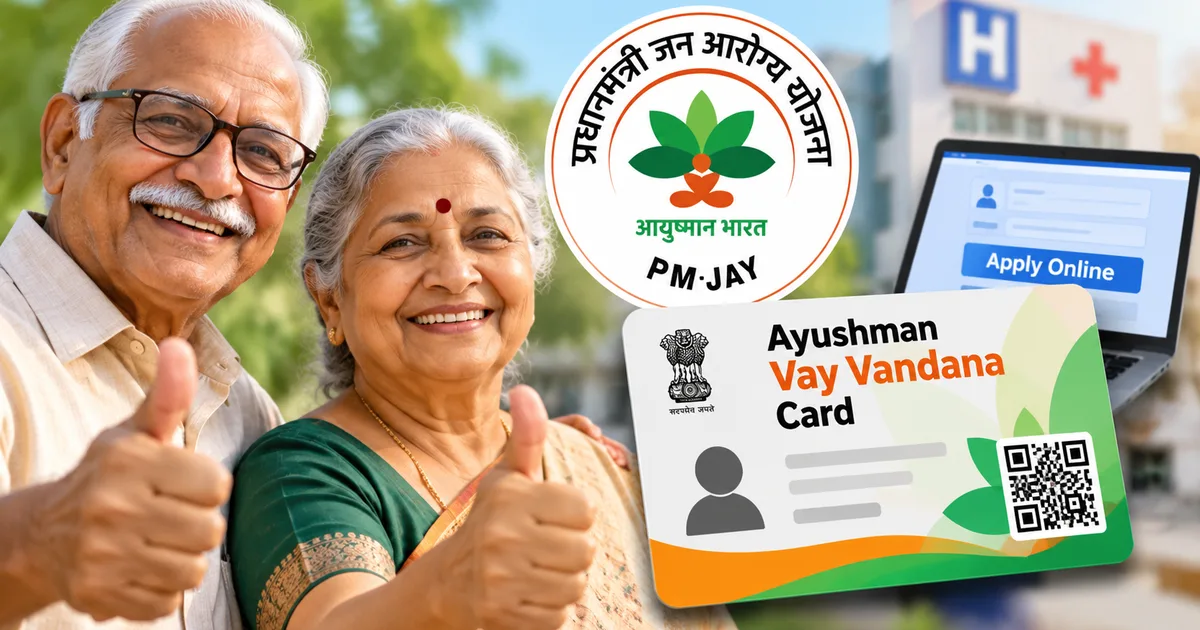
If your parents or grandparents are 70 or older, you know how quickly hospital bills can wipe out a family savings account in India. Private health insurers either refuse to cover elderly parents or quote yearly premiums of ₹40,000 to ₹70,000 with harsh co-pay clauses. That's why the Ayushman Vay Vandana Card is such a massive deal for Indian households. It gives an exclusive ₹5 lakh annual cashless hospitalization cover for every senior citizen aged 70 and above, regardless of their income status.
According to the Press Information Bureau, over 25 lakh senior citizens enrolled within the first month of the national rollout. Now, the exact ground-level numbers are probably a bit fuzzy across different states, but adoption is clearly massive. The whole process is paperless and costs zero rupees. And honestly, it takes less than 15 minutes right from your smartphone.
What is the Ayushman Bharat 70+ senior citizen scheme?
The central government expanded the Pradhan Mantri Jan Arogya Yojana to include every single Indian citizen who has crossed the age of 70. Previously, PMJAY was strictly tied to socio-economic caste census data. If your name wasn't on the list, you couldn't get benefits. Simple as that. I'm not sure why it took so long to fix that, but this new expansion throws out the income ceiling completely. So whether you live in a modest village home or a high-rise apartment in Gurugram, your elderly family members qualify.
Here's how it works in practice, if you ask me. If your family already holds a standard Ayushman card with ₹5 lakh family floater coverage, the senior citizen doesn't share that pool. They get an independent ₹5 lakh top-up solely reserved for themselves. If there are two seniors aged 70 or above in the same home, they share this separate ₹5 lakh senior pool (which makes sense, actually). It just sits right alongside whatever coverage the rest of the household uses.
You might wonder what happens if your parent already has CGHS, ECHS, or another government plan, or even private Mediclaim. The rules are clear on this. Seniors with central government health schemes like CGHS or military schemes like ECHS must choose between their existing scheme and the Ayushman card. But if your parents have a private retail health policy from an insurer like Star Health or ICICI Lombard, they can hold both policies together. No need to surrender either one.
The Ayushman Vay Vandana Card provides ₹5 lakh in annual cashless hospital cover to all citizens aged 70 and above, with pre-existing conditions covered from day one and zero waiting periods.
Who is eligible and what documents do you need?
Honestly, the entry criteria couldn't be simpler. The applicant must be an Indian citizen, and their date of birth on their Aadhaar card has to confirm they've turned 70. That's it. Nobody asks for salary slips, bank statements, tax returns, or medical reports. And if you want to check other government initiatives, our step-by-step tech guides cover several similar digital services.
Before you sit down with your phone, make sure you've got these items ready:
- The physical Aadhaar card of the senior citizen showing the correct birth year.
- The mobile phone linked with that Aadhaar number to receive the mandatory OTP.
- An Android phone with a working front camera if you need to use face verification.
If the mobile number linked to Aadhaar is inactive, don't panic. In my experience, this happens constantly with older relatives who changed SIM cards years ago (annoying, I know). You can either visit a local Aadhaar Seva Kendra to update the number or just use the face-authentication feature on your smartphone camera.
Step-by-step guide to apply for your card on your phone
Look, applying for the card is entirely digital. You don't need to stand in line at a district hospital or pay some sketchy middleman at a cyber cafe. Just grab your Android phone and follow this exact process.
- Install the official Ayushman App from Google Play Store. Verify that the publisher name is National Health Authority. The app has a blue icon with the national emblem. If you plan to authenticate using face matching instead of mobile OTP, also install the AadhaarFaceRD application released by UIDAI. Both apps are completely free.
- Open the Ayushman App on your mobile device. At the bottom right corner of the welcome screen, tap the Login button. The screen displays two user roles: Beneficiary and Operator. Select Beneficiary. Type in your 10-digit Indian mobile number and press Verify. You will receive a 6-digit OTP via text message. Type that code into the box, enter the security captcha shown on the screen, and tap Login to reach the search dashboard.
- Set up the search parameters. On the dashboard, tap the State dropdown and select your state. Under Scheme, select PMJAY. In the Sub-Scheme field, choose PMJAY-70+ or PMJAY-VAY VANDANA. For Search By, pick Aadhaar Number. Now enter the 12-digit Aadhaar number of the senior citizen and tap the blue Search button.
- Start the digital eKYC verification. If the senior citizen has never enrolled before, their details will display with a yellow tag marked e-KYC Pending. Tap the e-KYC button directly next to their name. The screen prompts you to choose an authentication method between Aadhaar OTP and Face Auth. If their registered mobile phone is active, select Aadhaar OTP, accept the UIDAI consent checkbox, and press Generate OTP. When the 6-digit code arrives on the Aadhaar-linked phone, type it into the authentication field.
- Capture a live photograph and submit family details. After the Aadhaar matching succeeds, the app opens your phone camera. Keep the senior citizen seated in a well-lit spot facing the lens and take a crisp portrait photograph. Next, the app asks for basic profile inputs including the applicant mobile number, relationship with family head, residential pin code, and district name. Check that all fields match your records, tick the final declaration, and tap the Submit button.
- Check the approval confirmation. Once submitted, the screen refreshes immediately with a success message showing your reference number. For most users whose Aadhaar data matches cleanly, the status badge turns green with the word Approved within a few minutes.
If you also need to help younger family members enroll, check out our guide on standard Ayushman card online application. It has full instructions for the family floater scheme.
How to download your Ayushman card online
Once approved, getting that digital card onto your phone takes barely two minutes. Super quick.
- Launch the Ayushman App again and log in as Beneficiary using your mobile number and SMS OTP.
- Run a quick search using the senior citizen Aadhaar number just like you did during registration.
- Look for the green Approved badge next to the applicant name. Right beside it, you will spot a downward arrow button labeled Download Card. Tap this button.
- Authenticate the download request with an Aadhaar OTP sent to the registered mobile phone.
- View the generated Ayushman Vay Vandana Card on your screen. The digital card features a distinct golden-yellow Vay Vandana header, the beneficiary portrait, their ABHA health ID, and PMJAY barcode. Tap the Download icon at the bottom to store the PDF in your phone download folder. You can also send the PDF to DigiLocker for permanent safe storage.
I strongly recommend taking a physical printout of this card and laminating it. Keep one copy in the patient's medicine pouch and another in your household medical file. Seriously. When an emergency happens at midnight, having that physical card and PMJAY ID handy saves precious minutes at the hospital reception.
Watch out for fake links and registration fees
Whenever a major welfare initiative launches in India, scammers rush in to cheat people. We're already seeing sketchy WhatsApp forwards claiming to offer VIP senior citizen health cards with instant doorstep delivery. If you ask me, these operators prey directly on anxiety. If you want to understand how these traps work, read our report on health card WhatsApp scams to keep your family protected.
The scam works like this. Someone sends a message with an unverified link or an APK file attachment, promising to skip the government queue for a small fee of ₹250 or ₹500 paid via UPI. Once you pay or install that APK, your money vanishes. And your banking details could easily get compromised too.
Thing is, the Ayushman Vay Vandana Card is 100% free. The National Health Authority doesn't charge any application fee, card fee, processing charge, or delivery fee (not a single rupee). So never download random APK files sent over WhatsApp or Telegram. If you spot fake websites or someone demanding money for this card, report them immediately at the National Cyber Crime Reporting Portal at cybercrime.gov.in or call the national cyber fraud helpline at 1930.
Treatments covered and hospital admission rules
Having the card in your pocket is great, but knowing how to use it during an emergency is what actually counts. Right now, the scheme gives senior citizens cashless treatment at over 29,000 empaneled hospitals across India. That covers both government medical colleges and participating private hospitals.
The annual ₹5 lakh benefit covers secondary and tertiary care hospitalizations. That means doctor consultations during admission, ICU stays, OT charges, surgical implants like pacemakers or knee replacements, medications, and diagnostic tests are all included. It also covers medical expenses from three days before admission and 15 days following discharge.
The biggest relief is the pre-existing disease clause. Commercial health policies routinely exclude diabetes, hypertension, asthma, or heart conditions for three to four years. Not this one. Under this scheme, every existing illness is covered from the very first hour the card turns active.
Routine outpatient OPD checkups, cosmetic treatments, unapproved alternative therapies, and dental procedures aren't covered. To trigger the cashless claim, the patient has to be admitted to an empaneled hospital for at least 24 hours (though day-care procedures like dialysis or cataract surgeries are exempt from this rule). You can read our plain English tech explainers to discover more about how government digital health infrastructure operates behind the scenes.
Honestly, spending 15 minutes this weekend to set up this card for your elderly parents or grandparents is well worth the effort. The registration is straightforward. And having that ₹5 lakh medical security brings real peace of mind to the entire family.