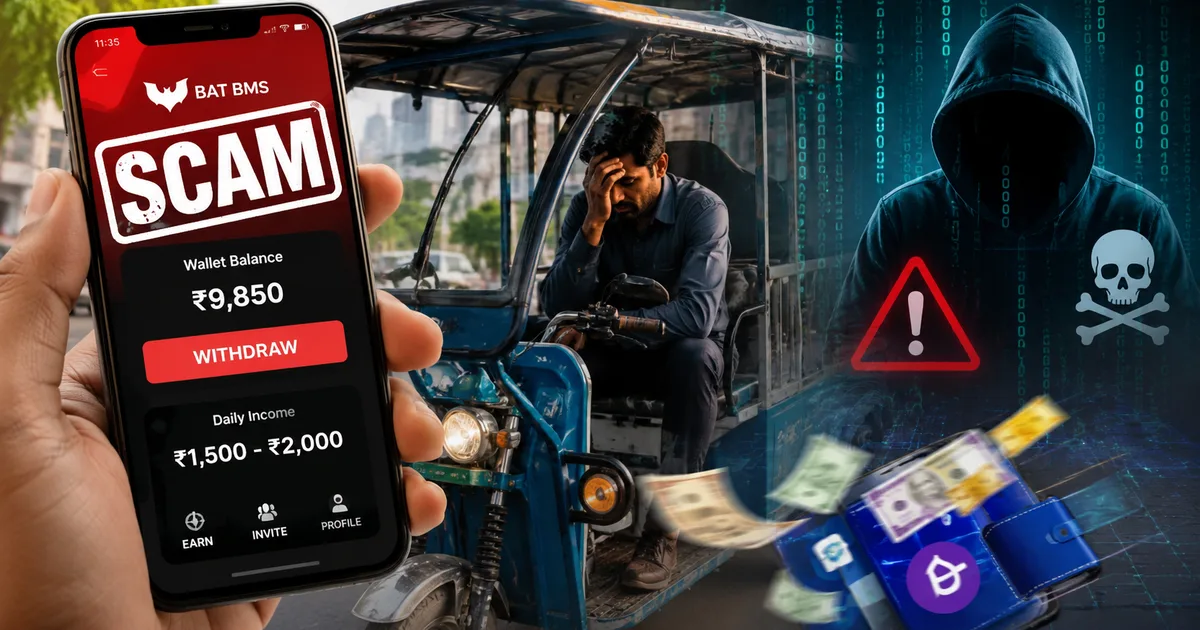
You have probably seen the viral videos floating around WhatsApp and social media this week. Maybe you even searched for the BAT BMS App Scam 2026: How Indian Users Are Losing Money to the Fake Earning Application after seeing someone claim they made quick cash with it. Let me clear this up right now. This is not an earning app. You will not make any money downloading it. Instead, you are looking at one of the most bizarre and damaging cybercrimes to hit Indian streets this year.
I watched one of these videos yesterday. A driver in Delhi was standing next to his e-rickshaw, looking completely defeated. His vehicle was fully charged but completely dead. Standing a few feet away was a teenager with a smartphone, demanding ₹300 via UPI to "fix" the problem. The teenager had literally switched off the rickshaw using a Chinese app called BAT-BMS. Once the driver paid, the kid tapped a button on his screen, and the rickshaw roared back to life.
This is street-level ransomware. And it is spreading across UP, Delhi, Bihar, and practically every city where e-rickshaws operate.
What exactly is the BAT-BMS app?
To understand how this scam works, you have to understand how modern e-rickshaws function. Many of them now use advanced lithium-ion or modern lead-acid battery packs. These batteries are smart. They come with a Battery Management System, or BMS for short.
The BMS is essentially the brain of the battery. It makes sure the battery does not overheat, overcharge, or discharge too quickly. To help owners monitor the health of their battery, Chinese manufacturers created the BAT-BMS app. It connects to the battery via Bluetooth.
Here is the fatal flaw. The app uses a default Bluetooth PIN. Usually, it is something completely insecure like 123456 or 000000. Most e-rickshaw drivers buy their vehicles, plug them in, and start driving to earn their daily bread. Nobody tells them they need to open a smartphone app and change a default password to secure their vehicle.
Honestly, why would they even think of that? A rickshaw is a physical vehicle, not an online bank account. But in 2026, everything is connected. And that connectivity is exactly what scammers are exploiting.
How the extortion works on the streets
The scam is terrifyingly simple. It requires almost zero technical skill. Here is exactly what is happening at busy metro stations and auto stands right now.
- The scammer stands near a parked e-rickshaw and opens the BAT-BMS app on their phone. They scan for nearby Bluetooth devices.
- Because the Bluetooth module on the rickshaw's battery is always on and broadcasting, the scammer's phone finds it instantly.
- The scammer enters the default PIN. They are now connected to the rickshaw's battery management system.
- Inside the app, there is a simple toggle to turn the battery output off. The scammer taps it. The rickshaw is now completely immobilized.
- The driver returns, tries to turn the key, and nothing happens. The scammer approaches, offering to "fix" the mysterious breakdown for ₹300 or ₹500.
The driver is losing money every minute he sits idle. He just wants to get back to work. So he opens his PhonePe or GPay, scans the scammer's QR code, and pays up. The scammer secretly hits the "turn on" button in his app and walks away. The driver thinks he just got lucky finding a mechanic so fast. He has no idea he was just hacked.
Why some think it is a fake earning app
You might be wondering where the "earning app" rumor started. Scammers are actually selling access to this method in shady Telegram groups. They market the BAT-BMS APK file as a "secret earning app" to gullible teenagers.
They tell kids, "Just download this, go to an auto stand, and you can make ₹1000 a day easily." This is creating a massive secondary market of fraud. Teenagers think they are just pulling a profitable prank. They do not realize they are committing digital extortion and tampering with a vehicle. Both are serious crimes under Indian law.
This is not a harmless prank. Disabling a vehicle in the middle of a busy road can cause severe accidents. It is a direct threat to public safety and the livelihoods of daily wage earners.
The real-world impact on Indian drivers
Let us talk numbers for a second. An average e-rickshaw driver makes maybe ₹800 to ₹1000 on a good day. That is after paying for charging and maintenance. Taking ₹300 from them is robbing them of a massive chunk of their daily income. It means less food on the table for their families. It is cruel.
And the sheer scale of the problem is huge. India has millions of e-rickshaws. They are the primary mode of transport for short distances in Tier 2 and Tier 3 cities. We are talking about a massive, unorganized sector running on imported hardware with zero cybersecurity standards.
We often write about sophisticated financial frauds in our scams section, like deepfake video calls or fake stock trading platforms. Those usually target the middle class. This is different. This is cybercrime hitting the working class squarely in the jaw. And they are completely unprepared for it.
How e-rickshaw drivers can protect themselves
If you drive an e-rickshaw, or if you know someone who does, you need to take action right now. Do not wait for this to happen to you. The fix is actually quite easy once you know what to do.
- Change the default password. Download the official BAT-BMS app yourself. Stand next to your rickshaw, connect to your battery via Bluetooth, and go into the settings. Change the PIN from 123456 to something only you know. This completely blocks scammers from connecting.
- Disconnect the Bluetooth module. If you do not use a smartphone and do not care about the app, go to your local battery mechanic. Ask them to physically disconnect the Bluetooth wire from the BMS. The rickshaw will run perfectly fine without it. No Bluetooth means no wireless hacking.
- Never pay the ransom. If your rickshaw suddenly dies at a busy stand, look around. Is someone staring at you while playing with their phone? Do not offer them money. Threaten to call the police instead. Watch how fast your rickshaw miraculously starts working again.
The role of e-commerce and unregulated imports
Part of the blame here falls squarely on how these components enter the country. A massive chunk of the e-rickshaw spare parts market relies on cheap, unregulated imports. Local assemblers buy these BMS units in bulk from online marketplaces or wholesale importers. They slap them into local chassis and sell the finished vehicles to drivers.
Nobody in this supply chain takes responsibility for software security. The importer just moves boxes. The local assembler just tightens bolts. The final seller just wants their commission. If you check our explainers on tech supply chains, you will see this is a recurring problem in India. We import the hardware but ignore the software ecosystem it relies on. Until the Bureau of Indian Standards starts testing the companion apps and firmware of these imported components, Indian consumers will remain sitting ducks.
Are other vehicles at risk?
Right now, this specific scam is isolated to e-rickshaws using the BAT-BMS system. But the underlying vulnerability is everywhere. Think about the cheap electric scooters flooding the market from unknown brands. Many of them use similar off-the-shelf Chinese battery management systems with identical Bluetooth modules.
If you own an entry-level electric scooter, you should absolutely check if it broadcasts an open Bluetooth signal. Grab your smartphone, stand next to your scooter, and search for new devices. If you see a weird device name pop up that you can connect to without a password, you have a problem. You are relying entirely on the hope that scammers do not figure out how your specific app works. It is only a matter of time before they do.
The government and regulators need to step up
It is wild that imported batteries with a hardcoded universal password are allowed on Indian roads. Where are the basic hardware security standards?
The Ministry of Road Transport and Highways needs to look into this immediately. We need a mandate that any connected vehicle component sold in India must force the user to set a custom password upon first activation. It is a standard practice for home Wi-Fi routers. It absolutely should be standard practice for a moving vehicle.
Furthermore, CERT-In should issue a nationwide advisory in Hindi and regional languages. Press releases in English do not reach the auto stands of Lucknow or Patna. The message needs to go out through local RTO offices and driver unions. You can read more about how the government handles tech regulations in our news section, but this specific issue needs a grassroots approach.
Where to report the BAT BMS scam
If you have been a victim of this, you must report it. Do not write it off as just a bad day.
Call the national cybercrime helpline at 1930 immediately. You can also file a formal complaint online at cybercrime.gov.in. When you report it, provide the UPI transaction ID if you paid the scammer. That digital footprint is the easiest way for the police to track them down.
Also, report it to the local traffic police. They are usually stationed near major auto stands and can keep an eye out for these street-level hackers.
What we can learn from this
We are rushing headfirst into a world where everything has a Bluetooth chip and an internet connection. Smart TVs, smart fridges, smart watches, and now smart rickshaws. But we are ignoring the basic security risks that come with making dumb objects smart.
The BAT BMS situation is a massive wake-up call. It proves that cybercrime is no longer just about stealing data or emptying bank accounts from a thousand miles away. It is happening right on the street corner. It is affecting people who have never even used a laptop.
Look out for the people around you. Next time you sit in an e-rickshaw, ask the driver if he knows about the Bluetooth battery scam. Show him this article. Help him change his password if he does not know how. It takes five minutes, and you might just save him a day's wages.