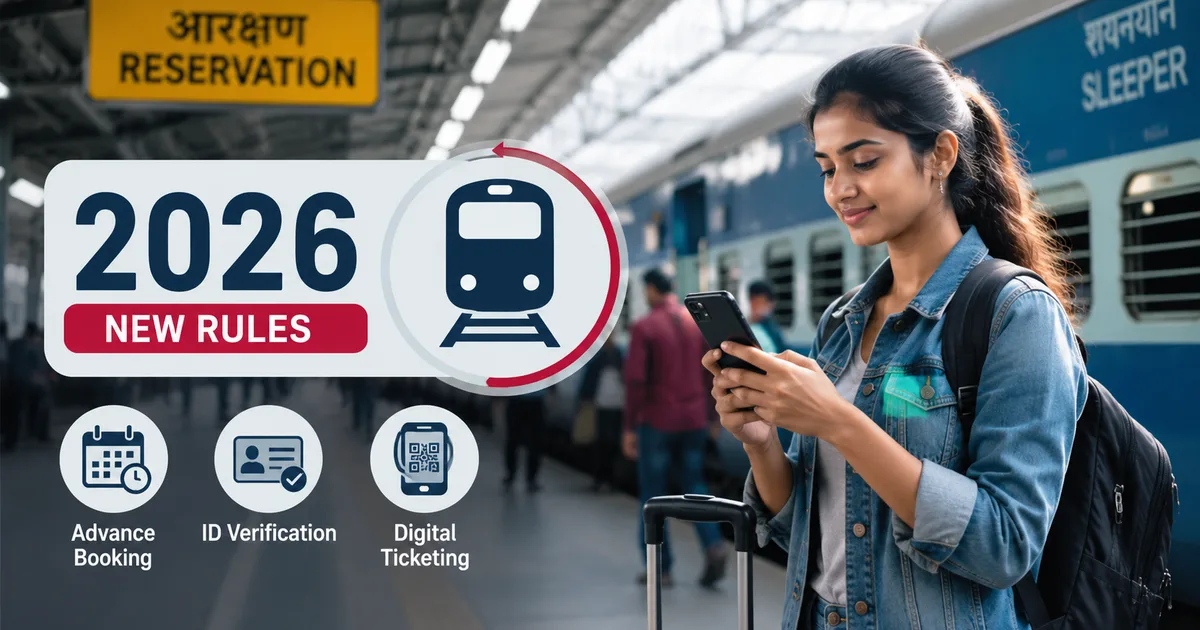
Booking a train ticket in India is basically an extreme sport. You sit in front of your laptop at 9:59 AM. Your heart is pounding. You watch the clock tick over to 10:00 AM for Tatkal, and suddenly the website freezes. We've all been there. And while the struggle is real, Indian Railways is trying to change how the system works. Today, a bunch of updates are kicking in. If you plan to travel for Diwali or just need to visit home for the weekend, you need to understand the New Railway Ticket Reservation Rules 2026. The changes are massive. Some will make your life easier. Others are definitely going to frustrate you.
I've spent the morning digging through the official notifications and press releases. The government is pushing hard to modernize the entire booking network. We're seeing changes to advance bookings, last-minute seats on premium trains, new rules for refunds, and even what happens if you leave your physical ticket at home. The shift is aggressive. And these changes will directly affect your travel budget and how you plan holidays.
The advance booking window drops to 60 days
This is probably the biggest shocker for most travelers. For the longest time, you could book your train tickets 120 days in advance. That's roughly four months. If you were planning a summer vacation in May, you'd block your seats in January. Not anymore.
The advance reservation period is now officially cut down to 60 days.
Why did they do this? I can tell you the official reason is to stop ticket hoarding. Travel agents and scalpers often block thousands of seats four months out. Then they cancel them at the last minute if they can't sell them to desperate travelers at a massive premium. So by shrinking the window to two months, the Railways hopes to give regular people a fairer shot at getting confirmed seats. You can read more about how the system handles waitlists in our waitlist explainer.
Honestly, I have mixed feelings about this. Yes, it might reduce hoarding. But it also makes a mess of long-term holiday planning. If you ask me, middle-class Indian families rely on booking early to secure berths. This is huge for popular routes like Delhi to Patna or Mumbai to Kerala during major festivals. Think about Diwali or Chhath Puja. Now you have to wait until exactly two months before your trip. The numbers here are a bit fuzzy on how much this actually stops scalpers. Still, it means setting a calendar reminder and hoping you don't miss the 8:00 AM window on that specific day (annoying, I know). It's going to take some getting used to.
Vande Bharat gets a 15-minute rule
If you travel for work, you'll probably like this next change. Vande Bharat trains are fast. But they aren't always completely full on certain routes. Until now, the charts were prepared a few hours before departure. If seats were empty after chart preparation, they basically stayed empty.
Under the new rules, you can book confirmed tickets on Vande Bharat and similar premium trains up to 15 minutes before departure. If a seat is vacant, it shows up on the IRCTC app right until the train is practically blowing its horn at the station.
This is genuinely helpful for business travelers. It also helps anyone dealing with an emergency. You no longer have to rely on expensive last-minute flights if you need to travel between cities like Chennai and Bengaluru or Mumbai and Ahmedabad. Just open the app on your way to the station, pay via UPI, and grab a seat. Look, it brings train travel a bit closer to how bus bookings work. I checked the app this morning. The feature is live. It's a smart move that benefits passengers and helps the Railways fill empty seats that would otherwise generate zero revenue.
Strict new cancellation and refund policies
Prepare yourself for this one. The refund rules are getting significantly tighter. Indian Railways has introduced higher cancellation charges across the board. But the real sting is the strict time limit.
You won't get any refund if you cancel your confirmed ticket less than 8 hours before the scheduled departure of the train. Zero. In the past, you could get a partial refund up to a few hours before the journey. The Railways wants to stop last-minute cancellations that leave berths empty and prevent waitlisted passengers from getting a fair upgrade.
Here's the deal. If you book a ticket, I think you better be sure you're traveling. A sudden change of plans on the day of the journey means you lose the entire amount. For an AC 2-tier ticket from Delhi to Mumbai, which easily costs around INR 2,800, this is a heavy penalty. Make sure you cancel a full day in advance if your plans are sketchy. There are no exceptions for falling sick or missing your cab to the station. We cover tips on saving money on bookings in our travel booking guide.
The new IRCTC website is launching
The IRCTC portal is infamous. It's slow and clunky. Plus, it loves to crash exactly when you need it most. I'm not sure exactly why they kept the old interface for so long, but relief is supposedly coming. The government is launching a completely redesigned website on July 15, 2026. Railway Minister Ashwini Vaishnaw promised a much smoother experience with some highly requested features.
The numbers sound impressive. The new system is built to handle 1.5 lakh bookings per minute. That's a massive upgrade from the current capacity. They're also removing those annoying CAPTCHAs for regular bookings. But they might stay for Tatkal to stop automated bots. They also added a visual seat choice. You can pick your preferred berth layout much like choosing a seat on an airplane (which makes sense, actually).
I'll believe it when I see it. We've heard promises of a bulletproof IRCTC website before. Just yesterday, The New Indian Express reported that Tatkal bookings went completely haywire despite recent app reforms. Thousands of users were logged out right at 10:00 AM. But if the new infrastructure actually works, it will save millions of Indians a lot of morning stress. We'll be testing the new portal thoroughly once it goes live and posting our thoughts in the tech news section.
What if you forget your physical ticket?
Most of us use e-tickets on our smartphones. But plenty of people still buy physical tickets from the PRS counters at railway stations. Have you ever reached the station and realized you left your paper ticket on the dining table at home? It used to mean buying a new ticket on the spot or paying a hefty fine to the TTE.
The new rules finally bring some common sense to this situation. If you forget your physical counter ticket, you can still travel. You just need to verify your identity with the TTE using an official digital ID. Pull up your Aadhaar on the DigiLocker app. Then the TTE can check your details against the digital train chart on their tablet.
This is a fantastic update.
It uses existing digital infrastructure to solve a real-world problem without punishing honest travelers. Just make sure your DigiLocker is properly linked and your phone has enough battery. A dead phone and a forgotten physical ticket will still get you thrown off the train at the next station (and the fine isn't cheap).
More flexibility with boarding stations
Sometimes you book a ticket from New Delhi. But it turns out to be easier to board from Hazrat Nizamuddin. Or you book from Mumbai Central but want to get on at Borivali. Changing the boarding point used to be a massive hassle. You had to do it 24 hours in advance, and the interface made it needlessly difficult.
Now, passengers can modify their boarding station much closer to the departure time. The window to make this change is relaxed. That makes it easier for people stuck in traffic or dealing with last-minute route changes in big cities. You do this directly through the IRCTC app under your booking history.
- Open the IRCTC app and log in with your PIN.
- Go to your upcoming journeys section.
- Select the specific train ticket.
- Tap the option to change the boarding point.
- Choose from the dropdown list of available stations on the route.
You can only change to a station that is on the train's route between your original boarding point and your destination. You can't pick a station earlier in the route. Also, if you change your boarding point, you lose the right to board at the original station. If you change your mind again, you're out of luck. Your original seat might be allocated to someone on the RAC list.
Phasing out offline reservation counters
The push for digital bookings is getting aggressive. Indian Railways is starting to permanently close physical reservation counters at smaller stations across the country. For example, eight stations in the Sealdah Division are completely shutting down their ticketing counters starting July 1.
This makes sense on paper. Most bookings happen online now through smartphones. But it does leave out people who aren't comfortable with digital payments or navigating apps. The government says they will rely on authorized agents to help these citizens. I just hope the agents don't overcharge elderly passengers who have no other options. In my experience, relying purely on third parties usually ends up costing the consumer more.
We're moving toward a fully digital railway network. UPI is already the dominant payment method on the app. The physical paper ticket is dying out quickly. These new rules just accelerate the process of making train travel completely paperless.
"The reduction in advance booking limits and strict refund cutoffs are necessary steps to maximize train occupancy and ensure waitlisted passengers get confirmed seats."
That's what railway officials handling the new policy are saying. Thing is, you just have to adapt to the new reality of train travel. Set your alarms 60 days before your trip instead of 120. Double-check your plans to avoid the harsh 8-hour cancellation penalty. And keep your Aadhaar handy on your phone just in case.
The railway network is the lifeline of India. Millions of us rely on it every day to get to work or see our families. When the rules change this drastically, it impacts the entire nation. So take a few minutes to figure out these updates before you plan your next trip. Otherwise, that 8-hour cancellation penalty is going to hit your wallet hard.