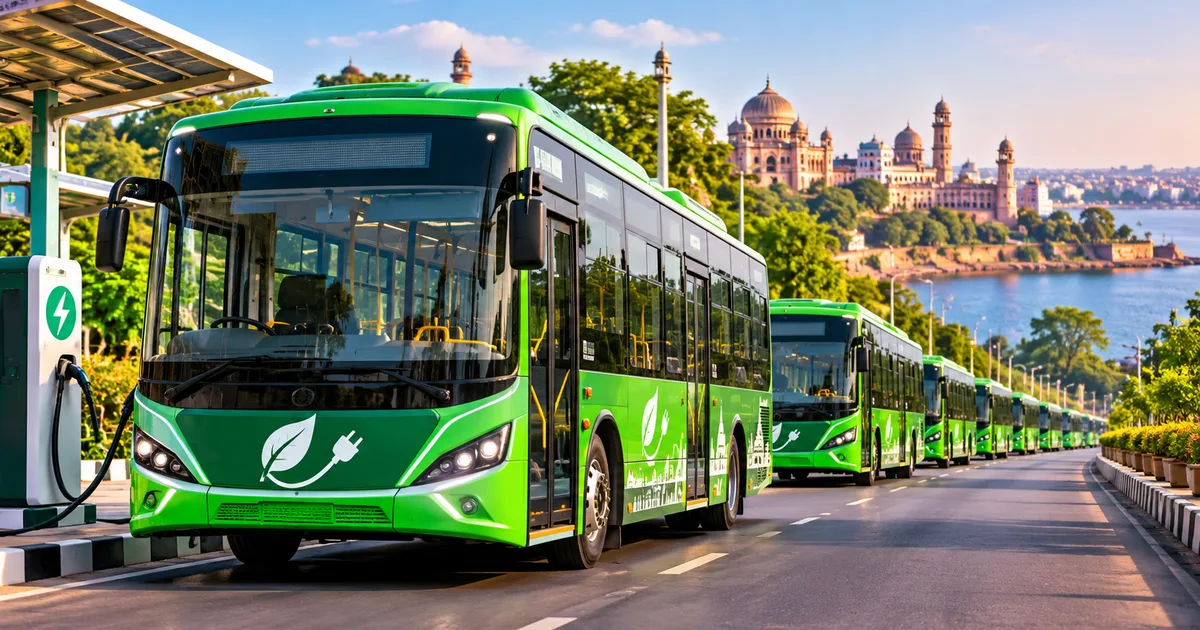
You know how it goes when you're trying to catch a state transport bus during peak summer. You're sweating before you even get on, and the engine noise is loud enough to rattle your teeth. We've accepted this as the standard way to travel between cities for decades. The diesel fumes and the shaking seats. The complete lack of predictable schedules. But things are changing in the public transit space, and honestly, the shift is happening faster than I expected. If you've been tracking transport news, you've probably heard about the Bhopal 5000 Electric Buses Initiative 2026.
EaseMyTrip is a company you probably only use to book cheap flight tickets or hotel rooms. They've decided to start building and running electric buses under their new brand, EMTev. It's a wild pivot. I spent the weekend digging through their technical specs and financial plans to figure out what they're actually building. Look, this isn't a quick PR stunt. They're throwing serious cash at a massive logistical mess.
Understanding the ₹200 crore business plan
EaseMyTrip is an online travel agency. They've operated an asset-light model for years (which makes sense, actually). They write code, sell tickets, manage digital marketing, and take a cut on every booking. They don't own the planes. They don't own the hotels. So, they're completely changing lanes now. They're committing an initial ₹200 crore over the next two to three years to set up R&D and an actual manufacturing plant.
This is a massive risk. Honestly, building software just means fixing bugs with a simple code push. But building hardware means dealing with raw materials and assembly lines. Building commercial vehicles is a straight-up nightmare of supply chain logistics. The math is solid if they can pull it off, though. Under their Vision 2030 roadmap, they plan to build up to 5,000 electric buses a year. This push from software to hardware is something we've seen before. It's similar to the deep tech transitions we cover in our Tech Explainers section.
So, how does a software company run a bus fleet? They have YoloBus. That is their operating arm. They'll handle the daily headaches of running the routes and setting up the charging infrastructure. This setup lets the manufacturing side of EMTev focus purely on building the vehicles. Meanwhile, YoloBus figures out the harsh realities of Indian road transit.
What exactly is driving these new EMTev electric buses?
I was genuinely curious if they'd just import basic shells from overseas and slap a logo on them. But it turns out they're doing the hard work of getting proper certifications. They have already secured type approval for both 12-meter and 13.5-meter models from the transport authorities.
The first batch rolling out in Bhopal is the 12-meter variants. They are configured as seater coaches. They are built to hold 45 passengers plus the driver. The interesting part is entirely hidden under the floorboards.
Their technical spec sheet has a few major upgrades over standard city buses:
- A massive 423.9 kWh LFP battery pack designed for high thermal stability in Indian weather conditions.
- A dual-gun fast charging configuration that significantly cuts down depot turnaround times.
- Electronic braking paired with electronic stability control for sudden highway maneuvers.
- Liquid-cooling systems specifically engineered to prevent battery degradation during heavy use.
If you know anything about EV batteries, you know lithium iron phosphate (LFP) is the safe, stable choice for Indian summers. LFP doesn't catch fire easily. It also lasts for thousands of charge cycles without much degradation. Just to put 423.9 kWh in perspective, a standard electric car has about a 30 to 40 kWh battery. We are talking about ten times the capacity here just to move this heavy vehicle around.
With that battery, EMTev claims a range of up to 350 km on a single charge. But ARAI testing numbers and real-world Indian traffic are two very different things. The air conditioning is blasting during a May afternoon. You have a full load of passengers navigating through heavy traffic. I'd expect that real-world range to drop (the numbers here are a bit fuzzy, honestly). Even at 250 km, that easily covers most intra-city routes and short intercity runs. It shouldn't cause range anxiety for the operators. They can hit a top speed of 100 km per hour. That is plenty for our state highways.
And they aren't skimping on the ride quality. The buses have air suspension. If you've ever sat at the back of a standard leaf-spring bus on a bad road, you know exactly why this matters. It smooths out the inevitable potholes and uneven expansion joints on bridges.
Smart features and safety tech inside the cabin
This is where the tech background of the parent company starts to show. These aren't just large batteries on wheels. They are basically rolling data centres. They are designed to optimize every part of the journey.
I think the charging setup is particularly clever. They have a dual-gun configuration. You plug two high-capacity DC fast chargers into the bus at the same time to cut the charging time in half. This is very important for commercial fleets. A bus sitting in a depot charging is a bus that isn't making money. Downtime literally costs cash.
The battery has a liquid-cooling system. Heat is the absolute enemy of battery life. It's especially bad when you are pumping massive amounts of electricity into the battery during a fast charge. Managing thermal loads is a necessity in a place like Madhya Pradesh. Summer temperatures regularly cross 40 degrees Celsius there.
But the software layer is what really caught my eye. They have AI-enabled driver monitoring systems inside the cabin. A camera constantly watches the driver's face. If they start nodding off or staring at their phone, the system immediately flags the sketchy behavior. They also have blind-spot detection. Driving a 12-meter bus means dealing with massive blind spots where two-wheelers and auto-rickshaws like to hide. Any tech that gives the driver a warning and stops accidents before they happen is a win in my book.
They're feeding all this telemetry back to a centralised control tower. Speed, battery temperature, route data, driver behaviour. The fleet managers see it all in real-time. They can tell a driver to slow down. They can route a bus to maintenance if the battery thermals start acting up.
"Electric mobility has to move beyond the conversation around sustainability and demonstrate a strong case for scale, reliability, and economics," said Manoj Soni, CEO of EMTev.
I agree with him. Nobody is going to pay for a ticket on a terrible bus just because it saves the polar bears. It has to be cheaper and more comfortable than the diesel alternative.
We're seeing a lot of interesting things happen in the smaller consumer EV space too. You can read up on the Simple Wave Electric Scooter 2026 India Launch if you need personal mobility options for your daily commute.
The launch timeline and localization roadmap
So when does all this actually happen at scale? The Bhopal rollout is happening right now. That is a big deal. But this is just phase one of a very long journey. They are using this initial fleet to figure out the real-world bugs. You can't just drop hundreds of commercial electric vehicles on a city without building out the massive charging depots and grid connections first.
Their Vision 2030 plan targets that 5,000 units a year manufacturing mark. But they want to do it smartly by sourcing parts locally. Right now, the Indian EV supply chain is heavily dependent on imported cells and motors. EMTev says progressive localisation is a major priority for them. I'm not sure exactly why it took so long to prioritize this. They want to manufacture components domestically in phased stages. It reduces their reliance on messy global supply chains and eventually brings the capital cost of the buses down.
We've seen this localization strategy work incredibly well in the consumer car market. For example, the upcoming Tata Curvv EV 2026 relies on local manufacturing to hit a competitive price point. EaseMyTrip CEO Rikant Pittie mentioned they're focusing heavily on efficiency and long-term value creation for the mobility ecosystem in India.
Financial risks and the road ahead
Honestly, I'm fascinated by this entire project. A digital ticketing company deciding to physically build the transport network is a massive swing. The ₹200 crore initial investment will put a dent in their short-term cash flow. They are moving from a high-margin business to a notoriously capital-intensive sector. Managing a physical assembly line is a completely different beast than managing cloud servers.
Thing is, they'll absolutely face delays. They'll have operational hiccups in Bhopal. Dealing with grid power supply issues for charging depots is going to be a massive headache.
But if they manage to pull this off? If they build a reliable electric bus network that actually runs on time and lowers operating costs? That is a huge upgrade for public transport in this country. I'll be keeping a close eye on how these first few buses perform on the roads of Madhya Pradesh over the next few months. We'll see if the real-world passenger experience matches the spec sheet. If you want to keep up with how these tech expansions play out, keep checking our Latest Tech News hub.