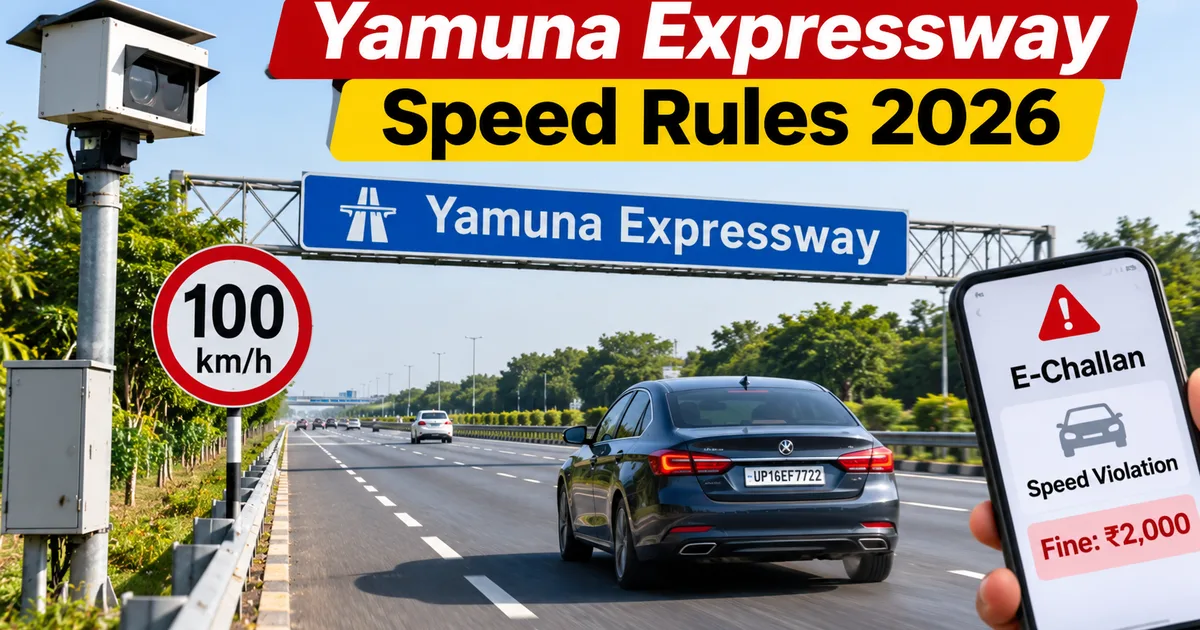
If you have driven on the 165 km stretch between Greater Noida and Agra recently, you know the temptation to step on the gas pedal. But keeping an eye on the Yamuna Expressway speed challan rules 2026 has become more critical than ever. The UP Traffic Police and highway management have turned up the dial on automated speed monitoring. Miss the fine print or drive just slightly above the posted limit, and an e-challan text message will hit your phone before you even reach the Agra toll plaza. I'm not exaggerating either. Drivers are getting hit with steep penalties for terrifyingly small margins.
Things have gotten pretty wild on this highway lately. We're seeing cases where people get fined for going just 1 kmph over the limit, while cameras somehow log locations in the middle of the Atlantic Ocean. Total mess, honestly. Meanwhile, Union Minister Nitin Gadkari is talking about raising speed caps to 140 kmph without penalties. Confusing? Absolutely. So let's break down what's actually happening on the road, how the tech works, and how you can save your wallet.
Winter vs regular speed limits on the Yamuna Expressway
The regular speed limit on the Yamuna Expressway for cars and SUVs is 100 kmph. Heavy vehicles like buses and trucks stay capped at 60 kmph. Simple enough for most of the year, right? But everything changes when winter hits.
Heavy fog drops visibility across western Uttar Pradesh every single winter. So, to stop mass pileups, police put in lower speed limits between December 15 and February 15. If you're driving during these two months, the rules get strict (which makes sense, actually, given the crashes we see every year).
- Light Motor Vehicles (Cars, SUVs): Reduced from 100 kmph to 75 kmph
- Heavy Motor Vehicles (Buses, Trucks): Capped at 60 kmph
- Noida Expressway: Reduced to 75 kmph for cars and 50 kmph for heavy vehicles
- Noida Elevated Road: Reduced to 50 kmph for cars and 40 kmph for heavy vehicles
Jaypee Infratech handles the physical updates along the road. They put up temp signs, set up fog blinkers, and hand out hot tea with safety flyers to truck drivers at night. Patrol cars, ambulances, and cranes sit ready every few kilometers too.
If you break these limits, the penalty is pretty harsh. Under Section 183 of the Motor Vehicles Act, an overspeeding ticket gets you a ₹2,000 fine if you're in a car and ₹4,000 if you're driving a heavy vehicle. In my experience, Noida Traffic Police don't let people off easy. They handed out over 26 lakh challans in just one year, and around 77,500 of those were purely for speeding. You can check out more traffic updates over in our Latest Tech News section.
How ANPR speed cameras and radar traps actually track you
Ever wondered how these cameras catch your car so fast? The Yamuna Expressway uses radar gantries linked up with Doppler sensors and Automated Number Plate Recognition camera units.
Here is how the tech catches you when your vehicle comes up to a gantry.
- Doppler radar units bounce high-frequency microwave signals off your moving vehicle.
- The sensor calculates your exact speed within milliseconds by measuring the frequency shift of the returned signal.
- If your calculated speed exceeds the speed threshold configured for that camera location, the radar triggers high-resolution cameras.
- The ANPR cameras snap high-speed photos of your front and rear license plates.
- Optical Character Recognition software extracts your vehicle registration number from the image and cross-references it with the central Parivahan database.
- The system automatically generates an e-challan record and sends an SMS alert directly to the registered vehicle owner's mobile number.
Sounds bulletproof on paper, right? But in real life, this software makes some really sketchy mistakes. I think these glitches happen way more often than police admit. If you want to see how public software works in India, check out our guides in Tech Explainers.
The 1 kmph fine controversy and the Null Island glitch
Honestly, this is where things get plain dumb. Back in late 2026, an X user named Anujeet Shivam posted a screenshot of an e-challan he got on the Yamuna Expressway. The camera clocked him at 101 kmph in a 100 kmph zone. That's literally 1 kmph over the speed limit. Just a 1 percent shift.
And the penalty? A full ₹2,000 fine.
"Got a Rs 2,000 challan on the Yamuna Expressway. My speed: 101 km/h. Limit: 100 km/h. 1 km/h. That's it. Bonus: the speed gun logged my location as 0°N, 0°E. That's the middle of the Atlantic Ocean." — Anujeet Shivam
The camera logged his coordinates as 0°N, 0°E. Coders call this place Null Island. It's just a spot in the ocean off West Africa where broken GPS hardware dumps data when it loses satellite signal. (Annoying, I know). And to top it off, the photo showed three different cars together, so nobody even knows which car triggered the radar.
When Shivam tried to challenge the ticket on the official portal, the site gave an error saying "No active GRO available", which meant no officer was assigned to handle grievances. Noida Traffic Police eventually replied on social media and told him to call their helpline at 7065060882.
If you ask me, this whole mess exposed two huge problems with automated cameras in India. There's zero speed tolerance buffer, and the software calibration is clearly buggy.
Gadkari 140 kmph proposal vs current motor vehicle law realities
Union Road Transport Minister Nitin Gadkari kicked off a big debate when he said he told officials to stop fining cars going up to 20 percent over the 120 kmph limit on expressways. Basically, that meant you could hit 140 kmph without getting a ticket.
But there's a big catch here. Current motor vehicle laws just don't allow it.
Under Central Motor Vehicles Rules, the top speed for cars on expressways is 120 kmph. The law gives a strict 5 percent speed buffer to cover speedometer errors. Anything past that 5 percent margin gets fined.
Also, local police and state governments have full authority to lower speed limits whenever they want. The numbers here are a bit fuzzy across different states, but around 58 percent of road deaths in India link directly to speeding. So pushing speed limits up to 140 kmph isn't happening anytime soon. For more details on driver penalties and road safety rules, read our breakdown on the Nitin Gadkari Negative Points System 2026.
How to contest unfair Yamuna Expressway speed challans step by step
Got a bad e-challan because of a camera glitch or wrong GPS data? Don't panic. You don't have to pay it right away. Here is how you can fight the fine.
- Visit the official Ministry of Road Transport and Highways portal at echallan.parivahan.gov.in.
- Click on the Check Challan Status tab and enter your vehicle registration number or challan number.
- Review the snapshot evidence, location coordinates, recorded speed, and timestamp carefully. Look for multiple vehicles in the frame or GPS glitches like 0°N 0°E.
- Click on the Complaint or Grievance section on the portal and upload your vehicle registration certificate along with screenshots highlighting the evidence errors.
- If the online portal shows an error or lacks an active officer, call the UP Traffic Police e-challan helpline directly at 7065060882 or tag @noidatraffic and @uptrafficpolice on X with your challan reference number.
- If administrative channels fail to resolve the issue, contest the ticket through the Virtual Traffic Court system (vcourts.gov.in), where a magistrate reviews automated evidence before enforcing penalties.
In my experience, knowing how to navigate these government portals saves real cash and time. Have a look at our guides in How-to Tech Guides for more practical tips.