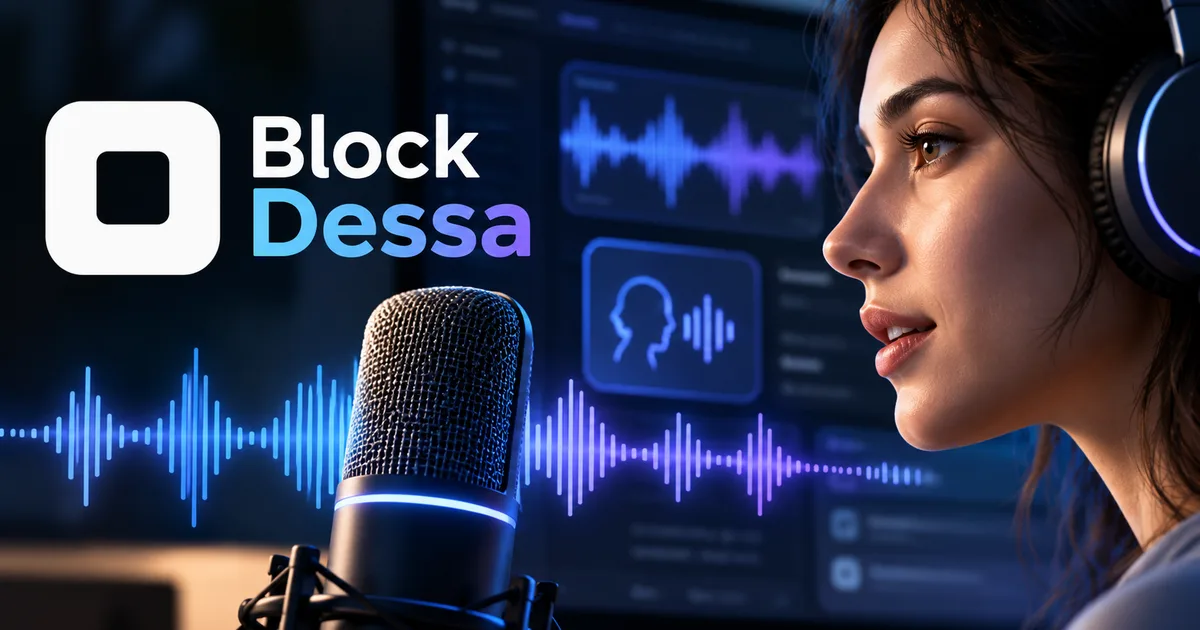
Jack Dorsey's fintech firm Block just dropped early previews of its latest speech project, and the Block Dessa AI voice model immediately started turning heads across developer circles. Most conversational bots still sound like polite call-center software reading off a script. Dessa takes a noticeably different route. It speaks, pauses, chuckles, and handles interruptions in real time without converting your words into text first. I listened to the release demos, and while a few moments felt clumsy, the conversational rhythm is remarkably natural.
Here's the deal: in my experience, voice tech has felt stuck for years.
Even when you test newer options inside our AI tools directory, you usually run into that robotic hesitation where the bot waits for you to finish completely before it starts grinding through an answer. Dessa tries to scrap that pattern. Basically, it treats human speech as audio from start to finish.
What is the Block Dessa AI voice model?
Dessa is an experimental full-duplex speech system built by Block, the company behind Square and Cash App. (Sounds a bit strange for a payments company, I know, but Jack Dorsey has always backed oddball infrastructure experiments.) Instead of training a giant text model on web pages and stitching it to a voice synthesizer, Block built Dessa on actual spoken human dialogue. If you ask me, that choice alone makes this project worth paying attention to.
Jack Dorsey summarized the project during the reveal: "Dessa learns purely from human speech, cutting out text altogether to preserve the pauses, tone, and pacing of real conversation."
That single decision changes how the entire pipeline behaves.
Traditional voice assistants work through a clumsy three-step dance. Speech recognition converts your voice into text, an LLM drafts a response, and then a synthesizer reads it back aloud. It's a clunky setup. You lose the speaker's vocal tone and that natural hesitation before replying, missing the subtle cues that tell humans when to chime in. Dessa replaces those separate layers with a single speech-to-speech architecture. It hears audio waves and generates audio waves directly. There's no intermediate text step involved.
Full-duplex speech features and natural conversation flow
Full-duplex just means both parties can talk and listen at the exact same time.
Think about a regular phone call versus a walkie-talkie where you have to say "over" before anyone else speaks. Most AI voice chats work like walkie-talkies. You speak, wait around, and hope the bot figures out its response. Try talking while the bot is answering, and it either freezes or crashes into silence. (annoying, I know)
With full-duplex audio, Dessa listens while it talks. You can cut in mid-sentence or drop a quick "uh-huh", and the system adapts without missing a beat. NDTV Profit covered the early launch recordings. In their breakdown, the bot laughs at funny moments and handles realistic pauses without awkward resets. In my experience, that ability to interrupt is what separates a usable voice bot from a frustrating gimmick.
Look, those pauses aren't bugs at all.
When humans talk, we use filler words like "um" alongside brief pauses while gathering our thoughts. Text-trained models don't do that. Written training data just doesn't capture breath or natural pacing. TechCrunch reported that listening to Dessa feels strange precisely because of those human imperfections. It doesn't sound like a sterile radio broadcaster reading a prompt. It sounds like someone sitting across the table having a chat with you.
Hardware specs and running Dessa locally on Apple Silicon
Sure, the conversational flow is impressive, but where the software actually runs is the real surprise.
Block ran Dessa live on an Apple M4 Max chip inside a standard MacBook Pro. That's a massive shift away from giant server farms. Until now, any setup handling continuous audio streams needed cloud clusters packed with expensive enterprise GPUs. If you ask me, pulling this off on a consumer laptop changes the entire conversation around AI infrastructure.
Running high-grade local inference on a laptop matters for three practical reasons:
- Zero cloud latency: Audio does not travel halfway across the globe to a server in Virginia or Dublin, cutting response delays down to immediate earshot.
- Absolute privacy: Your microphone feed never leaves your local SSD, meaning personal discussions and business conversations stay offline.
- Predictable cost: You do not pay recurring monthly token bills in US dollars every time you talk to the agent.
Now for the Indian reality check: an M4 Max MacBook Pro starts around ₹3,19,900 on Apple India's online store.
Honestly, that price tag puts it out of reach for most students and freelance devs in cities like Pune or Jaipur. You need heavy unified memory to hold weights and process streaming audio matrices at the same time. (The exact numbers here are a bit fuzzy on bare-minimum RAM requirements, but 64GB seems like the bare floor.) Still, the fact that Block crammed this architecture onto a laptop means quantized, smaller models will land on mid-range PCs sooner than people expected. You can check our detailed tech explainers to understand how quantization compresses model footprints without wrecking audio fidelity.
How Dessa compares with ChatGPT Voice and rivals
To see where Dessa sits in the market, you have to compare it against OpenAI's Advanced Voice Mode and the Google Project Astra AI tool. Both platforms pick different trade-offs between cloud scale and local privacy.
| Platform | Architecture | Where It Runs | Pros | Cons |
|---|---|---|---|---|
| Block Dessa | Direct audio to audio (zero text) | Local hardware (M4 Max) and Cloud | Zero cloud latency on local machines, natural conversational overlap, high privacy | Requires heavy hardware, early waitlist stage, limited public benchmarks |
| OpenAI Advanced Voice | Multimodal audio tokens (GPT-4o) | Cloud servers only | Wide general knowledge, polished accents, available directly on mobile phones | Strict cloud monthly limits, sends private audio over internet, costly API fees |
| Google Project Astra | Multimodal video and voice | Cloud infrastructure | Fast multimodal vision integration, strong ecosystem hooks | Not available for private on-premise execution, relies on high-speed internet |
OpenAI has broader factual knowledge because its engine is GPT-4o. Ask it about medieval history or some tricky Python bug, and OpenAI gives you a thorough, helpful breakdown. Dessa is specialized for natural cadence instead. In my experience, Dessa feels far more human to talk to, but I'm not sure exactly how well zero-text training will handle complex coding or math compared to text-trained giants.
And similar to the workflow debates around Flow AI features and pricing, whether you want local hardware control or raw cloud power comes down to what you're building.
Waitlist access and developer sign-up steps
Block isn't handing out Dessa as a public download just yet.
Instead, they opened a closed developer waitlist over at block.xyz to get feedback from engineers and researchers. If you want early access to test the model on your own machine or via cloud APIs, here's how to sign up:
- Visit the official block.xyz project portal on desktop or mobile. The homepage displays an audio visualizer that pulses as sound clips play, with a simple button labeled Request Access. (The screenshot shows a dark gray layout with an email input form and an audio sample player at the top right.)
- Enter your contact details and specify your technical environment. The form includes specific fields asking whether you intend to run local tests on Apple Silicon or build remote integrations via API endpoints. (The screenshot displays hardware selection checkboxes including M-series Macs and Linux workstation configurations.)
- Describe your project use case and submit your GitHub handle. Block prioritizes developers working on accessibility tools, offline voice interfaces, and conversational research. (The screenshot shows the final confirmation screen with your queue submission ID and links to developer documentation updates.)
Be realistic about timelines here. If you ask me, early batches will almost certainly go to enterprise partners and established audio researchers before regular builders in India get access (which makes sense, actually).
What on-device voice models mean for Indian builders
For Indian startups and solo founders, local speech models could solve some real headaches.
Just think about how Indian companies run automated phone support today. Most cloud bots choke on mobile networks. When you're stuck on a crowded 4G connection in Lucknow or Kochi, waiting 800 milliseconds for a server in California to process audio feels painful. Running speech locally on an office server or edge gateway cuts out that lag entirely.
Then there's compliance with India's Digital Personal Data Protection (DPDP) Act.
When you process user conversations locally, you don't have to stress about cross-border data transfer rules or cloud vendors training on your audio. That's huge (and saves a mountain of legal paperwork). For fintech startups building voice-confirmed UPI payments, keeping every bit of customer sound inside Indian borders is a major win.
The big missing piece right now is regional language support.
Dessa learned its speech cadence purely from English conversations. Anyone who's tried speaking English with a heavy Indian accent to American voice bots knows how sketchy the transcription gets (we've all been there). Until Block or open-source teams train speech-native models on Hindi, Tamil, Telugu, and Marathi datasets, adoption in India will stay limited to hackathons and bilingual developers.
Still, if you ask me, watching a speech model run entirely offline on a laptop proves that on-device voice is already practical. It sounds genuinely human, and it makes traditional text-to-speech bots feel hopelessly outdated.