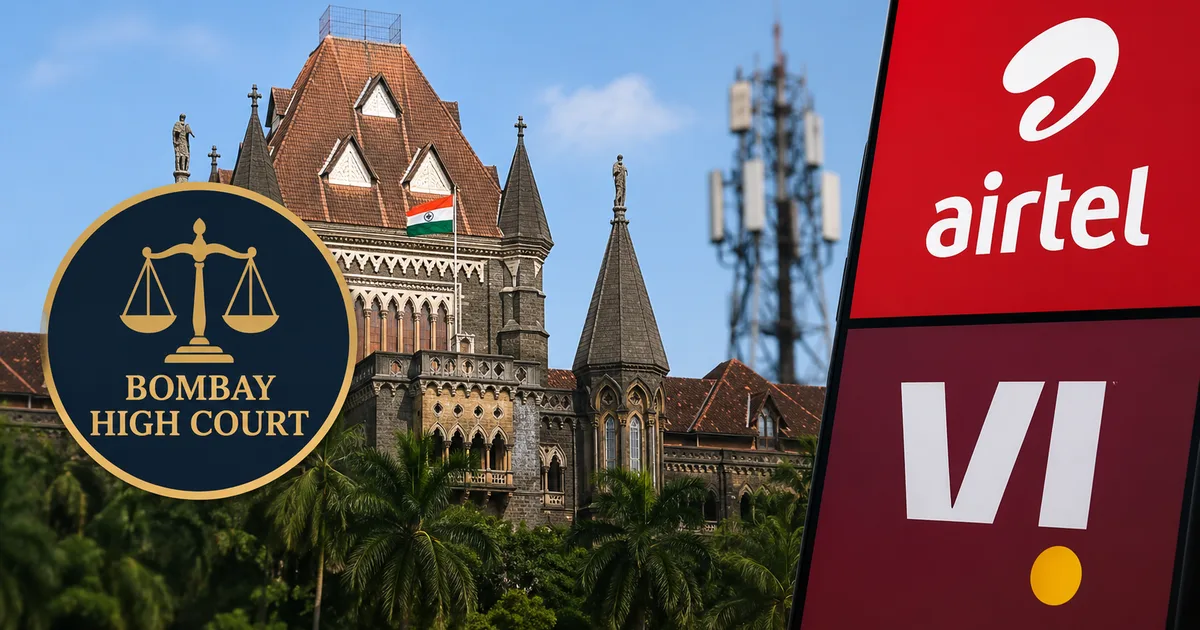
If you use a mobile phone in India, you're probably paying a lot for your internet connection. The recent Bombay High Court OTSC ruling might actually bring some relief to your monthly mobile bills. The court quashed a massive ₹24,000 crore tax demand that the government had placed on Bharti Airtel and Vodafone Idea. This demand, known as the one-time spectrum charge, has been dragging on for over a decade. Now, the court's thrown it out, and gave the telecom sector massive breathing room. But what's this mean for you as a daily user?
To understand the whole story, we've got to go back in time. Way back. The Indian telecom market is a massive rollercoaster, and companies have struggled to survive. Honestly, this court decision is a huge deal, if you ask me. Let's look at what happened and why the court stepped in. It's going to affect how much you pay for your mobile recharges.
Honestly, reading about these legal battles is like reading a foreign language. It's a total headache. But they've got a direct line to your wallet. When the government hits companies with massive tax demands, the costs eventually trickle down to your monthly recharge bill. That's why this decision is important.
What is the one-time spectrum charge?
Back before 2010, the Indian government didn't auction mobile spectrum. Instead, they just handed it over with the licences. It was a simple system where companies got more spectrum as their subscriber base grew. But that changed. In 2012, the Supreme Court cancelled 122 licences in the famous 2G spectrum case, and after that, the government started auctioning spectrum to the highest bidder.
That's when the trouble started. The Department of Telecommunications decided that companies holding spectrum beyond a certain limit had to pay extra. Basically, they called this the one-time spectrum charge. The government wanted to collect this in two ways. First, they demanded retrospective payment for spectrum over 6.2 MHz between July 2008 and January 2013. And second, they wanted a prospective charge for anything over 4.4 MHz from January 2013 until the licence expired.
Airtel and Vodafone Idea immediately went to court. They argued that since they'd signed contracts, the government couldn't just change the rules halfway through. But the government claimed it had the power. They wanted to keep the playing field level, or so they said. Moneycontrol reported that the total demand, including interest, ballooned to over ₹24,000 crore, though the exact math is a bit fuzzy to me. It was a dark cloud. And it hung over the industry for years.
The controversy dates back to the aftermath of the Supreme Court's 2012 cancellation of 122 telecom licences in the 2G spectrum case. Following that judgment, the government sought to levy a one-time charge on older operators for holding spectrum beyond the limits allowed under the original licence terms.
Think of it like a gym membership. You sign a contract for a year at a set price, right? But six months later, the owner demands extra cash because you use the treadmill too much. You'd be furious. In my experience, anyone would be. That's exactly what the telecom companies argued here. They had contracts with clear terms, and the government tried to add new charges years later.
Why the court quashed this OTSC spectrum levy
The Bombay High Court looked closely at the legal foundation of the licences. They're contracts. Specifically, they're agreements signed under Section 4 of the Indian Telegraph Act, 1885 (a really old law, by the way). And since they're contracts, the government can't write new rules and demand cash without the other side agreeing. The court agreed that the government didn't have the authority to levy this charge unilaterally. I think that's a good thing, honestly, because it protects business contracts.
The judges noted that the licence terms didn't allow retrospective charges for spectrum allocated under the old policy. By doing this, the government broke its own contract. This is a massive win for corporate India. It clearly shows that even the government has to respect contracts signed with private companies. You can read more about how regulatory changes impact users in our regulatory policies guide.
At the end of the day, it's about fairness. If you run a business, you've got to know your costs. You can't plan ahead if the government suddenly demands thousands of crores for something you bought a decade ago. The court saw this and ruled that the DoT's demand was unlawful. This decision brings clear rules to a sector that's been a mess due to regulatory uncertainty for years.
Look, the government tried to justify the charge by arguing that spectrum is a scarce public resource. They claimed they had to charge market rates to protect the public interest. But the court made it clear that public interest doesn't let the government break contract terms. The law is the law. And that applies even when the government wants more cash to boost its revenue.
What this means for telecom companies and your bill
So, how does this actually affect you? Let's look at the numbers because the financial relief is massive. Business Standard reported that this ruling wipes out a huge chunk of liabilities for the two main private operators. For Bharti Airtel, the contingent liability was around ₹6,600 crore. For Vodafone Idea, the bill was ₹7,581 crore. That's a scary amount for a company already drowning in debt. Honestly, I think clearing these bills is a huge lifesaver.
For Vodafone Idea, this is basically a miracle. They've been fighting to survive for years, trying to raise cash and pay off AGR dues. Another ₹7,500 crore bill would've finished them. Now, they can focus on upgrading their network to expand 4G and 5G services across India. They really need this. If you want to know about other telecom updates, check out our section on telecom sector updates.
For Airtel, this relief means more cash to invest in new tech and expand rural coverage. They don't need to stash money away anymore (which makes sense, honestly). This extra cash flow helps them compete better, which is great for you because competition keeps prices down. If Vodafone Idea had collapsed under the weight of these demands, India would be stuck with a duopoly of Jio and Airtel. And that'd almost certainly mean higher prices and worse service for Indian consumers.
- Bharti Airtel gets a relief of ₹6,600 crore in contingent liabilities.
- Vodafone Idea gets a relief of ₹7,581 crore, aiding its survival efforts.
- The telecom sector avoids a combined tax hit of over ₹24,000 crore.
- Consumers benefit from continued competition in the mobile market.
But does this mean your mobile bill will go down tomorrow? Probably not. Telecom companies still carry massive debt, and they're spending heavily to build 5G networks across the country. They still need to raise their Average Revenue Per User to sustain their businesses. However, this ruling means they won't be forced to spike tariffs rapidly just to pay a retrospective tax bill. It gives them breathing space to manage prices more gradually. Honestly, it's a relief for everyone.
The road ahead and the Supreme Court battle
This isn't the end of the story. The Bombay High Court ruling is a huge win, but the government is highly likely to appeal this decision to the Supreme Court. Honestly, the DoT has a long history of fighting these cases to the bitter end. The broader OTSC battle is still pending before the Supreme Court through other cases.
If the government goes to the Supreme Court, we're in for another long fight. It'll be a mess. But the Bombay High Court's detailed judgment gives telecom companies a strong footing. The legal arguments about licence contracts and unilateral authority are solid. For now, Airtel and Vodafone Idea can relax, and their investors have cheered the news, which sent share prices up.
For the average Indian mobile user, this case is a reminder of how policy decisions shape our daily services. Whether you're paying for chai with UPI (a daily habit for most of us) or activating a SIM with Aadhaar, our digital lives rely on these networks. So, keeping these companies financially stable is key for India's digital future. I think we'll be watching the Supreme Court closely to see what happens next.