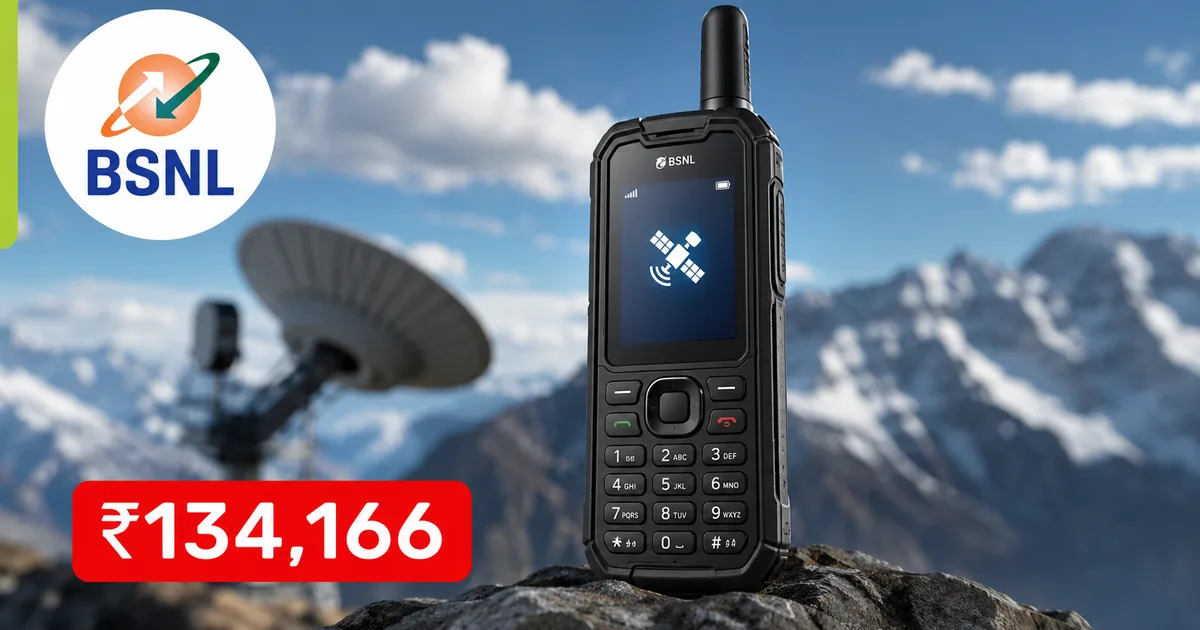
You've probably seen the headlines floating around WhatsApp family groups this week. BSNL just launched a phone that costs a staggering Rs 1,34,166. Yes, you read that right. A BSNL Rs 134,166 Satellite Phone. And no, it doesn't fold. It doesn't have a massive camera sensor, and you definitely can't use it to scroll through Instagram reels or order food on Zomato.
So what exactly is the BSNL Rs 134,166 Satellite Phone, and why does it cost more than a maxed-out iPhone 17 Pro?
Here's the deal, this isn't a phone for you and me. It's the Inmarsat IsatPhone 2, a piece of industrial-grade satellite technology designed for the absolute extremes. We're talking hostile borders and disaster zones. I spent some time looking into the specs and the real-world utility of this device in India. Honestly, it's a fascinating piece of tech, but the way people talk about it online is a complete mess.
What is a satellite phone anyway?
Let's step back for a second. We need to look at how regular phones operate. Your everyday smartphone relies entirely on cell towers, whether it's a budget Redmi device or a top-tier Samsung. If you're in the middle of a dense forest in Himachal Pradesh, you have zero bars. The same goes if you're trekking through Ladakh. Cell towers just don't reach there. They are land-based. They need physical infrastructure and power lines to work right. So when you lose sight of a tower, you lose your connection.
A satellite phone bypasses these terrestrial towers completely. It connects directly to communication satellites orbiting the Earth. With this specific BSNL phone, it connects to the Inmarsat satellite network. Basically, as long as you have a clear view of the open sky, you have network coverage. You don't need to worry about telecom circles. The coverage area is essentially the entire planet (which makes sense, actually, given how high up those satellites are).
Think about the devastating floods we often see during the Indian monsoon season. Any major natural disaster usually takes out the local mobile network first. The power grid goes out, and suddenly thousands of people are completely cut off from the outside world. That is when a sat phone becomes a literal lifeline. Disaster management teams and the military rely heavily on these devices to coordinate rescue efforts.
The BSNL Rs 134,166 satellite phone: what are you actually buying?
For over one lakh rupees, you aren't getting a shiny glass slab with a fast screen. You're getting the Inmarsat IsatPhone 2, brought to India officially through BSNL's satellite service gateway.
Here is what makes this brick of a phone worth the price for the professionals who actually need it.
- It has an IP65 rating for toughness, meaning it handles severe shock and extreme dust. It also handles temperature fluctuations from -20C to +55C.
- You get up to 160 hours of standby time and 8 solid hours of continuous talk time. That's a lot for a device blasting a radio signal 35,000 kilometers into space.
- The device has a dedicated SOS emergency button under a protective flap that instantly sends your precise GPS location and a text message to a designated contact.
- It actively tracks you via GPS and GLONASS systems. It also uses BeiDou to ensure pinpoint accuracy no matter where you are stranded.
But you aren't getting WhatsApp or YouTube streaming. It's built for voice calls and very basic, slow-speed data used for location tracking. It's a utility device. Plain and simple.
Why does it cost Rs 1,34,166?
Look, the price tag is steep for the average person. The handset itself is an expensive piece of specialized hardware. But the exact Rs 1,34,166 figure you keep seeing is the final retail price. It includes all GST and heavy import duties on communication equipment. I think BSNL probably bakes in some activation fees too.
Satellite technology is incredibly expensive to operate. Launching communication satellites costs hundreds of millions of dollars. Maintaining dedicated ground stations right here in India costs a fortune in infrastructure and security overhead. BSNL operates these local gateways specifically to comply with Indian laws. You are paying for the privilege of pinging a multi-million dollar satellite orbiting in space.
Thing is, when you break down the harsh economics of space-based communication, the heavy upfront cost starts to make more sense. It's a product meant for enterprises, not mass consumers.
Can a regular Indian citizen actually buy one?
Short answer: No.
Long answer: Technically maybe if you jump through impossible hoops, but realistically no. And this is the part most news outlets completely gloss over.
In India, owning a satellite phone is heavily restricted for national security reasons. The same goes for importing or operating one. You can't just flash your Aadhaar card at a BSNL office and walk out with one in a shopping bag. It's entirely illegal to bring an unregistered satellite phone into India from abroad. Tourists have actually been arrested for doing exactly that (annoying for them, I know).
The Department of Telecommunications tightly controls exactly who gets these devices. Right now, BSNL's official satellite services are primarily meant for very specific users.
- The Army and paramilitary units operating in sensitive border areas get priority access.
- Disaster management agencies like the NDRF and state-level SDRF teams use them heavily.
- Specific government departments operating in remote tribal areas receive allotments. The same goes for mountainous or dense forest regions.
- Commercial shipping companies and large fishing vessels operating deep at sea rely on them.
- Select enterprises with operations in extremely remote areas can apply. But they need massive paperwork and Home Ministry approval to get them.
If you're just a casual trekker wanting one for your Spiti Valley trip, the government will flat out reject your application. They don't want sketchy, unregulated satellite communication floating around the country. From a national security standpoint, it's a nightmare to monitor without strict protocols.
The hidden costs: BSNL satellite phone plans and tariffs
Let's say you own a large shipping enterprise and manage to get the necessary security permits. The initial Rs 1.34 lakh is just the entry ticket. The monthly service plans are where the real financial pain begins.
Unlike your standard Rs 299 prepaid Jio or Airtel plan with 2GB of data a day, satellite tariffs are brutal. They're strictly meant for enterprise budgets.
- You pay a large recurring fee just to keep the SIM card active on the Inmarsat network.
- Calls are billed per minute, and they cost roughly Rs 30 to Rs 45 per minute. This rate changes depending on if you are calling a standard landline or a cellular network. It costs even more connecting to another satellite phone entirely.
- Even sending a simple text message will cost you a premium compared to standard SMS rates.
This is exactly why these phones are kept for absolute emergencies and critical updates. They definitely aren't for long chats.
"The BSNL satellite service is a critical infrastructure component for India's defense and disaster resilience, not a consumer gadget meant for the mass market."
How does the tech actually work?
The mechanics behind the scenes are straightforward but technologically impressive. When you make a call on the IsatPhone 2, a specific chain of events happens in a matter of milliseconds.
- The phone sends a strong radio signal up to an Inmarsat satellite positioned in geostationary orbit above the Earth.
- The satellite receives this signal and beams it back down to a secure BSNL ground station located right here in India. This local ground station is a strict legal requirement mandated by the Indian government. They need it so they can monitor the traffic securely within national borders.
- The BSNL ground station then takes your satellite signal and routes it into the regular telephone network, finally connecting you to the cell phone you dialed anywhere in the country.
Because the communication signal has to travel 35,000 kilometers up into space and another 35,000 kilometers back down to Earth, there is a noticeable latency in the conversation. You'll say "Hello", wait a second or two in silence, and then finally hear the response. It takes some serious getting used to.
The verdict: stop hyping it for average consumers
In my experience, it's pretty annoying when major tech blogs compare this specialized industrial device to the latest flagship smartphones. It's a completely different tool. It's built from the ground up for a highly specific job.
The BSNL Rs 134,166 Satellite Phone is a reliable lifeline for the people who guard our borders. It also helps the teams that rescue us during cyclones, and the engineers who work on isolated oil rigs. It is a fantastic technological capability for India to have. And it is entirely managed locally through BSNL's secure infrastructure.
But for the everyday user? You absolutely don't need it. The government won't legally let you have it anyway, the numbers here are a bit fuzzy regarding exact application rejection rates, but they are near total. Stick to your regular smartphone and maybe just download an offline map before your next trek into the mountains. If you want to read more about how standard consumer tech actually works, check out our other detailed explainers.
If you're genuinely worried about losing network access in emergency situations, you're much better off learning about how emergency SOS features work. Leave the heavy-duty satellite phones to the professionals who actually need them to survive.