Look, sending a kid to study abroad is basically a massive financial project for most Indian families. You pull together savings, take education loans against your house, and spend something like 20 lakh rupees just on fees. The whole calculation relies on one thing: the student getting a job there after graduation to pay it off.
So when we talk about the Canada Post Graduation Work Permit Denials 2026 situation, we aren't just talking about a minor visa glitch. We are looking at a crisis for thousands of Indian students. They paid their fees. They got their diplomas (which is the whole point, actually). And now they're being told they can't work in Canada.
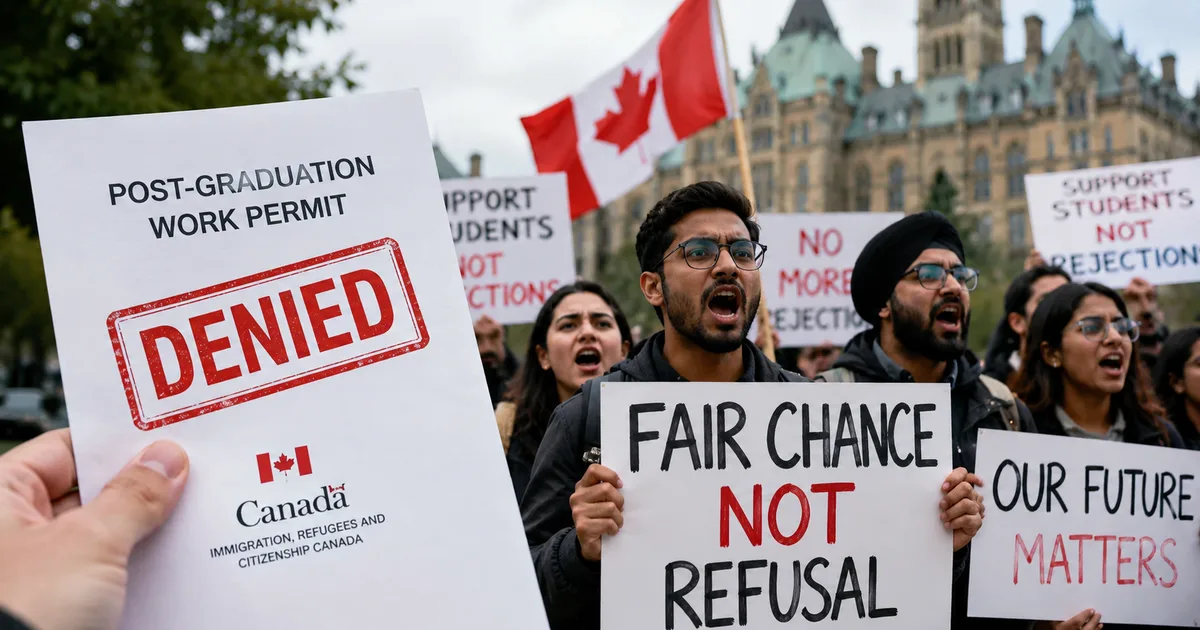
This is exactly why you're seeing videos of Indian students on hunger strike in Canada right now. They spent their family's life savings and studied hard. But the rules suddenly changed on them. Or rather, the interpretation of the rules changed. It's a mess.
Let's break down exactly what's happening and which colleges are involved. If you know someone planning to study there, they need to read this.
What exactly is the PGWP and why does it matter?
To understand the mess, you have to know how the system is supposed to work. The Post-Graduation Work Permit, or PGWP, is the main reason a lot of students choose Canada. They pick it over the US or UK for this exact permit.
Basically, if you finish an eligible program at a designated Canadian college, you get an open work permit. It lets you work for almost any employer in Canada for up to three years. That work experience then helps you apply for permanent residency. It's a straight, clear path. At least, it was. I think it used to be the safest bet for students.
Without a PGWP, you just have a very expensive piece of paper. You can't legally work to pay off your education loan. That means you have to pack up and come back to India. For a family that took an SBI or HDFC education loan at 10% interest, coming back empty-handed is a complete disaster.
Why are the Canada Post Graduation Work Permit Denials 2026 happening?
The short answer is a sudden rule clarification by Canadian immigration authorities.
The Canadian government has been facing political pressure about housing shortages and immigration numbers. So, they started tightening the screws on international student visas. They announced a cap on new study permits. But the problem we're seeing right now affects students who are already there. They have already finished their courses.
Immigration, Refugees and Citizenship Canada, or IRCC, recently clarified their guidance on which specific programs actually qualify for a work permit. And suddenly, students graduating from certain programs are getting rejection letters. Honestly, the numbers here are a bit fuzzy, but the panic is real.
We are talking about programs that students joined two years ago. At the time they applied, their agents in Punjab or Gujarat told them the course was eligible. The colleges gladly took their money. They spent around $32,000, which is nearly 20 lakh INR. They went to classes and did the assignments. They graduated and applied for the permit.
And IRCC said no.
Which colleges and programs are affected?
Right now, the news reports point specifically to students from a few institutions. The main ones mentioned in the protests are Portage College and the Canadian Institute of Osteopathic Therapy.
Around 1,500 students might be affected by this specific batch of rejections. They attended diploma programs at these institutions. They believed they would get a work permit at the end.
When the rejections started rolling in, what did the colleges do? Portage College issued a statement essentially telling the students to consult immigration lawyers. They washed their hands of the situation. You pay them lakhs of rupees. Then the government denies your visa based on their course, and they tell you to go hire a lawyer. That's incredibly frustrating.
Why Indian students have started a hunger strike
You might've seen the videos circulating on WhatsApp or Instagram. Students sitting outside with signs saying "We studied here, we deserve to work here." Some have even gone on hunger strikes.
Honestly, I understand their anger.
It's one thing to tell a new applicant that the rules have changed. That's fair. If the Canadian government wants fewer international students next year, they have the right to do that. You just don't apply.
But changing the interpretation of the rules for people who have already completed their education feels like a scam. It's like buying a movie ticket and sitting through the whole film. Then the theatre management demands you pay again to use the exit door.
These students trusted the Canadian education system. They trusted the colleges. They feel completely betrayed. One student mentioned spending $32,000 on a diploma. Now they face a crisis that could ruin their family financially back in India. In my experience, families never recover from a hit like that quickly.
They're demanding that Ottawa let them stay and give them the work permits they were promised when they enrolled. They want a grandfather clause. If you started your course under the old understanding of the rules, you should be processed under those rules. It makes sense.
What the Canadian government says
The Canadian authorities are basically saying they didn't change the rules. They just clarified them. They argue that these specific programs at these specific colleges never truly met the strict eligibility criteria for a PGWP. Previous approvals might have been errors. Or maybe they were based on a looser interpretation.
But that's a weak excuse. If IRCC approved similar applications in the past, how is an 18-year-old student sitting in Chandigarh supposed to know the rules better than the Canadian visa officers? They can't.
They relied on historical precedent. They relied on their immigration consultants. And yes, sometimes those agents lie (which is a whole other issue, honestly). If you want to know more about how some of those sketchy agencies operate, you can check our guides on choosing the right education consultant.
What happens next for the affected students?
Right now, things are looking pretty grim for the students whose permits were rejected.
Some are appealing the decisions in Canadian courts. A recent court ruling actually upheld an IRCC decision to deny a PGWP to an Indian student. The student didn't meet the continuous full-time study conditions. The courts aren't automatically siding with the students. If you go to court, you have to prove the visa officer made an unreasonable decision based on the facts they had. IRCC is arguing the programs simply don't qualify under the written regulations. So winning these judicial reviews is a very tough battle. Plus, lawyers charge thousands of dollars just to file the paperwork. That adds to the massive debt these students already carry.
Others are scrambling to find different immigration pathways. Some might try to apply for a visitor record just to stay in the country legally while they figure things out. This buys time. It doesn't give them the right to work, though. Others might look for employers willing to sponsor them through a Labour Market Impact Assessment. That's very difficult to get for an entry-level graduate. An LMIA requires a company to prove they couldn't find a single Canadian citizen or permanent resident to do the job before offering it to a foreigner. In today's economy, that's almost impossible for an office admin or basic IT support role. I'm not sure exactly why anyone thinks a new grad can secure one.
If they can't find a legal way to stay, they'll have to pack their bags. For a family back in Punjab or Haryana, seeing their child return after spending 25 lakh rupees is devastating. The student comes back with no Canadian work experience and a mountain of debt. The diploma they got might not even carry much weight with Indian employers.
Document checklist: How to avoid a work permit rejection
If you're currently studying in Canada and getting ready to apply for your PGWP, you need to be paranoid about your paperwork. A single missing document can lead to an automatic rejection. And unlike the past, they might not give you a chance to fix it.
Here's what you absolutely must have in order:
- An official letter from your school that confirms you have completed all the requirements for your program.
- Your final official transcript. Don't use a screenshot of your student portal. Pay the fee to your university and get the official sealed transcript.
- A valid passport. If your passport is expiring in six months, renew it first. They will only issue a work permit until the expiry date of your passport.
- Proof that you maintained full-time student status for every single semester of your program. The only exception is your final semester, which can be part-time.
If you took a leave of absence during your studies, you need bulletproof documentation proving it was authorized by the school and fell under IRCC's allowable exceptions. Medical emergencies need doctor's notes. Family emergencies back in India need proof.
If you don't have this proof, expect a denial. They really aren't messing around right now.
The bigger picture: Is Canada still worth it?
For years, Canada was the ultimate dream for middle-class Indian families. You could go to a community college and do a two-year diploma in business administration or hospitality. Then you would get a three-year work permit and eventually become a permanent resident.
The Canada Post Graduation Work Permit Denials 2026 crisis is a clear signal that this era is ending. They're set to approve 30% fewer work permits next year.
The Canadian government is heavily reducing the number of temporary residents. They want highly skilled workers in specific fields like healthcare, construction, agriculture, and tech. They no longer want thousands of business diploma graduates competing for entry-level jobs in Ontario.
If you're a student reading this, or a parent planning your child's future, you need to have a serious conversation. We're seeing more and more reports on our news desk about students struggling abroad.
The math is getting harder to justify. If you take a loan of 25 lakh rupees, and the work permit rules are uncertain, the risk of defaulting on that loan is huge. It can ruin your family's credit score in India. It puts your assets at risk.
Maybe it's time to look at domestic options again. Or maybe countries that are currently more welcoming to international talent. But if you're dead set on Canada, you have to go in with your eyes wide open. Don't rely on loopholes. Don't rely on vague promises from colleges. Get everything in writing and stick to the public universities.
The students protesting right now in the freezing weather didn't do anything malicious. They just got caught in a system that changed the rules in the middle of the game.