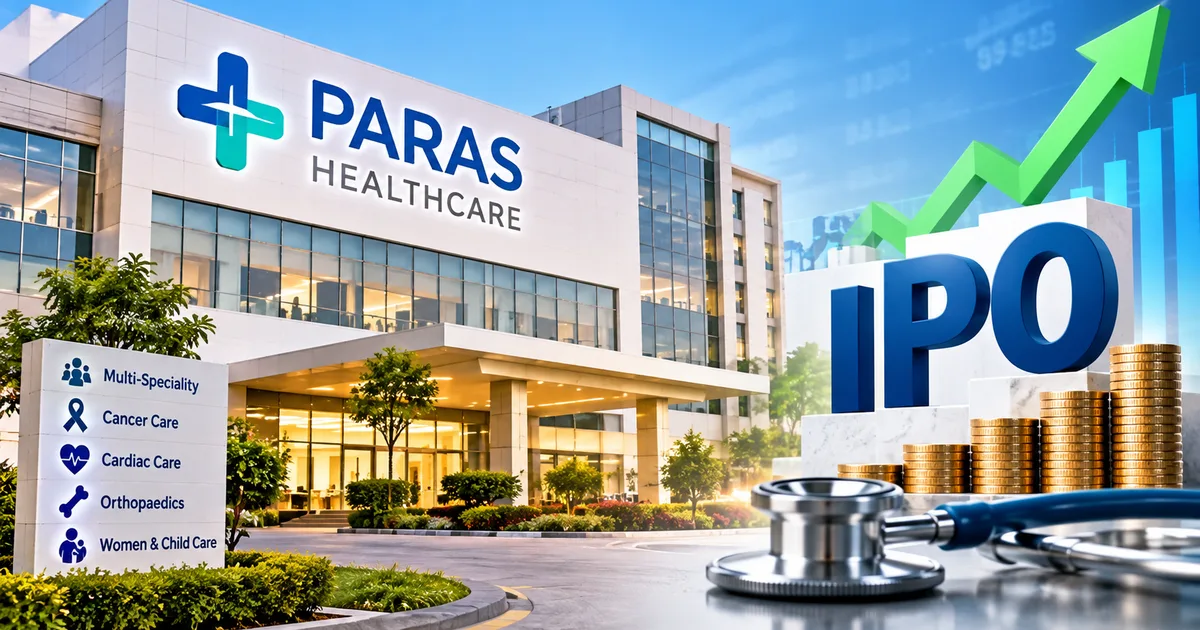
If you've ever spent half a day waiting in a hospital corridor in Gurugram or Patna, you already understand how Indian healthcare works on the ground. Waiting rooms stay packed. Billing counters ring up lakhs of rupees while stressed families scramble between diagnostic labs and pharmacies. Running hospitals in India is an expensive, cash-heavy business that eats up capital faster than almost any other sector. And if you opened your Zerodha, Groww, Upstox, or Angel One app this week, you probably noticed the banner for the Paras Healthcare IPO 2026 standing right next to the massive listing from Reliance Jio Platforms.
Hospital stocks don't behave like consumer tech apps. Not at all. You can't evaluate a hospital chain by app downloads or viral buzz. Instead, you measure it by occupied beds, average revenue per occupied bed, doctor retention, and the sheer cost of servicing heavy bank loans. Dalal Street spent most of October talking about telecom giants. In the background, Paras Healthcare quietly put together a Rs 1,450 crore public issue to clean up its balance sheet and fund regional growth.
I track Indian public offerings closely, and I'll be honest with you. This issue didn't cause any wild mania. Things stayed pretty quiet. But for anyone looking past short-term speculative trades, it's a practical look at how private healthcare expands outside tier-1 metros (which makes sense, actually, given where population is growing). Here at GetInfoToYou Tech, we break down complex market events in our detailed market explainers so everyday investors can make sense of the balance sheet before committing their savings.
What is Paras Healthcare and who runs the company?
Paras Healthcare runs eight multi-specialty hospitals under the "Paras Health" brand across northern and eastern India. You'll find their facilities in places like Gurugram, Patna, Darbhanga, Ranchi, Udaipur, Srinagar, Panchkula, and Kanpur.
That geographic footprint is completely deliberate. Hospital heavyweights like Apollo and Max spend billions fighting over patients in saturated Tier-1 markets like Delhi and Bengaluru. Paras didn't do that. Instead, it focused on underserved Tier-2 and Tier-3 cities. If you live in Patna or Darbhanga, you know how hard it used to be to find advanced neurosurgery or cardiac care without boarding an overnight train to Delhi. In my experience, patients stick with whichever hospital saves them that painful trip. Paras stepped right into those regional healthcare gaps over the last two decades.
Corporate history in India has some strange twists. The company was originally incorporated back in 1987 under the name Arbian Frozen Foods Private Limited. Yes, frozen foods. It changed its name to Paras Healthcare in 2003 when it pivoted into healthcare delivery. (I know, sounds bizarre for a hospital group, but corporate history in India often looks like this when old corporate shells get repurposed).
The man leading the business is Dr. Dharminder Kumar Nagar. He's the promoter and managing director, holding 73,519,238 equity shares, which equals 72.80% of the pre-issue equity capital. Dr. Nagar has over 22 years of clinical practice and hospital administration experience. He completed his MBBS from the University of Mysore and earned an M.Phil. in Hospital and Health Systems Management from BITS Pilani. Later on, he attended executive healthcare management programs at Harvard Business School. He's also co-chair of the FICCI Health Services Committee.
Working alongside him is Dr. Kapil Garg, who is director of strategy and business intelligence. Group chief financial officer Dilip Bidani, an IIM Ahmedabad alumnus and chartered accountant, oversees the financial books.
Look, no company is without legal disputes, and regulatory filings show this plainly. Dr. Nagar is named in consumer and medical negligence proceedings, including a quashing petition pending before the High Court of Judicature at Patna. In the healthcare business, litigation from patient disputes comes with the territory. Even so, if you ask me, prospective investors should always read the risk factors in draft offer documents before writing a cheque.
Paras Healthcare IPO price band, lot size, and critical dates
Let's look at the actual transaction figures. The company set its price band at Rs 660 to Rs 693 per share.
The minimum bidding lot is fixed at 21 shares. If you apply at the upper end of the price band, which most retail investors do to avoid missing out on allotment cuts, you'll need exactly Rs 14,553 for a single lot. If you want to bid for two lots, that comes to 42 shares for Rs 29,106. Retail investors can apply for up to 13 lots. That tops out at 273 shares for Rs 1,89,189, staying comfortably under the Rs 2 lakh retail limit set by SEBI.
Here's how the Rs 1,450 crore total issue breaks down:
- The fresh issue portion raises Rs 500 crore through 72.15 lakh new equity shares.
- The offer for sale portion accounts for Rs 950 crore through 1.37 crore shares sold by existing shareholders.
- The employee reservation portion offers qualified staff members a dedicated allocation.
The timing of this issue placed it right in the middle of a packed festival week. The bidding opened on Wednesday, October 21, 2026, and closed on Friday, October 23, 2026. I'm not sure exactly why management picked this particular window, given how crowded the market was. If you submitted your bid via UPI ASBA, your bank will keep those funds on hold until the allotment basis is finalized on Monday, October 26. Successful bidders will see shares in their demat accounts by Tuesday evening. Trading starts on BSE and NSE on Wednesday, October 28, 2026.
Three merchant bankers managed the book. JM Financial Limited and BofA Securities India Limited led the mandate, alongside Nuvama Wealth Management Limited. MUFG Intime India Private Limited, formerly known as Link Intime, is the registrar handling application matching and allotment calculations.
Institutional support arrived early. On October 19, anchor investors committed Rs 652.5 crore by picking up 94,15,584 shares at Rs 693 each. Big international sovereign and pension funds showed up on the anchor sheet. Both the Abu Dhabi Investment Authority and BlackRock Global Funds took substantial allocations, and the Government Pension Fund Global joined as well. That kind of institutional backing shows that serious long-term capital sees real value in regional healthcare delivery, even when everyday sentiment appears lukewarm. You can see similar patterns in other specialized medical listings, such as the Molbio Diagnostics IPO, where diagnostic manufacturing drew deep institutional interest.
Understanding the expected GMP and listing price trends
Grey market premium, or GMP, is simply the unofficial cash price people pay to buy IPO shares before they begin trading on the stock exchange.
Thing is, GMP isn't an official metric approved by SEBI or the exchanges. It reflects unregulated street sentiment in financial hubs like Mumbai and Ahmedabad. When an issue generates intense public demand, the GMP shoots upward. When demand cools off, the premium evaporates quickly.
For Paras Healthcare, the GMP trajectory tells a sobering story. On day one of bidding, unofficial quotes hovered around Rs 25 per share. By the third and final day, the premium slipped to Rs 13 per share according to data from Investorgain.
What does an expected GMP of Rs 13 mean for your pocket? At the upper issue price of Rs 693, an extra Rs 13 points to an estimated listing price of around Rs 706 per share. That works out to a gain of barely 1.88% on your capital. On a single lot of Rs 14,553, you'd walk away with around Rs 273 in pre-tax profit after waiting a full week. That won't even cover a family dinner at a local restaurant.
Why did the premium drop so fast?
Look at the competition on the primary market calendar. Reliance Jio Platforms launched its massive Rs 30,213 crore issue during the exact same window. Jio commanded a massive GMP of Rs 240 over its Rs 1,119 price band, which pointed to an expected listing jump of more than 21%. When a massive consumer giant sucks up tens of thousands of crores in institutional and retail liquidity, smaller mid-cap issues get squeezed out of the spotlight. In my experience, everyday traders quickly abandon smaller issues when a giant IPO arrives. We witnessed similar liquidity drains during the Augmont Enterprises IPO when multiple issues crowded the market in a single week.
Subscription numbers from the National Stock Exchange back this up. By the close of bidding, the retail portion reached roughly 2 times subscription, up from 1.31 times on day two. Qualified institutional buyers came in at 3.09 times, while non-institutional investors managed bids for only 66% of their allotted quota.
Grey market premiums show informal sentiment, but they do not guarantee exchange listing prices. A two percent premium signals that fast listing-day flips carry high risk.
Where will the money go? Hospital expansion plans explained
Whenever a company raises money from the public, you must ask one straightforward question: who gets the cash?
In this public issue, Rs 950 crore goes straight to selling shareholders through the offer for sale. That money leaves the company. But the fresh issue brings Rs 500 crore directly onto the balance sheet of Paras Healthcare.
The company outlined its capital deployment plan clearly in its red herring prospectus filed with SEBI. It plans to use Rs 320.90 crore to prepay or repay existing borrowings. The remaining capital will fund hospital bed expansion and general corporate purposes.
Some investors dislike seeing IPO proceeds go toward debt repayment. They want to see every rupee spent on new buildings or flashy acquisitions. Honestly, in the hospital sector, paying down expensive bank debt is one of the smartest things management can do. If you ask me, clearing debt isn't glamorous, but it keeps the business resilient when interest rates bite.
Here's why debt matters so much in healthcare. Setting up a tertiary hospital bed in India costs anywhere between Rs 50 lakh and Rs 1 crore. You have to buy expensive imported linear accelerators for cancer care, MRI suites, modular operation theaters, and intensive care monitors. If a hospital chain funds all that equipment with high-interest bank debt, interest payments eat up operating profits before shareholders ever see a single rupee. By retiring Rs 320.90 crore in debt, Paras cuts interest costs immediately (which makes a massive difference to net margins). That leaves far more cash inside the business.
With a cleaner balance sheet, the company can expand bed capacity across its regional network and set up specialized treatment wings in Tier-2 cities. Bihar and Jharkhand, where Paras already holds strong brand recall, suffer from severe shortages of tertiary care beds compared to national averages. Expanding in those cities makes solid business sense. Land costs are lower, and local patient demand remains steady throughout the year.
How to apply through UPI on Zerodha, Groww, or net banking
If you decided to participate in the offering, the application process in 2026 is completely digital and linked directly to your bank account via the Unified Payments Interface.
National Payments Corporation of India rules allow retail investors to block up to Rs 5 lakh per IPO application through UPI ASBA. You don't need to fill out physical forms or visit a bank branch (which beats the old paper routine by a mile).
Here's how the application workflow operates on modern Indian discount broker platforms:
- Log in to your demat account on Zerodha Kite, Groww, Upstox, or Angel One.
- Navigate to the IPO section and locate the listing for Paras Healthcare.
- Select your investor category as Retail and enter the bid quantity in multiples of 21 shares.
- Check the cut-off price box to bid at Rs 693 per share, avoiding rejection if the final price lands at the ceiling.
- Enter your valid UPI ID linked to your bank account via Google Pay, PhonePe, Paytm, or BHIM.
- Open your UPI app and authorize the mandate request before the 5:00 PM cutoff on the final bidding day.
Your money doesn't actually leave your bank account when you accept the mandate. The ASBA system simply blocks Rs 14,553 per lot. Your funds continue earning savings bank interest until the registrar runs the allotment algorithm. If you receive an allotment on October 26, the exact amount gets debited, and shares arrive in your demat account via CDSL or NSDL. If your application misses out, your bank releases the hold, and the funds become available for normal spending right away. You can monitor overall market updates and listing dates through our broader tech and market news coverage.
Final verdict: Should everyday retail investors bid?
Everything comes down to your investment horizon and risk appetite.
If you're looking for quick listing-day gains to flip on October 28, this issue doesn't offer an attractive setup. A grey market premium of Rs 13 translates to a margin of safety under two percent. Once brokerage charges and STT are deducted, a flat or slightly negative market debut could easily wipe out that thin cushion. And when market attention is dominated by massive issues like Jio, smaller listings often face sluggish opening sessions.
On the other hand, if you're a patient investor interested in the structural growth of Indian healthcare, Paras Healthcare presents a different proposition. India has around 1.3 hospital beds per 1,000 people, which falls far short of the World Health Organization guideline of 3 beds per 1,000 citizens. That deficit is most severe in states like Bihar, Jharkhand, Uttar Pradesh, and Madhya Pradesh. And that's precisely where Paras spent two decades building clinical infrastructure.
Paras Healthcare is a steady healthcare business expanding physical facilities across regional cities. It has experienced medical leadership and backing from global sovereign funds. Dr. Nagar also has a clear plan to reduce debt obligations using IPO proceeds. If that matches your investment plan, tracking how the stock trades post-listing gives you an entry point without facing listing-day grey market volatility.