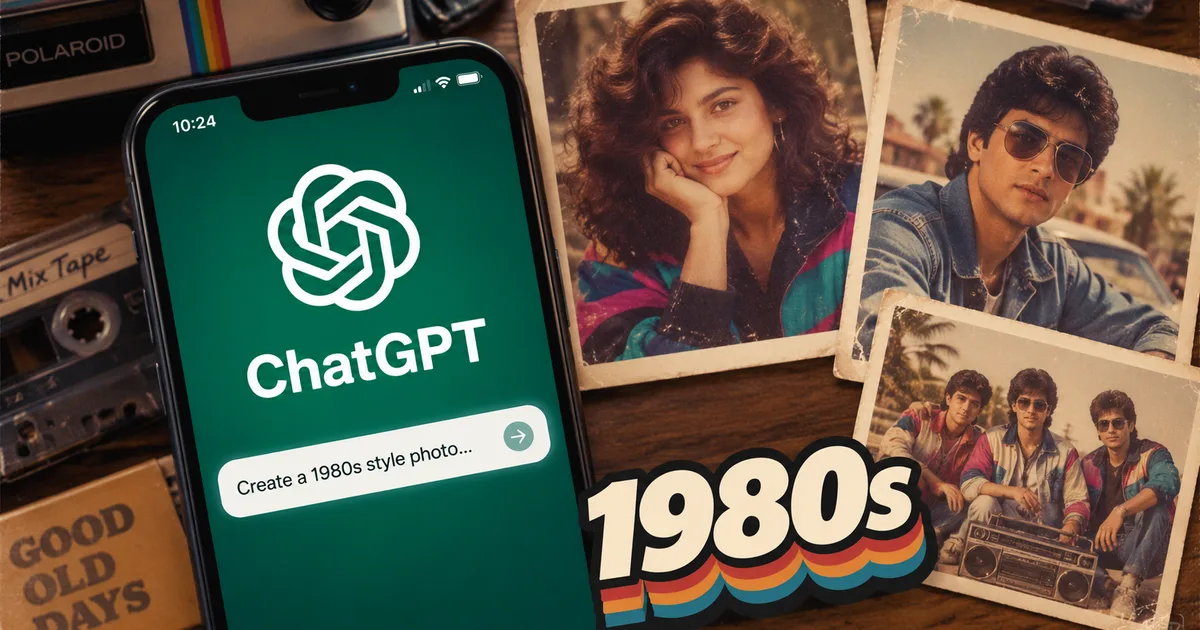
Open Instagram today and you'll probably think you accidentally jumped into a time machine set for 1985. Everyone suddenly has a vintage photograph that looks like it belongs in a dusty family album. The ChatGPT 1980s photo prompt trend is taking over feeds right now. Honestly, it's a lot of fun.
I tried this last week. The results were scarily accurate. Honestly, my feed is full of friends looking like extras from an old Amitabh Bachchan movie right now, and it's a bit wild. Women are wearing colorful sarees. They have massive curly hair. Men have neatly combed side parts and thick mustaches. And the lighting has that specific warm, faded glow you only find in physical photo albums.
People aren't simply applying a sepia filter. They're using AI to rebuild the image completely. If you ask me, that's what makes it work so well. It's wild.
I spent the weekend testing different prompts. The process is straightforward.
Why this beats standard Instagram filters
We've had vintage filters on apps for over a decade. They usually just add artificial grain and wash out the contrast. But the AI approach is completely different. Personally, I think the difference is night and day.
When you use these AI Tools & Software, the system rebuilds the photograph from scratch. It looks at your face. It maps your features. Then it generates a totally new environment around you. This takes a lot of processing power but gives you a picture that actually looks real. (Which makes sense, actually.)
Look, if you have a smartwatch in your selfie, ChatGPT will remove it. It replaces your modern t-shirt with a period-appropriate 1980s shirt. Basically, it changes the sharp digital focus of your phone camera into the soft focus of an old analogue lens. And the details are what sell the illusion.
A report in Hindustan Times explains it well. They wrote, "The images don't all follow the same look. Some feel like Bollywood portraits, while others resemble studio photographs, old magazine covers, movie stills or family photos."
(I know, giving an AI this much control sounds complicated, but it's really just a matter of typing the right words.)
Understanding the exact 1980s aesthetic
You need to understand what you're actually asking the AI to generate. The 1980s aesthetic in India was very specific. It was the era of Doordarshan. Single-screen theaters were everywhere. And physical photo studios anchored every neighborhood market.
Photography wasn't cheap back then. So people dressed up for photos. The lighting in those studios was harsh but warm. Photographers often used a direct flash. This created deep shadows on the painted backdrops. Thing is, the film stock handled colors differently than modern digital sensors. Reds and yellows popped out. But blues often looked a bit muddy. I'm not sure exactly why, but that's just how the old film worked.
When you tell ChatGPT to add analogue film grain or use warm studio lighting, you're giving it the technical vocabulary to recreate these physical limitations of old cameras. That's what makes the AI image look real. Without those instructions, the AI generates a perfectly sharp image of someone wearing old clothes. That always looks fake.
How to create your 1980s photo using ChatGPT
You can do this on your phone or laptop. The whole thing takes about two minutes.
First, you need the right reference picture. Most people make a mistake here. Don't use a photo where you have sunglasses on, and please don't use a heavily edited picture. Just take a simple selfie where your face is completely visible. A neutral expression works best. A slight smile is fine too. In my experience, simpler photos give the AI less to mess up.
Follow these steps once you have your picture:
- Open ChatGPT on your phone or computer.
- Tap the attachment icon and upload your photo.
- Paste one of the specific 1980s prompts into the chat box.
- Hit send and wait a few seconds.
- If the result looks slightly off, ask ChatGPT to tweak specific things.
If you prefer to use your voice to describe what you want, read our ChatGPT Astra 2026 India Rollout: Voice AI Access Guide for instructions on setting that up.
The best ChatGPT prompts for the 80s look
The secret is entirely in the prompt. If you just say you want to look like you're in the 80s, the AI will probably give you neon workout clothes and a mullet. That's the American aesthetic. You have to be highly specific to get the Indian aesthetic.
Here are five tested prompts that actually work. Just copy and paste them exactly as they are.
The classic Bollywood studio portrait
This gives you that dramatic, warm look you see in old movie posters. It's perfect for a glamorous Instagram Story. In my experience, this one gets the most likes.
"Transform my uploaded photo into an authentic 1985 Indian studio portrait. Keep my face, facial structure, skin tone, eyes, nose, and identity completely recognisable. Give me period-appropriate 1980s Indian clothing, like a retro shirt or a classic saree. Style my hair with 1980s volume. Apply warm studio lighting, direct flash, soft focus, subtle analogue film grain, and slightly faded colours. Make it look like a real physical photograph taken in an Indian studio in 1985. Do not change my facial structure. Keep the result photorealistic."
The middle-class family album picture
This is my personal favorite. It creates a picture that looks like it fell out of a heavy photo album at your grandparents' house.
"Recreate this image as a casual photograph taken at an Indian family function in 1987. Keep my face exactly the same. Dress me in modest, everyday 1980s Indian fashion. The background should look like a simple Indian home interior from that era. Add heavy film grain, slightly imperfect exposure, and the characteristic colour shift of old Kodak film. Remove any modern items like smartphones or smartwatches."
The vintage magazine cover
If you want something a bit more stylized, this prompt mimics the look of old film magazines.
"Turn this picture into a 1980s Indian film magazine photoshoot. My facial features must remain 100% accurate. Add retro styling, bold 1980s accessories, and a painted studio backdrop. The image should have the glossy but slightly degraded look of a vintage printed magazine, complete with soft lighting and a warm colour palette."
The Doordarshan news anchor
This produces a very clean image. It feels formal and nostalgic.
"Make this photo look like a 1980s Indian television news anchor on Doordarshan. Preserve my facial identity perfectly. Dress me in formal, traditional Indian attire from 1984. The background should be a plain, solid blue or brown studio wall. Add a slight CRT television glow and the texture of early broadcast video tape."
The college student in 1985
This is great for a youthful retro aesthetic. It's much more casual.
"Reimagine this selfie as a photograph of an Indian college student on a university campus in 1985. Keep my exact facial structure and skin tone. Give me a retro haircut and casual 1980s college fashion like a high-waisted outfit or a simple patterned shirt. Shoot it in natural sunlight with the distinctive colour reproduction of a cheap 1980s point-and-shoot film camera."
Why you must tell the AI to keep your face
You probably noticed that every single prompt above explicitly tells ChatGPT to keep your facial structure and identity recognizable. This is absolutely necessary. It's a mess if you forget it. I think this is the most crucial step.
AI image generators have a habit of making everyone look like a generic model. If you don't give strict instructions, the AI will try to improve your face. It might change the shape of your nose. Or it could totally alter your jawline. The whole point of the trend is to see yourself in the past. You definitely do not want to see a stranger who just sort of resembles you.
News18 noted this in their guide to the trend. They said, "The most important instruction is to tell ChatGPT to preserve your facial features and identity while changing the styling, clothing and surroundings. This helps prevent the result from looking like a completely different person."
Fixing common mistakes with retro AI images
Sometimes your first result will look weird. This is normal. You don't have to start over from scratch. Honestly, my first few tries were pretty bad.
If the image looks too cartoonish or like a digital painting, reply to ChatGPT and say you want it to look like a real physical photograph shot on film. Tell it to add realistic skin texture (because AI loves smooth plastic skin).
If the clothing looks too Western, tell it to make the clothing specifically Indian 1980s fashion.
If the picture looks too sharp and modern, ask it to soften the focus. Make the colors look slightly faded from age.
You can also experiment with other platforms if you aren't getting the exact look you want. Some people are trying similar prompts on Claude. If you're curious about setting that up, read our Claude AI Desktop App 2026 India Rollout: Step-by-Step Download Guide and New Features Explained for more details.
Pricing and limits for AI generation
One of the best things about this trend is that you can participate without spending any money. Most people in India are using the free tier of ChatGPT. This tier runs on their newer models. It allows for a limited number of image generations per day.
But there's a catch. If you generate too many images in a short period, you'll hit a usage limit. When this happens, ChatGPT will ask you to wait a few hours before you can create more photos. If you're hosting a party and everyone wants to try it, you might run out of free generations quickly. The numbers here are a bit fuzzy, but the limit is pretty strict. I've hit it a few times myself.
If you're a heavy user or a professional using this for content creation, the Plus subscription costs ₹1,950 per month. This gives you much higher limits and priority access during busy times. But for the average person just trying to make a fun profile picture, the free version is more than enough. Just pace yourself. Tweak your prompts carefully instead of asking for twenty completely new images in a row.
A quick note on privacy
Uploading your face to an AI company always carries some privacy considerations. It can feel a little sketchy. ChatGPT states they process images to provide the service. Depending on your account settings, your inputs might be used for training future models.
If you use the free version, you can go into your settings, find the data controls section, and turn off chat history and training. This ensures your photos aren't saved and used to train OpenAI's systems. It takes thirty seconds to do. I highly recommend it. (annoying, I know, but better safe than sorry).
Sharing your retro photos
Once you have a photo you like, you can save it to your phone. The trend is massive on Instagram right now. It's mostly in Stories.
Look for the "Add Yours" sticker when you post. It attaches your picture to a public chain, letting your friends see it and encouraging them to try it out too. You can also just post it as a regular photo with a fun caption about your supposed past life as a vintage movie star.
This trend is a perfect example of AI being genuinely fun. It's accessible. It requires zero technical skills. And the results are incredibly entertaining to share in family WhatsApp groups. Go ahead and try it out. You might be surprised by how good you look in a 1980s studio portrait. I know I was.