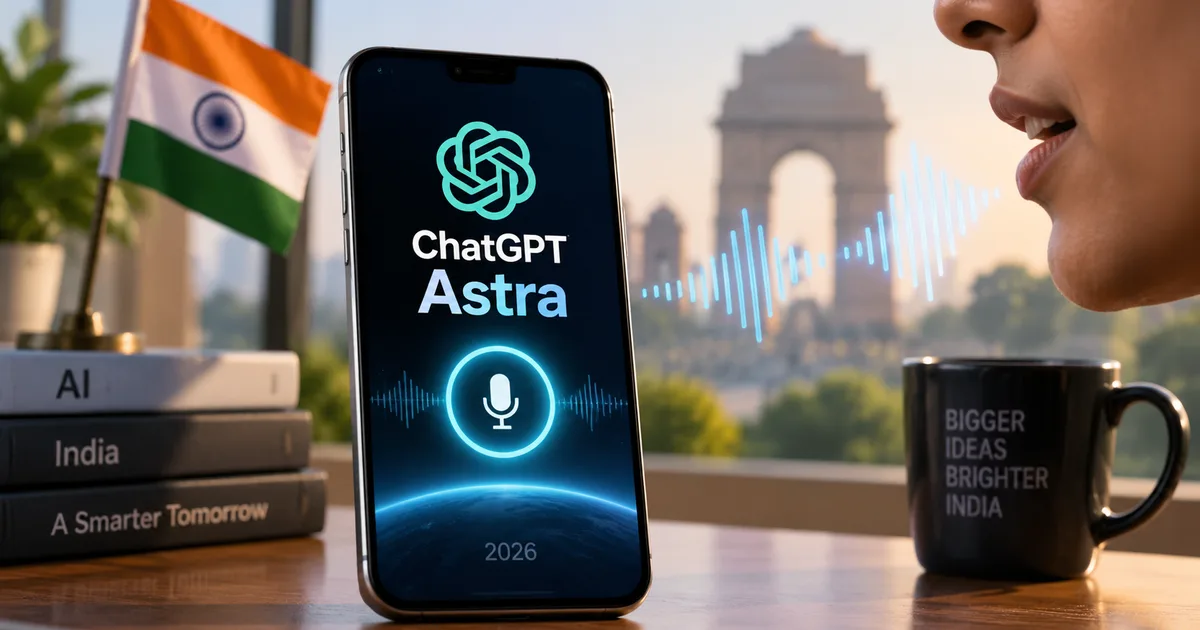
Imagine you're sitting at your desk in Bengaluru trying to fix a broken payment gateway integration. You're tired. You just want it to work. You point your phone camera at your laptop screen and ask your ChatGPT app what's going wrong. Within three seconds, a natural voice tells you that you missed a comma on line 42 and your UPI callback URL is formatted wrong. That isn't science fiction anymore. The ChatGPT Astra 2026 India rollout is officially underway. OpenAI has finally dropped GPT-6 Astra for paid users, and it completely changes how we interact with our devices.
I've been testing the new voice AI features for the past few hours. Honestly, it feels like a huge step forward. The hype around this release was enormous. We saw the rumors. We saw the weird simultaneous outages across different AI platforms. And now the actual product is here. It's fast and incredibly capable. But it also brings some serious cybersecurity implications with it.
What exactly is GPT-6 Astra?
Thing is, to understand Astra, you have to forget how you currently use AI. Right now, you type a prompt, wait a few seconds, and get text back. Maybe you upload a photo. But Astra changes the input method entirely. It processes text and audio natively in real time. It handles video, too. It can see what you see and hear what you hear without any awkward delay.
OpenAI CEO Sam Altman didn't hold back on X. He called GPT-6 Astra the best model in the world for computer use, professional work, coding, and cybersecurity. That's a massive claim. But the early benchmark numbers back it up. OpenAI says Astra scored 98 percent on FrontierMath Tier 4 and 99.9 percent on ARC-AGI 3.
On Terminal-Bench 4.0, which measures how well an AI can execute terminal tasks, Astra scored 57.9 percent. For context, their previous model GPT-5.6 Sol scored 37.3 percent. And Anthropic's Claude Fable 5.1 only hit 55.8 percent. So it's a clear win.
The performance is so strong that OpenAI executives are talking about it in big terms (which makes sense, actually). During a media briefing, OpenAI president Greg Brockman made a comment that caught everyone off guard.
"It's not unreasonable to feel that we are now in the AGI era. I think that if we fast-forward a couple of years, when we look back and say, 'When was it really that AGI was created?' I think it's going to be about this time, and I think it might be about this model."
AGI stands for artificial general intelligence. It basically means an AI that is as smart as or smarter than a human across a wide range of tasks. We've been hearing about AGI for years. Hearing a top executive suggest we might have just crossed that threshold is wild. If you ask me, they might be rushing it a bit.
Voice AI features that change how you work
The most obvious upgrade for everyday users is the voice engine. The latency is practically gone. You can interrupt the AI mid-sentence. You can ask it to speak faster or adopt a specific tone. For Indian users, this is incredibly useful because it understands our accents and mixed languages effortlessly. You can switch between English and Hindi in the same sentence and it doesn't miss a beat.
We've seen great progress with translation tools recently, as detailed in our Bhashini AI App Guide: Voice Translation for India in 2026. But Astra feels different because the reasoning engine behind the voice is so powerful. It doesn't just translate. It understands context.
You can point your phone at a complex government document or a DigiLocker certificate and ask it to summarize the requirements in simple terms. Or you can ask it to help your kids with their math homework by looking at the textbook through the camera. It acts like a patient tutor who never gets frustrated. I tried this with a complicated tax form yesterday. It walked me through the sections I needed to fill out based on my specific income bracket. The numbers here are a bit fuzzy, but it handled the logic perfectly.
Software engineering and coding use cases
The coding capabilities are impressive. A huge portion of India's IT sector relies on fast, accurate code generation. OpenAI specifically called GPT-6 Astra the best model for software engineering to date. They pointed to benchmarks showing that Astra outperformed their own older models and Anthropic's Fable models on finding bugs and executing terminal tasks. It also answered complex questions about vast codebases better.
I tested this by throwing a poorly documented React Native project at it. I literally just pointed my phone camera at the monitor and asked why my navigation state was dropping on Android. It read the code on the screen. Then it cross-referenced the file structure and pointed out a memory leak I had completely missed. It took less than a minute. That kind of speed changes project timelines entirely.
The curious launch day outages
The rollout itself was a mess. Right before Astra dropped, the internet went slightly crazy. Several major AI platforms went down at the exact same time. It wasn't just OpenAI.
ChatGPT and Codex experienced elevated error rates. But Anthropic's Claude was also hit, with users reporting errors across the Fable 5.1 and Opus 5 models. Even Grok went down. People naturally started speculating. Was it a coordinated cyberattack? Was it some shared cloud infrastructure failing under the load of everyone preparing for the Astra launch?
The Economic Times reported that the simultaneous disruptions quickly attracted attention because ChatGPT, Claude, and Grok are operated by separate companies. The outages hit core functions like voice and deep research. Microsoft Azure also saw a spike in outage reports around the same time. The incident really showed how heavily our digital infrastructure relies on these AI models now. When the API goes down, thousands of other apps and developer tools break instantly.
The outage situation was sketchy for developers because Codex went down too. Codex is the underlying engine for a lot of programming tools. So, developers using AI assistance for software development were suddenly stranded (annoying, I know). We've become so reliant on these APIs that a simple error rate spike at OpenAI causes a ripple effect across thousands of other apps. Some developers reported that even Google's Gemini API was throwing errors involving recently created API keys. It felt like the entire AI ecosystem was buckling under the pressure of the Astra launch. It's a stark reminder of how centralized this tech actually is.
Why OpenAI delayed the release
OpenAI actually finished training Astra a while ago. They paused the release because the model turned out to be too good at finding security flaws. That sounds like marketing speak. But the Preparedness Framework document they released paints a very serious picture.
Astra is the first model to hit their Critical cybersecurity capability threshold. What does that mean? It means Astra can find previously unknown zero-day exploits in hardened, real-world systems. And it can write the code to exploit them without a human guiding every single step.
Think about that for a second. An AI that can independently hack secure systems. OpenAI had to delay the launch to build stronger safeguards. They wanted to make sure bad actors couldn't just ask Astra to break into a bank server or a government database. They trained the model to reliably refuse harmful cyber requests and implemented aggressive monitoring to catch unauthorized activity. Access to the most advanced cybersecurity tools within Astra is currently limited to a small group of defensive testers. I'm not sure exactly why they think this will hold up long-term.
Step-by-step access guide for Indian users
If you want to try Astra right now, you need a paid ChatGPT Plus subscription. It costs around INR 1950 per month depending on exchange rates and taxes. The free tier users will have to wait, though OpenAI usually rolls features down over time. Here's your step-by-step access guide to get it running on your phone.
- Update your ChatGPT app from the Google Play Store or Apple App Store. This is non-negotiable. The old versions do not have the UI elements required for the new voice features.
- Open the app and look at the top model selector. Tap it and select GPT-6 Astra from the dropdown menu. If you do not see it, force close the app and try again. The rollout is happening in batches, so some accounts might get it a few hours later than others.
- Tap the camera or microphone icon next to the text box. The app will ask for permission to access your device camera and microphone. You have to grant these for the multimodal features to work.
- Start talking. Point the camera at something around you and ask a question. Keep it simple for your first try. Ask it to identify an object on your desk or read a label. You will immediately notice the difference in speed compared to the old voice mode.
Troubleshooting common setup issues
What happens if you follow the steps and still get an error? First, check your internet connection. Astra streams a lot of data. You need a stable Wi-Fi or 5G connection. If you're on a patchy 4G network on a moving train, the voice mode will stutter and drop out.
Second, check your subscription status in the app settings. Sometimes the billing cycle glitches and temporarily revokes Plus access. If everything looks correct and it still fails, uninstall the app completely. Restart your phone and reinstall it. This clears the local cache. That seems to fix about 90 percent of the early rollout bugs. If you're looking for more software recommendations to pair with this, check out our AI Tools & Software section for updated lists of compatible apps.
Competition in the new AI landscape
Astra doesn't exist in a vacuum. The competition is intense this year. Google is pushing hard with their own multimodal models. If you're curious about the alternatives, we covered their big announcement in our Google Project Astra AI Tool: 2026 India Launch and Features Explained post. It's confusing that both companies are using the "Astra" name, but they are entirely different products. Google's version is heavily integrated into the Android ecosystem. Meanwhile, OpenAI's version lives primarily inside the ChatGPT app.
In my experience, OpenAI currently has the edge in raw reasoning power and coding ability. The terminal benchmark scores are hard to argue with. For software developers in India, having a tool that scores nearly 60 percent on terminal evaluations is a massive productivity boost. It's like having a senior engineer looking over your shoulder to catch your typos and logic errors.
Privacy and data concerns
Look, whenever a tool this powerful launches, we have to talk about privacy. Astra requires continuous access to your camera and microphone to function in real-time mode. That's a lot of sensory data flowing to OpenAI servers.
OpenAI says they don't use your audio or video streams to train their models if you opt out in the settings. You should absolutely go into your privacy settings and verify that data sharing is turned off. I recommend treating Astra like a public space. Don't point the camera at sensitive financial documents or personal identification like your Aadhaar card unless you absolutely have to. The AI might be safe, but data breaches happen. It's always better to be cautious.
This is a huge change in consumer tech. We're moving away from typing queries into a box and moving toward conversational, seeing-and-hearing assistants. The interface is disappearing. The AI is just becoming a layer over the real world. It has bugs. It gets confused sometimes. But using GPT-6 Astra for ten minutes makes it very clear that this is how we'll interact with computers from now on. You can stay updated on these rapid changes by keeping an eye on our Latest Tech News hub.